




7 Red Flags to Watch for When Vetting Landing Page Optimisation Services
How to Choose Landing Page Optimisation Services
The best landing page optimisation service for your law firm is one that can show how it turns paid clicks into qualified case enquiries. Look for a provider that studies visitor behaviour, matches each page to its ad, tests changes, and reports on lead quality and acquisition cost. Be wary of anyone selling a prettier page without a plan to measure whether it works.
You pay for every ad click. If visitors land on a slow page with a vague headline or a hard-to-use form, that spend can go to waste. The seven red flags below will help you compare providers before you commit.
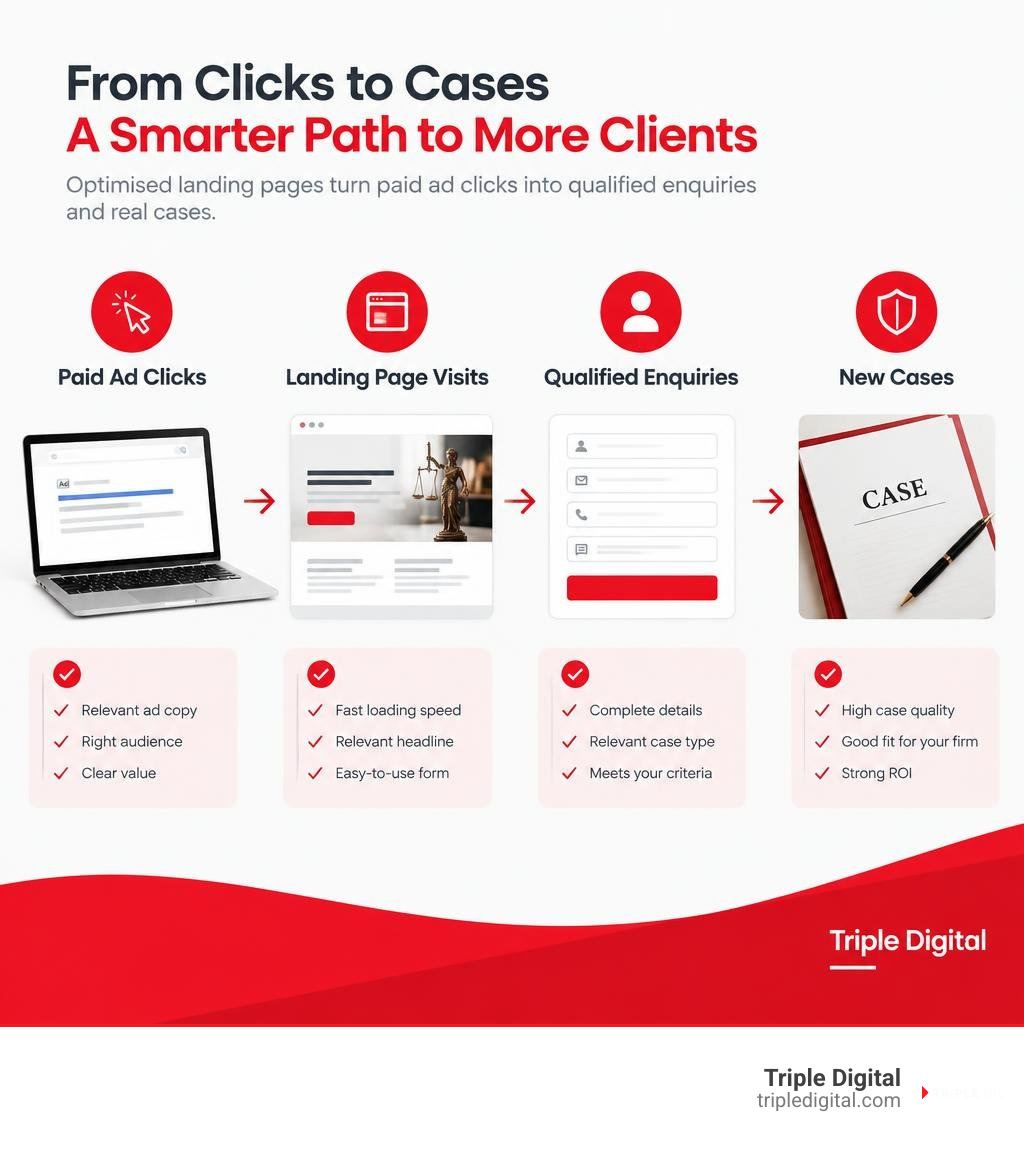
Landing page optimisation services basics:
Core Capabilities of Professional Landing Page Optimisation Services
Investing heavily in paid ad spend without an intentional post-click strategy is like pouring water into a leaky bucket. Dedicated landing page optimisation services focus on fixing those leaks. Rather than merely refreshing visual components, professional teams evaluate the complete user journey from initial search query to lead capture.
The core of any high-performing landing page rests on a crystal-clear value proposition presented above the fold. Visitors decide within seconds whether a practice can resolve their legal concern. An expert team ensures immediate message match between your ad copy and your hero section, dismantling friction before the user ever scrolls. To see how these elements fit together strategically, explore our conversion optimization resources.
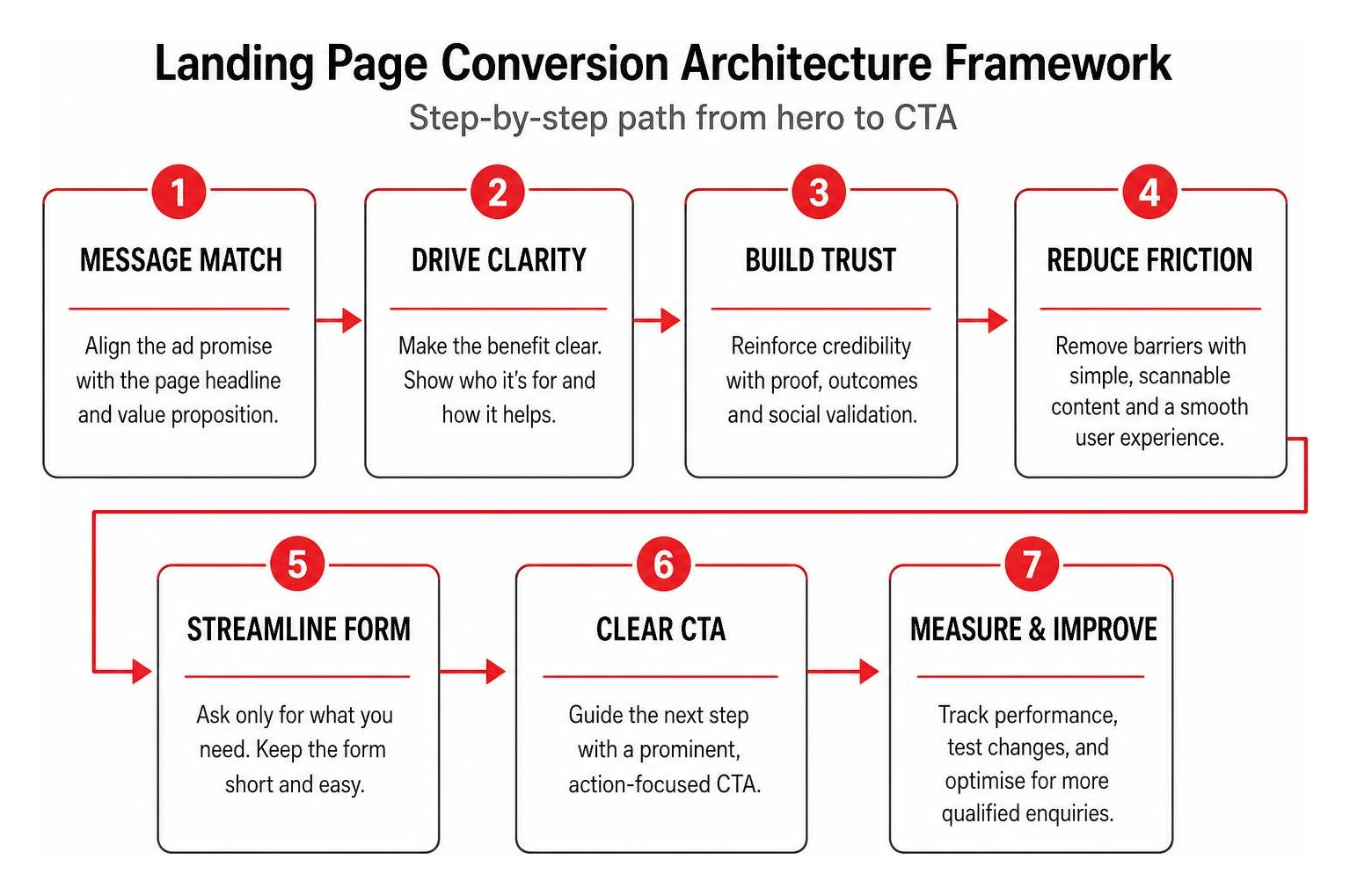
How Landing Page Optimisation Services Differ from In-House Optimization
Many growing practices attempt to tackle page optimization internally using DIY drag-and-drop builders. While page builders simplify publishing, tools alone do not uncover why potential clients abandon a contact form.
Professional agencies bring dedicated user heuristics, qualitative research protocols, and rigorous development QA to the table. They do not just swap button colours; they systematically eliminate conversion bottlenecks.
| Optimization Element | In-House / DIY Page Builders | Dedicated Agency Services |
|---|---|---|
| Research Foundation | Gut feel, basic Google Analytics data | Quantitative audits, heatmaps, and user interviews |
| Copywriting | Generic marketing or legal jargon | Psychologically framed, outcome-driven copy |
| Testing Methodology | Ad-hoc edits, unmeasured live changes | Controlled split testing with 95%+ confidence levels |
| Technical QA | Generic responsive templates | Custom Core Web Vitals and mobile script tuning |
| Focus Metric | Raw visits or form views | Qualified leads, signed retainers, and CAC |
Dual-Channel Alignment: SEO-Focused vs. PPC-Focused Landing Pages
A frequent point of confusion is whether one page can satisfy both search engine algorithms and paid ad visitors. Organic visitors arrive with diverse search intents across transactional and informational queries. They expect comprehensive depth, clear navigation, and supporting educational resources.
Conversely, paid traffic demands a laser-focused, friction-light experience. When paid visitors arrive, extraneous links create costly exit routes. However, advanced conversion architects bridge this divide by deploying hybrid technical frameworks.
By utilizing structured JSON-LD schema markup, tuning Core Web Vitals, and implementing proper canonical tags, an agency can maintain organic search indexation while placing primary direct-response CTAs and micro-CTAs in strategic locations. Our guide to website landing page optimization covers these on-page fundamentals in full detail.
7 Critical Red Flags When Vetting Agency Partners
Selecting the right partner requires looking past sleek slide decks. When evaluating prospective agencies, watch for these operational shortcomings that signal a lack of technical depth. Understanding why your business needs a conversion rate optimization agency starts with recognizing what effective testing actually entails.
1. Treating Page Optimization as a Cosmetic Redesign Instead of Data Science
A common pitfall among traditional web design agencies is treating conversion optimization as an aesthetic makeover. They change fonts, add stock photography, and reorganize layouts based on subjective taste.
True conversion science relies on rigorous heuristic evaluations and empirical testing. A pretty page that fails to address client anxiety, trust signals, or copy hierarchy will not move the needle. Reviewing how web design impacts profitability illustrates how usability and clarity consistently outperform empty visual polish.
2. Ignoring Ad-to-Landing Page Message Matching

When an ad promises a specific solution—such as immediate guidance for commercial contract disputes—the landing page headline must immediately mirror that phrasing. Maintaining clear “ad scent” assures users they have landed in the correct place.
When an agency builds generic, one-size-fits-all pages for distinct ad groups, bounce rates skyrocket. In fact, research demonstrates that tightening message match between ad messaging and landing pages can cut bounce rates by roughly 31% and lift conversion rates by 19% or more. Without continuous copy parity and cohesive offer framing, ad budgets get wasted on immediate exits.
3. Relying Exclusively on Guesswork Without Quantitative and Qualitative Research
If an agency provides recommendations during your initial consultation without auditing your data, they are guessing with your capital. High-impact optimization requires a blend of quantitative analytics and qualitative user feedback:
- Heatmaps & Click Tracking: Identifying areas where users click on non-interactive elements or skip critical value propositions.
- Session Recordings: Pinpointing exactly where users encounter friction or abandon multi-field forms.
- Funnel Drop-Off Analysis: Auditing GA4 event funnels to locate major conversion leaks across devices.
- User Surveys & Intake Insights: Reviewing direct prospect questions to integrate genuine client vocabulary into headers and FAQs.
4. Overlooking Core Web Vitals and Mobile Performance
Modern search engines and paid visitors alike show zero patience for sluggish websites. Mobile conversion rates drop precipitously for every additional second of latency. Furthermore, complex scripts that trigger unexpected layout shifts create intense user frustration.
A competent agency optimizes technical delivery to keep mobile Largest Contentful Paint (LCP) under 2.5 seconds. If a provider does not audit Cumulative Layout Shift (CLS) or Interaction to Next Paint (INP), their design updates may actively depress your campaign efficiency.
5. Guaranteeing Immediate Conversion Multipliers Without Statistical Testing
Be cautious of providers promising guaranteed 500% conversion lifts within forty-eight hours. Real-world testing requires adequate sample sizes and mathematical discipline.
Reputable practitioners conduct A/B split tests with a standard 95% statistical confidence threshold ($p \le 0.05$). This discipline ensures observed conversion gains reflect genuine behavioural shifts rather than random traffic anomalies. Making sweeping permanent site changes without running controlled experiments frequently leads to false positives that disappear the following month.
6. Demanding Proprietary Platform Lock-In
Certain vendors insist on building your assets inside restrictive, proprietary ecosystems. If you choose to conclude the relationship, you lose access to the underlying pages, custom code, and design files.
Ensure your contract stipulates complete ownership of all deliverables upon project completion. At Triple Digital, we believe partners should always retain complete ownership of their Figma source files, tracking setups, and custom CMS page templates. Portability guarantees long-term agility.
7. Optimizing for Surface Metrics Instead of Pipeline Revenue and ROAS
A high conversion rate is meaningless if incoming leads consist of unqualified inquiries or spam submissions. Shortening a contact form to a single input field might double form fills while simultaneously overwhelming your intake team with unusable leads.
Experienced providers measure success across the entire client acquisition funnel. They track marketing efficiency ratio (MER), return on ad spend (ROAS), and blended acquisition costs. Implementing tactics to lower acquisition costs ensures you attract high-intent clients rather than low-quality form submissions.
Essential Metrics and Testing Frameworks for Vetting Providers
Systematic optimization requires structured execution. Elite agencies use prioritization frameworks such as the ICE model (Impact, Confidence, Ease) to organize their testing roadmap.
This scoring model prevents teams from burning hours on low-impact adjustments, directing immediate focus to high-leverage elements like value propositions, intake forms, and reassurance copy. Reviewing specialized conversion rate optimization services will give you a clear sense of how structured roadmaps function in practice.
Core Metrics: CVR, AOV, MER, and ROAS
When evaluating campaign performance, professional optimization teams review several core financial and behavioral indicators:
- Conversion Rate (CVR): The percentage of unique sessions that complete a target action, such as a consultation request.
- Average Order / Case Value (AOV): The revenue potential associated with newly acquired clients.
- Marketing Efficiency Ratio (MER): Total revenue divided by total marketing investment, providing a macro view of campaign health.
- Return on Ad Spend (ROAS): Direct revenue generated per dollar allocated to specific paid ad sets.
- Revenue Per Session (RPS): The aggregate monetary value generated across all incoming traffic sessions.
What to Expect from Landing Page Optimisation Services During Onboarding
A structured agency onboarding process typically takes between four and six weeks before running active split tests. During this phase, you should expect:
- Source-Split Analytics Audit (Weeks 1–2): Granular tracking checks within GA4, setting up heatmaps and verifying custom conversion events.
- Market & Competitor Teardown (Week 2): Comprehensive review of peer positioning, ad libraries, and value proposition gaps.
- Hypothesis & Wireframing (Weeks 3–4): Translating qualitative friction findings into structured wireframes and outcome-driven copy.
- QA & Split Deployment (Weeks 5+): Technical quality assurance across mobile devices, deploying variants against existing baselines to capture statistically valid outcomes.
Frequently Asked Questions About Landing Page Optimization
How quickly should an optimization engagement produce measurable ROI?
While foundational UX fixes and message-match adjustments can yield positive indicators within the first thirty days, mature testing programs hit their stride around months two and three. In ongoing conversion programs, well-structured iterations frequently generate compounding returns, often achieving up to a 10x ROI as baseline data matures and higher-converting variants become permanent fixtures.
Can a single landing page effectively serve both paid and organic traffic?
Yes, through intentional hybrid architecture. The upper section of the page should cater to paid traffic: displaying a focused, message-matched headline, prominent trust markers, and a single primary conversion action.
Below the fold, you can incorporate rich semantic content, structured FAQs using JSON-LD schema, and comprehensive service details that satisfy search engine crawlers and informational search queries.
What minimum traffic volume is required to run reliable A/B split tests?
Statistically robust A/B testing typically requires several hundred conversions per variation each month to reach 95% confidence within a reasonable timeframe.
For lower-traffic campaigns, agencies rely on in-depth heuristic evaluations, user session recordings, and qualitative usability testing. These methodologies allow teams to deploy high-impact conversion overhauls safely without waiting months for minor statistical variations.
Elevate Your Case Acquisition Strategy
Scaling paid advertising without a disciplined landing page optimization strategy creates unnecessary cost overhead. By avoiding common industry pitfalls—such as cosmetic-only redesigns, missing ad scent, and platform lock-in—your practice can turn paid traffic into a predictable engine for new business.
We focus on building data-backed client acquisition systems that prioritize qualified cases over surface-level vanity metrics. If you are ready to eliminate conversion leaks and maximize your return on ad spend, schedule a meeting with our team to audit your current landing page strategy.