




How Do You Choose the Right Law Firm Web Design Agency?
How to Choose a Law Firm Web Design Agency
Start with proof, not a portfolio’s looks. Shortlist agencies that can show law firm websites they’ve built, explain how those sites help visitors contact the firm, and walk you through their approach to SEO, mobile speed, accessibility, and legal advertising rules. Ask who will write the content, how they’ll protect existing search rankings during a redesign, and who owns the site after launch.
A good-looking site matters. But for a firm that needs more cases, the better choice is an agency that can connect design decisions to clear practice pages, credible attorney bios, and an easy path to get in touch. Use the criteria below to compare proposals on more than price.
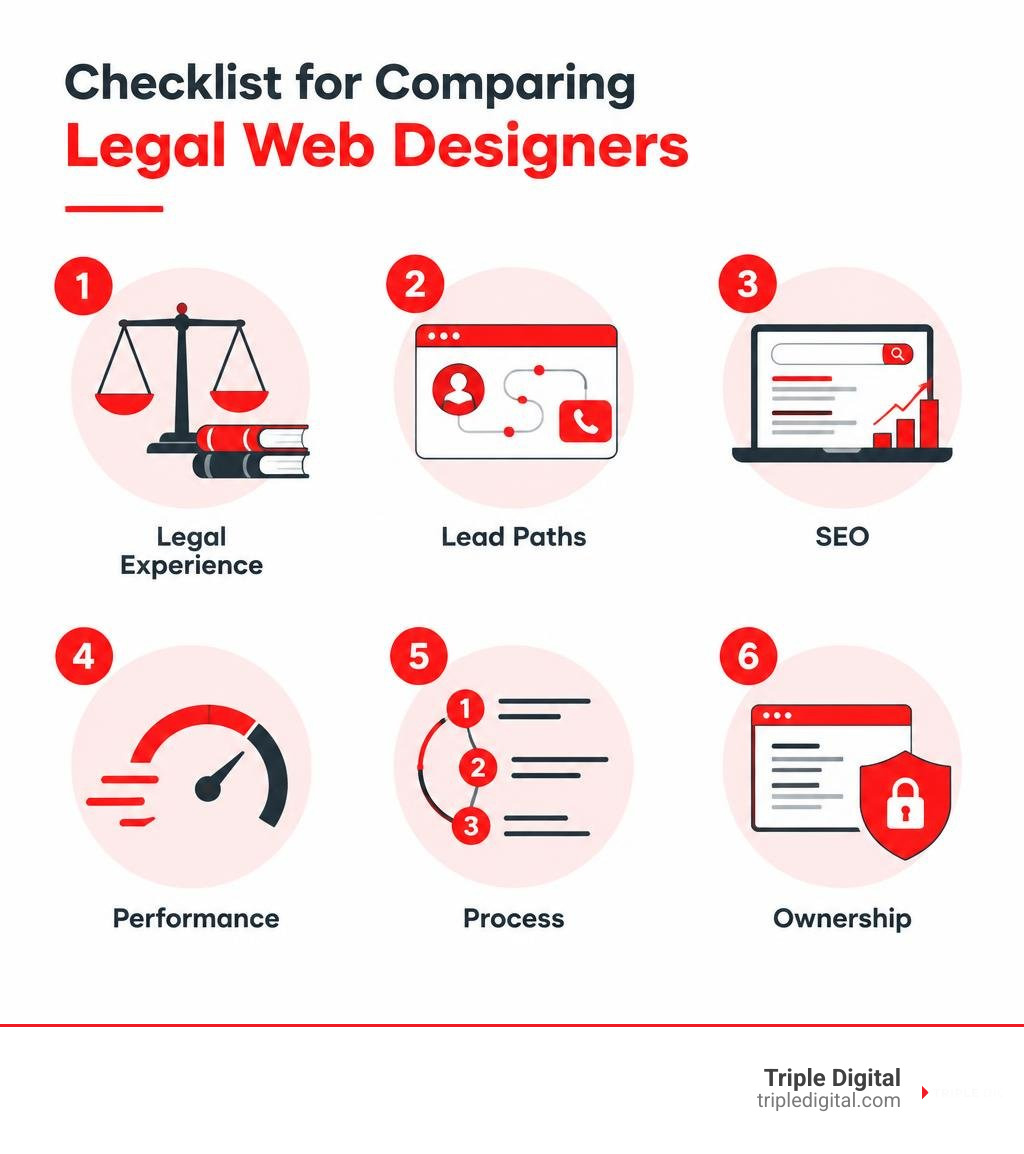
Law firm web design agency terms at a glance:
Core Criteria for Evaluating a Law Firm Web Design Agency
Selecting the right partner requires looking beyond generic creative portfolios. When vetting a dedicated law firm web design agency, you want a team that understands how digital strategy directly fuels client acquisition. At Triple Digital, our Houston-based team focuses on cutting through aesthetic fluff to engineer digital platforms that capture high-intent inquiries and turn qualified visitors into retained matters.
A successful legal web presence relies on three core evaluation pillars:
- Verifiable Portfolio in Law: Look for proven experience across practice areas, from solo attorneys to multi-partner practices.
- Technical Performance Standards: Ensure their sites consistently pass Google Core Web Vitals with clean, unbloated code.
- Compliance and Disclaimers: The agency must understand state bar advertising ethics, required legal disclaimers, and intake privacy rules.
Why Niche Legal Industry Specialization Matters
Generalist web agencies often struggle with the nuances of legal marketing. They might design visually striking pages that fail to convert because the content structure ignores how prospective clients search during stressful moments.
When you partner with a team experienced in web design legal projects, your information architecture reflects how people actually seek legal guidance. Niche specialists understand practice taxonomy, ethical compliance across jurisdictions, and how to structure intake forms that capture critical details without creating friction.
Evaluating Technical Performance and Google PageSpeed
A modern legal website must load instantly. Prospective clients navigating an urgent matter will bounce within seconds if a site stalls on their phone.
Top-tier agencies build platforms that achieve Google PageSpeed scores above 90 on mobile and 95+ on desktop. Excellent technical scores directly impact search rankings and user satisfaction:
- Core Web Vitals: Minimizing layout shifts and load delays keeps potential clients engaged.
- Accessibility Standards: Adhering to WCAG guidelines ensures universal usability and reduces legal liability.
- Mobile Responsiveness: Adapting layouts across smartphones, tablets, and desktop displays guarantees frictionless navigation for every visitor.
Custom Development vs. Templates: Cost and Scope Breakdown
One of the first strategic forks in your redesign process involves choosing between a pre-packaged template and custom web engineering. Investing in custom lawyer web design provides tailored functionality, unique brand positioning, and proprietary code that generic theme builders cannot replicate.
| Feature Category | Pre-Built Theme / Template | Custom Legal Web Engineering |
|---|---|---|
| Initial Cost | Lower ($3,000 – $5,000) | Moderate to High ($6,000 – $16,000+) |
| Page Speed & Code Quality | Often bloated with unused scripts | Lightweight, streamlined for 90+ PageSpeed |
| Brand Differentiation | Looks identical to dozens of other firms | 100% custom-tailored to your market and brand |
| Scalability & Integrations | Limited by theme framework | Built to grow with custom intake and CRM tools |
| SEO & AI Visibility | Basic on-page fields | Advanced schema, entity markup, clean architecture |
Investment Tiers and Realistic Project Timelines
Understanding standard industry price points prevents unpleasant surprises and sets realistic expectations for your project scope. As explored in our breakdown of law office website design options, costs typically align with structural complexity:
- Single-Page & Landing Sites ($3,000 – $3,500): Built for solo practitioners or boutique practices targeting a narrow service offering. Project timeline: 3 to 5 weeks.
- Focused Multi-Page Sites ($6,000 – $8,000): Ideal for growing practices needing dedicated practice pages, attorney bios, and localized SEO setups. Project timeline: 6 to 8 weeks.
- Complete Custom Practice Platforms ($8,000 – $16,000+): Designed for full-service mid-sized and large firms requiring bespoke workflows, extensive resource libraries, and CRM integrations. Project timeline: 8 to 14 weeks.
Template vs. Custom Law Firm Web Design Agency Deliverables
Generic templates often carry hidden technical debt. They rely on third-party page builders loaded with excess JavaScript, which slows load times and creates security vulnerabilities.
Understanding why website development for law firms requires custom craftsmanship helps protect your digital investment. Bespoke WordPress development ensures clean code, tighter security, and complete freedom to adjust layouts as your firm expands.
Essential Website Architecture and Content Strategy
A high-performing site guides prospective clients naturally from initial discovery to scheduling a consultation. To achieve this, your information architecture must present clear visual pathways and prioritize user intent.

Studying modern law firm web architecture reveals that successful legal sites organize content into distinct, logical categories:
- Primary Navigation: Focused on core practice areas, attorney backgrounds, firm overview, and immediate contact methods.
- Secondary Resources: Educational guides, FAQs, and informational blog posts grouped cleanly under resource hubs.
- Direct Calls-to-Action: Prominent phone numbers, click-to-call buttons for mobile users, and simplified consultation intake forms on every page.
Converting Visitors with Attorney Bios and Practice Area Pages
Your practice area pages and attorney biographies are where conversion happens. When prospective clients evaluate your firm, they look for authoritative experience, human empathy, and tangible results.
To make these pages convert, implement proven strategies for designing websites that convert:
- Practice Area Depth: Address common legal questions, explain step-by-step processes, and outline what clients can expect during representation.
- Attorney Biographies: Include high-resolution photography, clear educational credentials, admissions, notable recognitions, and personal philosophies.
- Social Proof and Case Highlights: Showcase anonymized case outcomes and client reviews to build trust without violating ethics rules.
Preserving SEO Rankings and Building AI Search Visibility
A website overhaul must never sacrifice the organic search equity your firm has built over years of publishing content. When planning a redesign, protecting rankings requires rigorous technical execution:
- 301 Redirect Mapping: Map every legacy URL to its exact new equivalent to preserve incoming backlinks and search indexing.
- Metadata and Heading Preservation: Maintain established target keywords within title tags, meta descriptions, and header structures.
- Schema Markup & Entity SEO: Implement structured data (such as
LegalServiceandAttorneyschemas) so both traditional search engines and AI answer engines can interpret your practice specialties, attorneys, and service areas.
The Collaboration Lifecycle: From Discovery to Post-Launch
A structured design lifecycle ensures your project stays on schedule without draining billable hours from your partners. If you are noticing signs your practice needs a website redesign, here is what a professional workflow looks like:
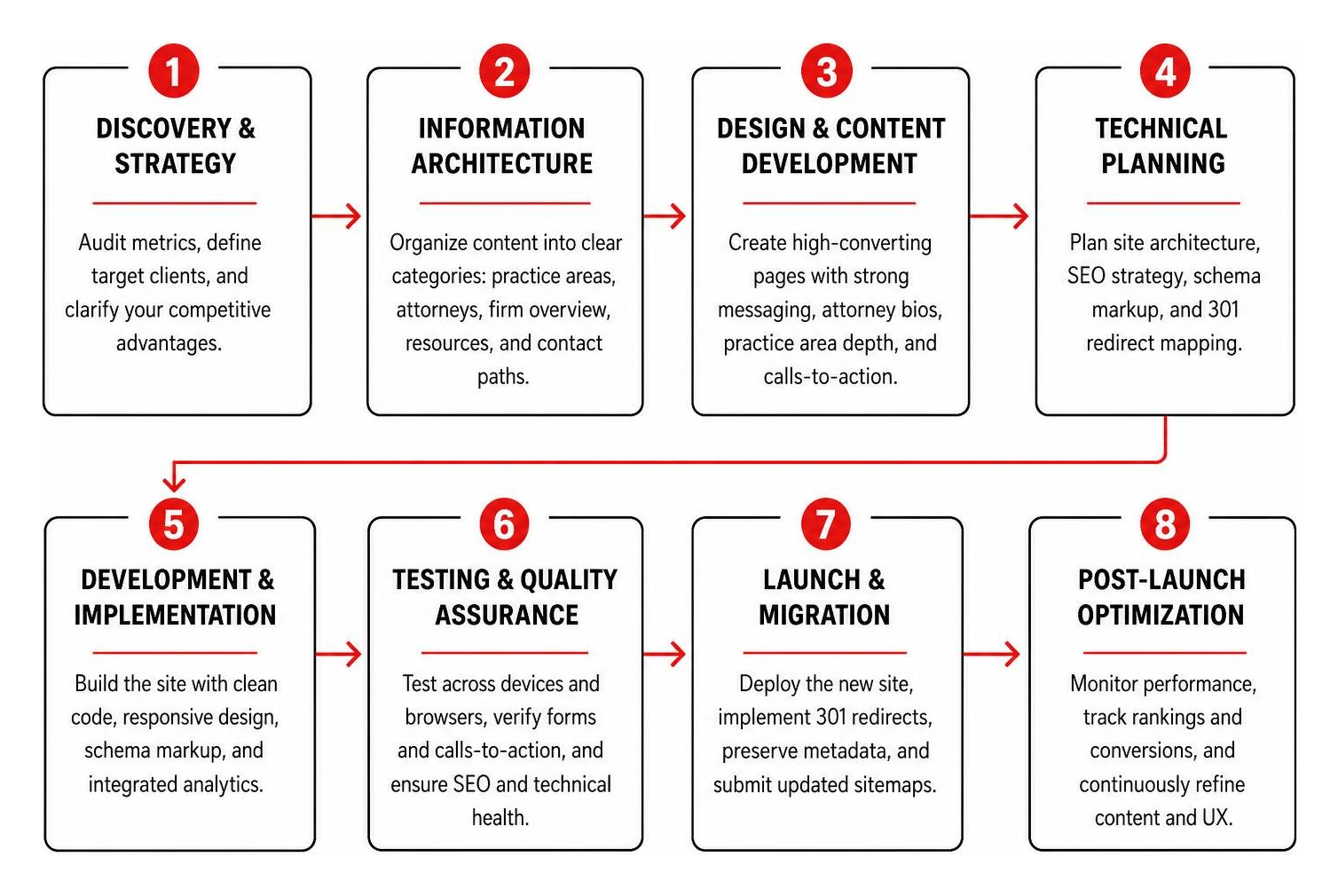
Collaborative Milestones with a Law Firm Web Design Agency
A transparent agency will walk you through clear, sequential stages:
- Discovery & Strategy: Auditing current metrics, identifying target client profiles, and defining your firm’s competitive advantages.
- Information Architecture & Wireframes: Structuring site maps, page hierarchies, and conversion pathways before applying visual styling.
- Visual Design & Copy Production: Crafting custom brand layouts alongside ethical, human-centric legal copy.
- Development & Technical QA: Building clean WordPress templates, testing cross-browser responsiveness, and verifying PageSpeed benchmarks.
- Pre-Launch SEO & Redirect Validation: Setting up technical redirects, auditing links, and conducting final staging reviews.
Post-Launch Maintenance, Security, and Asset Ownership
Your relationship with an agency should not end when your new site goes live. Ongoing site health requires routine maintenance, including core platform updates, daily off-site backups, and uptime monitoring.
Always confirm that your firm retains 100% full ownership of all custom code, graphical assets, domain registrations, and written content upon final payment. Your firm should never be locked into proprietary platforms that prevent you from moving your site if needed.
Frequently Asked Questions About Legal Web Design
How much does a custom law firm website cost?
Custom law firm websites generally range from $3,000 for simple single-page sites to $16,000+ for comprehensive platforms with custom integrations, extensive practice archives, and interactive attorney directories. The total investment depends on page volume, custom functionality, content migration, and specialized branding assets.
How long does a legal website redesign take from start to launch?
A standard legal website redesign takes between 6 and 12 weeks. The timeline depends primarily on the scope of practice pages, content development requirements, photography scheduling, and how quickly your internal stakeholders review and approve design milestones.
Who owns the website assets and code after project completion?
With a reputable design agency, your firm should own all custom designs, written copy, and creative assets once the final invoice is settled. Platforms built on open-source content management systems like WordPress allow you to host your website anywhere and manage updates internally or with any qualified developer.
Transform Your Digital Intake into a Predictable Growth Engine
Your law firm’s website is the cornerstone of your business development. Choosing an agency that combines technical performance, strategic legal copy, and data-driven client acquisition ensures your firm stands out and earns prospective clients’ trust.
At Triple Digital, we use data mining and AI-driven precision targeting to help firms capture high-value cases without the typical marketing runaround. When you are ready to upgrade your firm’s digital presence, explore our full suite of legal marketing services or schedule a meeting to discuss your custom law firm website with our Houston team today.