




AI Search Lawyer Ranking: Practical Strategies to Win Modern Engine Visibility
How to Improve Your AI Search Lawyer Ranking
To improve your AI search lawyer ranking, make it easy for AI tools to find and verify your firm. Keep your attorney names, practice areas, and contact details consistent across your site and trusted third-party profiles. Answer common client questions in plain language, earn credible mentions beyond your own website, and track whether AI visibility leads to inquiries.
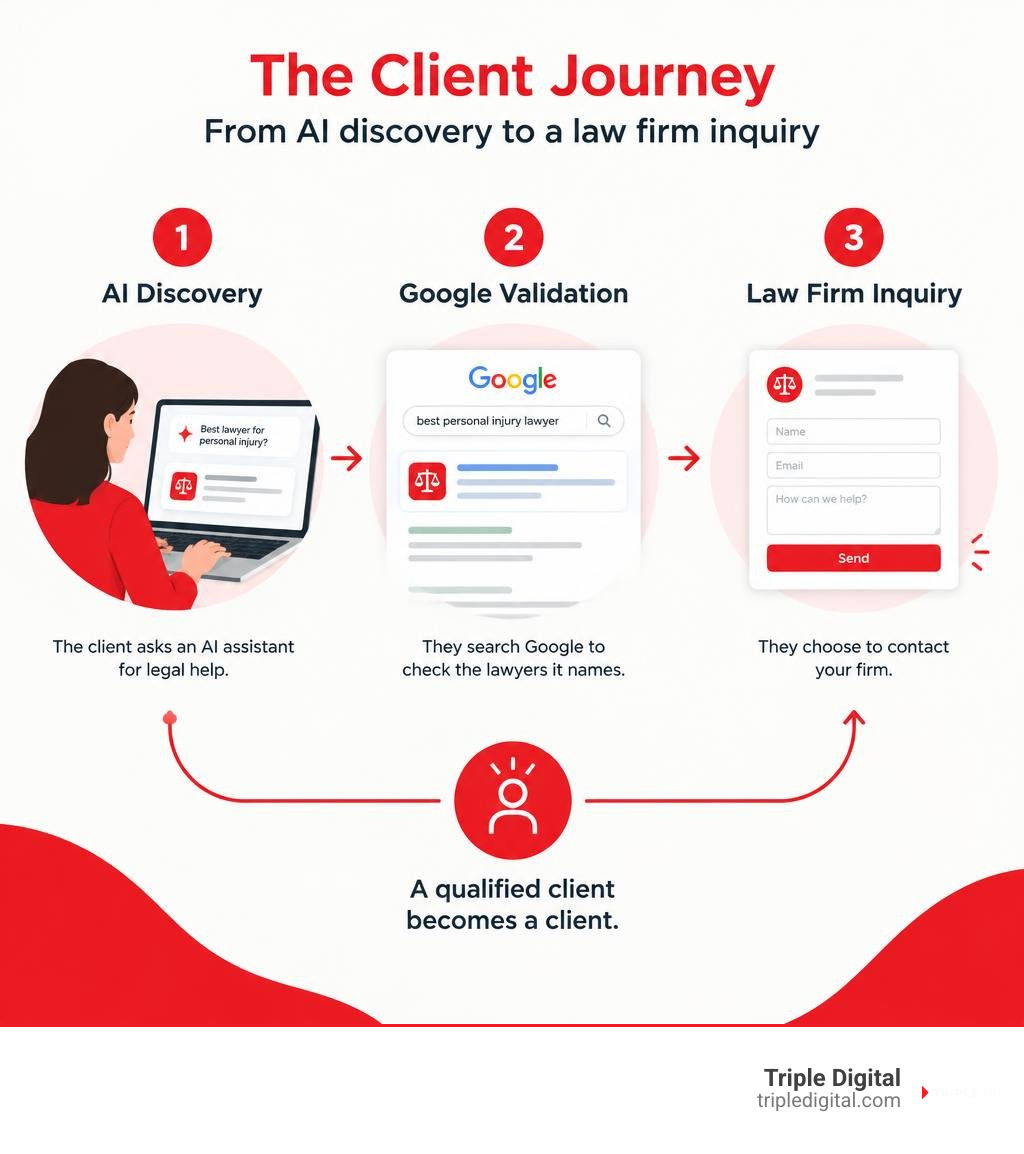
That matters because a client may first ask an AI assistant about a legal problem, then search Google to check the lawyers it names. The goal is not just an AI mention. It is a qualified client who chooses to contact your firm.
Quick AI search lawyer ranking terms:
How AI Search Lawyer Ranking Works Across Generative Engines
The Shift from Keyword Density to Entity Authority
The way legal clients discover practices has undergone a fundamental transformation. For decades, legal search marketing relied on matching exact keywords on static web pages. In October 2026, large language models (LLMs) and generative search systems evaluate legal authority through natural language comprehension, entity extraction, and knowledge graphs.
When a prospective client enters a detailed legal prompt into an engine like ChatGPT, Perplexity, or Google AI Overviews, the model does not run a simple index search for keyword frequency. Instead, it executes query fan-out. The system breaks a complex prompt into multiple sub-queries, searches diverse public sources simultaneously, extracts relevant entities (such as individual attorneys, law firms, credentials, and geographic jurisdictions), and synthesizes a direct narrative answer.
To earn inclusion in these synthesized answers, a firm must provide high information gain rather than content churn. Large models assess the authoritative consensus surrounding an attorney across dozens of independent reference points. If an entity is verified across reliable industry databases, trade publications, and structured web assets, the engine displays higher confidence when surfacing that attorney. Understanding these algorithmic realities requires embracing modern SEO strategies for legal practitioners in 2026 that prioritize entity depth over repetitive phrasing.
The Zero-Click Reality and Traffic Redistribution
The widespread adoption of generative summaries has dramatically reshaped search traffic distribution. Data reveals that approximately 60% of Google searches conclude without a click to any traditional website. When AI overviews appear at the top of search result pages, user behavior shifts noticeably away from organic blue links.
Research indicates that users click on traditional search listings only 8% of the time when an AI summary is present, compared to 15% when no summary is shown. Furthermore, a law firm website that historically held the number-one organic position can experience up to a 79% decline in organic traffic if pushed below a generative answer block.
| Search Environment Metric | Traditional SERP (No Summary) | AI Overview SERP | Impact on Practice Traffic |
|---|---|---|---|
| Zero-Click Rate | ~40% – 45% | ~60% | Higher on-engine answer resolution |
| Traditional Result CTR | 15% | 8% | 46.7% reduction in organic clicks |
| Top Organic Position Retention | Baseline (100%) | Up to 79% Traffic Loss | Severe displacement below the fold |
| Primary Visibility Mechanism | Keyword meta tags & links | Multi-source entity synthesis | Direct brand citations required |
Because generative answers solve immediate informational queries right on the results page, legal practices must adjust their marketing strategies. Success no longer means chasing top rankings for broad, low-intent informational keywords. Instead, attorneys need strategic optimization for attorney AI Overviews that positions their firm directly inside the AI summary as a trusted, cited authority for high-intent queries.
Discover on ChatGPT, Hire on Google: The Hybrid Journey
A widespread misconception in legal marketing is that clients use AI engines as a single-step hiring platform. Survey data shows that while roughly 13% of consumers use AI tools or chatbots to research legal issues, fewer than 2% directly hire an attorney through an AI prompt.
Instead, consumers follow a hybrid discovery path:
- Top-of-Funnel AI Discovery: A client asks an AI chatbot a nuanced question regarding their legal rights after an incident or dispute. The AI summarizes the legal principles involved and mentions two or three prominent, highly verified local practices as potential resources.
- Branded Google Validation: The consumer takes the firm names surfaced by the AI and searches for them on Google.
- Reputation & Local Review: The client examines the firm’s Google Business Profile, local reviews, peer recognitions, and attorney background before scheduling an initial consultation.

This multi-platform journey means that an AI mention acts as an unassisted or assisted lead generator. Firms that lack generative visibility lose potential clients before the Google search even begins. Executing effective AI search visibility tactics for legal practices ensures your firm is visible during that critical discovery phase.
Core Signals and Common Fallacies in Legal AI Optimization
Verified Credibility Signals AI Models Prioritize
Generative AI engines do not rely on standard keyword frequency or backlink volume alone. When recommending a legal professional, these models prioritize risk mitigation and verifiable expertise. They evaluate structured, third-party signals that establish authoritative consensus.

The primary credibility signals prioritized by generative models include:
- Peer-Reviewed Recognitions & Honors: Independent professional listings and recognitions that confirm peer standing provide strong signals of legal capability.
- Third-Party Editorial Validation: Unbiased coverage in recognized legal trade publications (such as Law360, national legal journals, and regional business reports) confirms entity legitimacy.
- Structured Schema Markup: Implementing structured schema (
LegalService,Attorney,knowsAbout,hasCredential) allows AI bots to map practice areas, bar admissions, and office locations directly into knowledge graphs. - Consistent NAP & Entity Data: Identical Name, Address, and Phone details across bar association directories, legal databases, and review platforms establish reliable entity identity.
Shifting focus from basic keyword optimization toward authoritative digital PR and schema integration is essential when transitioning legal marketing to generative engine optimization.
Debunking Generative AI Marketing Myths
As law firms work to adapt to AI engines, several marketing myths have emerged that misdirect resources and waste budgets.
- Myth 1: Guaranteed AI Rankings: No agency can promise a guaranteed recommendation inside ChatGPT, Perplexity, or Google AI Overviews. LLMs generate probabilistic responses influenced by dynamic prompt structures, geographic personalization, and continuous model refreshes. Any guarantee of fixed AI placement is fundamentally misleading.
- Myth 2: The Magic “llm.txt” File: A simple text file placed on a website root cannot force large language models to rank a firm. While structured markdown aids crawler efficiency, it does not replace independent authority, peer validations, or external citations.
- Myth 3: Third-Party AI Visibility Trackers are 100% Definitive: Many tracking tools take single-prompt snapshots that fail to capture the variability of conversational search. Multi-engine representation is fragmented; industry studies show that out of 100 eligible law firms, only 28 appear consistently across all four major AI engines (ChatGPT, Gemini, Perplexity, and Google AI Overviews), while 34 receive zero measured mentions.
- Myth 4: Mass AI Content Churn Drives Authority: Publishing hundreds of automated blog posts dilute a domain’s information gain score. AI engines actively discount repetitive, low-substance content in favor of unique, expert-authored insights.
Evaluating real engine performance requires analyzing how platforms parse information, as outlined in our breakdown of search engine impact across Perplexity and AI assistants.
Practical Framework to Improve Law Firm Visibility in AI Answers
Strategic Execution to Elevate Your AI Search Lawyer Ranking
Improving your firm’s standing in generative search results requires clear, verifiable on-page structuring paired with external validation. When structuring content on your website, follow these guidelines:
- Lead with Short, Declarative Statements: Place direct, one-to-two sentence answers immediately under H2 and H3 headings. AI retrieval algorithms favor concise declarations over conversational preamble.
- Avoid Ambiguous Pronouns: When discussing legal capabilities, explicitly state the attorney or law firm name rather than relying on “we,” “our attorneys,” or “the team.” Clear entity repetition simplifies automated entity extraction.
- Incorporate Detailed Schema Markup: Use JSON-LD to clearly define
Attorney,LegalService,alumniOf,memberOf, andareaServedproperties. - Publish Unique Legal Insights: Deliver original commentary on recent statutory amendments, local regulatory shifts, or procedural updates to provide high information gain that AI models reference.
Our team at Triple Digital focuses on technical execution and structured data to help firms establish verifiable digital entities that generative search platforms consistently identify and surface. Applying these proven methodologies for generative engine optimization provides a durable foundation for long-term discovery.
Dominating the Citation Economy via Digital PR and Directories
AI search visibility depends heavily on external mentions across what is known as the citation economy. In AI retrieval, third-party mentions often carry more weight than self-published website claims.
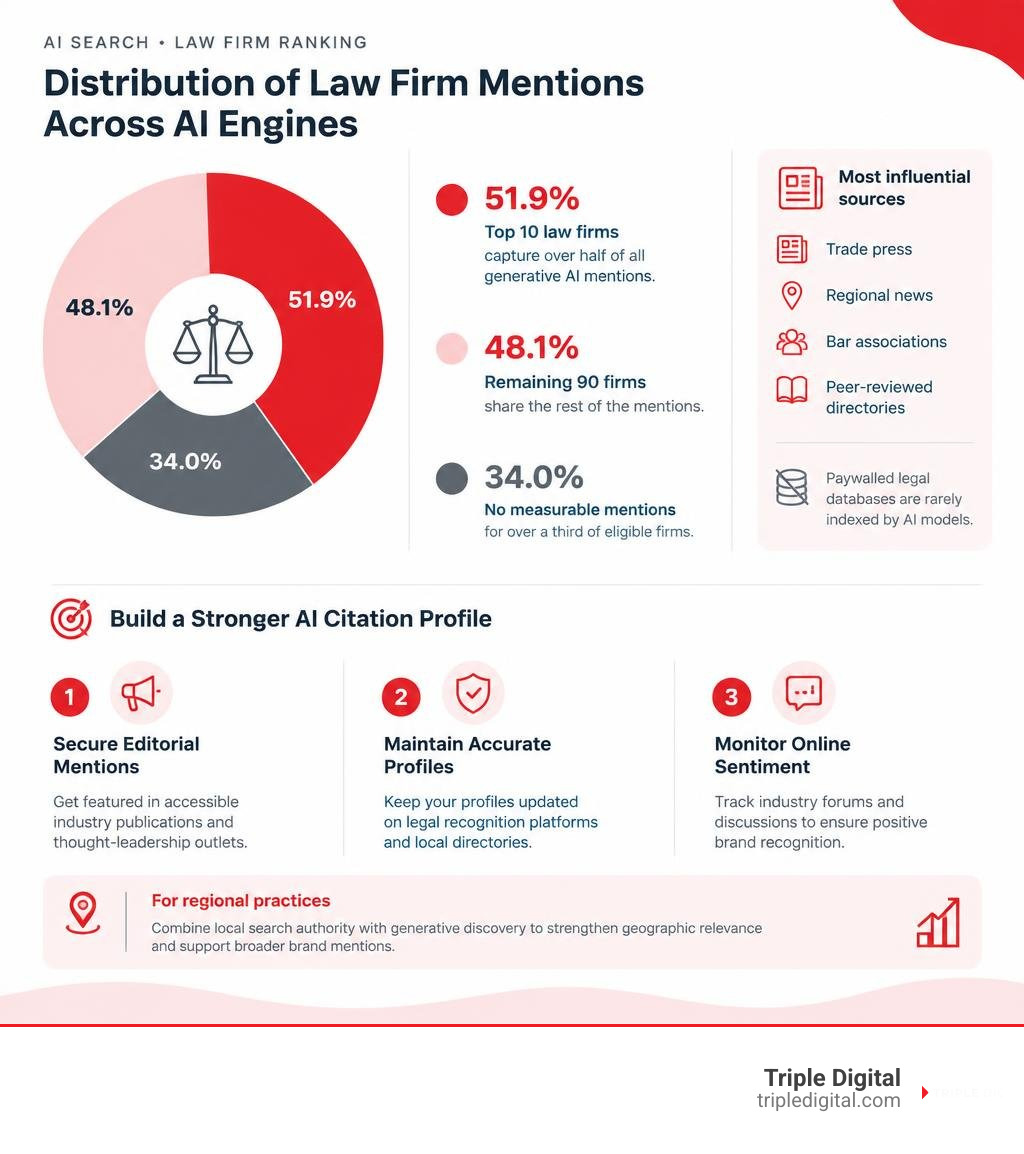
Studies evaluating law firm citations reveal that freely accessible trade press outlets, regional news sites, bar associations, and peer-reviewed directories are the most influential sources for AI recommendations. Paywalled legal research databases are rarely indexed directly by consumer-facing AI models, making public editorial visibility critical.
To build an effective citation profile:
- Secure editorial mentions and thought-leadership placements in accessible industry publications.
- Maintain accurate, verified profiles on legal recognition platforms and local professional directories.
- Monitor industry forums and discussion boards to ensure positive public sentiment and brand recognition.
For regional practices, integrating local search authority with generative discovery ensures that geographic relevance supports broader brand mentions.
Measuring Share of Voice and Real-World Attribution
Because conversational AI engines do not rely on fixed rankings, legal practices must evaluate visibility using Share of Voice (SOV) and multi-touch intake attribution.
Recent benchmark audits show significant concentration in AI engine visibility:
- The top 10 law firms in tracked practice areas capture 51.9% of all generative AI mentions.
- The remaining 90 eligible firms compete for the remaining 48.1%.
- Over 34% of eligible law firms receive no measurable mentions across major AI search engines.
To track your firm’s AI search performance and measure real-world business impact:
- Calculate Generative Share of Voice: Periodically query major AI platforms with realistic, buyer-intent legal prompts relevant to your practice areas and jurisdiction. Track how frequently your firm is surfaced relative to local competitors.
- Implement Qualitative Intake Tracking: Train intake specialists to ask every new caller: “Where did you first learn about our firm?” and “Did an AI tool like ChatGPT or Google AI mention our name during your initial research?”
- Monitor Branded Search Lift: Track increases in branded organic search impressions and direct website visits in Google Search Console following targeted digital PR and entity-building campaigns.
Adopting this structured approach supports winning high-intent client acquisition through generative search by connecting generative visibility directly to qualified case inquiries.
Frequently Asked Questions About Legal AI Search
How does AI search lawyer ranking differ from traditional Google rankings?
Traditional Google rankings evaluate individual URLs based on keyword targeting, backlink authority, and on-page metadata to provide a list of links. AI search lawyer ranking relies on vector search and multi-source retrieval across thousands of web assets. Instead of pointing users to a single page, generative models synthesize information from news outlets, directories, peer recognitions, and structured data to recommend specific attorneys and explain their qualifications in plain language.
Why is my law firm missing from major AI engine responses?
Firms are often absent from AI-generated answers due to entity fragmentation or a lack of third-party citations. If an attorney’s name, practice areas, and office locations are listed inconsistently across the web—or if the firm lacks mentions in accessible trade press and peer directories—generative models will not have sufficient confidence to recommend the practice. Adding clear schema markup and earning credible digital PR mentions helps bridge this gap.
How can law firms track client acquisition from AI discovery?
Because many AI tools do not provide traditional click-through referrals, firms must use a multi-touch attribution model. This includes capturing qualitative feedback during client intake, segmenting generative referral traffic in analytics, and tracking surges in branded Google search volume that occur after high-profile AI mentions.
Future-Proofing Your Law Firm’s Search Visibility
The rise of generative search does not mean the end of legal marketing; it marks a shift toward verifiable authority and structured digital trust. By moving away from keyword repetition and investing in structured entity data, peer-validated credentials, and strong digital PR, your practice can secure lasting visibility across both traditional and AI-driven platforms.
At Triple Digital, our Houston-based team delivers a focused, “less fluff, more cases” approach to digital marketing. We leverage data mining and advanced optimization techniques to ensure your firm is prominently positioned wherever potential clients search. Explore our full-scale AI Overview optimization for law firms to build a modern, high-performing search presence for your practice.