




Market Damages or Compensation? How Damages Marketing Answers That
Damages marketing starts with the harm a client can prove
Damages marketing helps law firms reach people with potential claims by explaining the harm they have suffered, the evidence they may need, and the money they may be able to recover. Start with plain-language answers to questions clients search for. Then make it easy to request a consultation without promising a payout.
The key distinction is simple: damage is the harm, such as lost sales or a damaged reputation. Damages are the money a court may award for a legally supported claim. That difference helps firms attract better-fit inquiries and set honest expectations from the first contact.
I’m Paul Taylor, president of Triple Digital in Houston, with more than 28 years of experience in digital marketing and lead generation. My work in damages marketing focuses on helping law firms turn clear client education and targeted campaigns into qualified inquiries and signed cases.
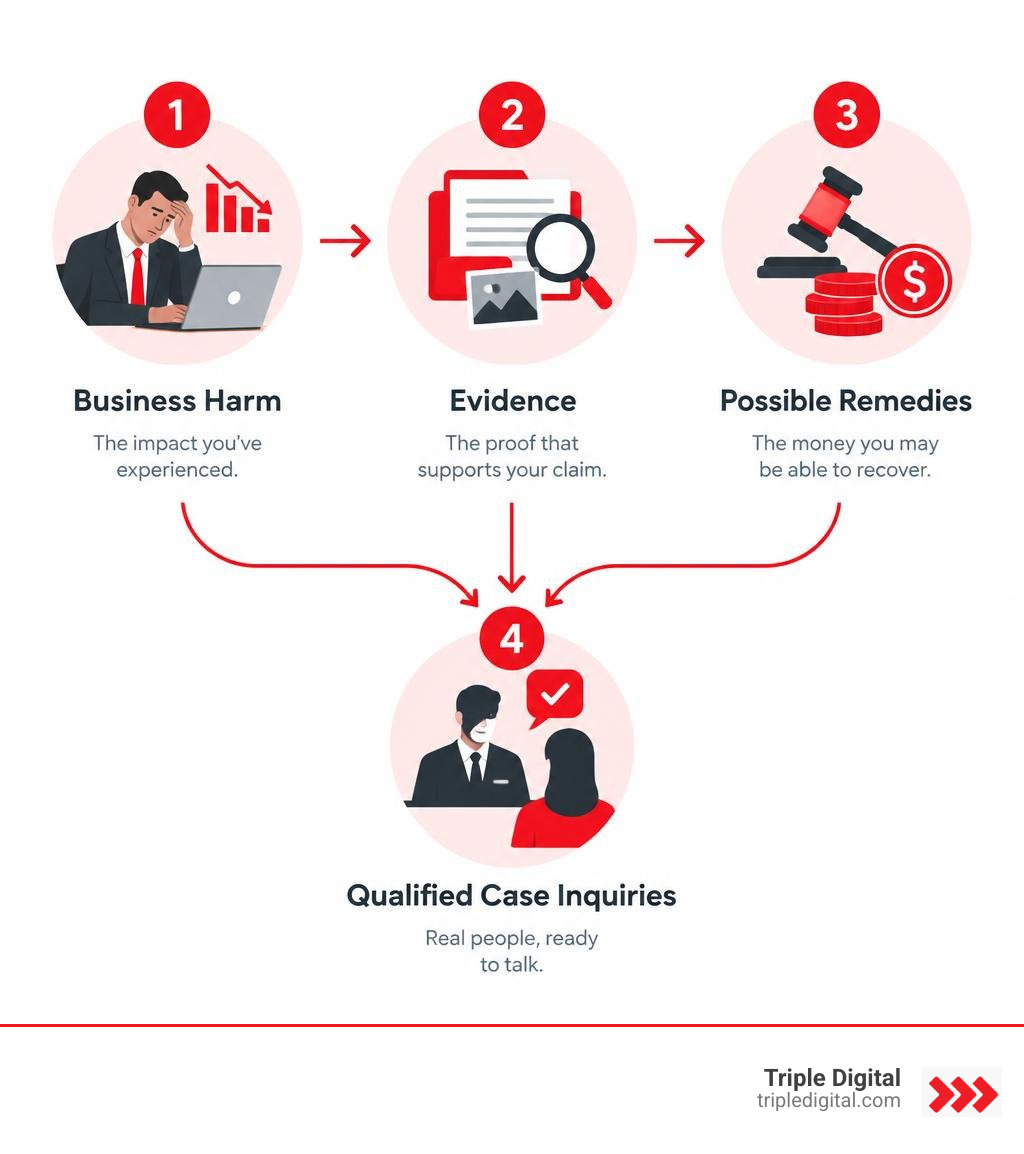
Damages marketing word list:
Damage, damages, and reputational harm: what businesses need to know
In a commercial dispute, damage is the actual injury or loss; damages are the legal remedy, often a monetary award. A supplier’s faulty component might damage a production machine. Repair costs and documented downtime could then be part of a damages claim if the law and contract support recovery.
Damages are generally meant to compensate, not punish. Contract damages often aim to put the injured party in the position it would have been in if the agreement had been performed. The recoverable losses depend on the claim, the evidence, the contract, and applicable law. A useful foundation for law firms explaining complex legal subjects is modern law firm SEO, where clear answers help prospective clients understand what to do next.
| Term | Meaning | Commercial example |
|---|---|---|
| Damage | The harm or loss itself | A data breach undermines customer trust |
| Damages | Money a court may award for a legally recognized claim | Proven response costs or lost profits |
Reputational damage differs from a broken machine or a direct invoice because it concerns how customers, employees, suppliers, and other stakeholders view a business. It may follow a data breach, a legal violation, misleading claims, poor service, or a supplier failure. The harm can spread: customers leave, employees seek other jobs, hiring becomes harder, and the business may face regulatory scrutiny or litigation.
How damages marketing can explain the difference between harm and compensation
Good legal content separates the story of the harm from the question of what can be recovered. A business may report falling sales after a public controversy, but timing alone does not establish that the controversy caused the decline or that the whole decline is legally recoverable.
A claim might involve direct expenses, such as repair or remediation costs, or lost profits supported by reliable records. Contract terms, causation, foreseeability, mitigation, and jurisdiction can all affect the analysis. Marketing should explain these issues in accessible language without implying every loss results in compensation.
What reputational damage can cost a business
A damaged reputation can affect revenue and operations in ways that are difficult to isolate. Customers may switch to other providers, negative reviews may discourage new inquiries, and weaker employee morale can increase turnover and recruitment costs. A business may also spend money responding to a crisis, improving security, correcting public information, or reviewing compliance.
These effects are real business concerns, but they do not automatically translate into a specific damages award. Evidence matters: customer records, sales trends, employee data, response costs, and the timing of events can help show what happened and what other factors may have contributed.
Types of damages and how businesses can measure harm to goodwill
Potential remedies depend on the claim. In trademark and unfair competition cases, the Lanham Act, including section 1117, allows certain monetary remedies, but the evidence and rules differ by claim. Courts may consider a plaintiff’s losses, a defendant’s profits, or other supported measures. Statutory damages are available for particular claims such as counterfeiting and cybersquatting, not as a general remedy for every false advertising or trademark dispute.
Goodwill is the value associated with customer recognition, trust, and favorable associations with a business or mark. It can be difficult to value because many forces affect a company’s reputation and sales at once. In Maier Brewing v. Fleischmann Distilling, the Ninth Circuit allowed an accounting of the defendant’s profits as a way to address goodwill harm, despite no proven lost sales and no direct competition between the products. That result illustrates that courts may use different measures in particular circumstances; it does not make defendant profits an automatic measure of plaintiff loss.
| Damages type | General purpose | Common proof considerations |
|---|---|---|
| Compensatory | Address proven injury | Loss records, causation, and a reliable measure |
| General | Address losses the law may infer from the type of claim | The legal claim and applicable rules |
| Special | Address specific, measurable losses | Particularized evidence such as invoices or sales records |
| Nominal | Recognize a legal violation where substantial loss is not shown | Proof of the violation; amount may be small |
| Punitive | Punish or deter especially wrongful conduct where allowed | State law, required mental state, and limits |
| Liquidated | Apply a contractually agreed amount for a specified breach | Contract terms and enforceability under applicable law |
| Defendant’s profits | Address profits linked to the unlawful conduct or unjust enrichment | Sales, deductions, and apportionment |
| Statutory | Provide a statute-specific remedy | Eligibility and statutory limits |
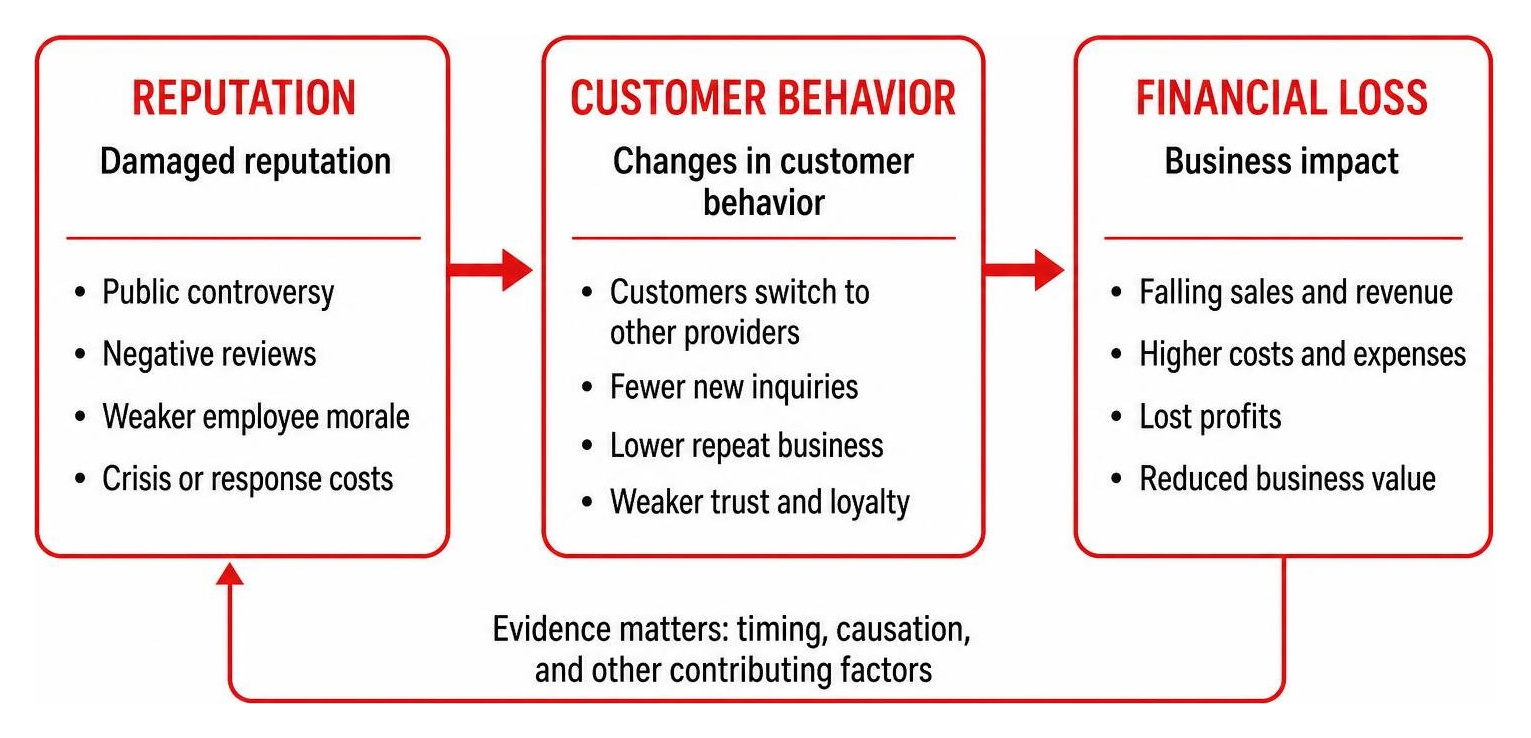
Businesses and experts may assess goodwill through a before-and-after analysis, comparable market data, consumer surveys, or regression analysis. Each method needs to distinguish the effect of the alleged wrongdoing from other causes, such as pricing, product quality, seasonality, competition, and changes in distribution. Out-of-pocket expenses and reasonable mitigation costs may be more directly documented than a broad estimate of lost goodwill.
How damages marketing claims should distinguish available remedies
Trademark infringement and false advertising are not interchangeable. A false advertising plaintiff may need to establish that buyers were deceived and that the deception caused injury; literal falsity or evidence of intent does not necessarily prove monetary loss. Trademark cases may involve consumer confusion, but the required evidence and available remedies vary by claim and court.
State-law consumer protection and unfair competition claims may have different standards. Statutory remedies also have defined limits. Law firms should explain these distinctions carefully and have legal counsel review educational content so it does not turn a possible remedy into a promise.
How to build a defensible goodwill damages model
A strong model starts by describing what happened in the real world and what likely would have happened without the alleged misconduct. It then isolates the effect of the conduct from other explanations. A sales decline, for example, may also reflect a price change, a new competitor, reduced inventory, or a wider market shift.
Useful evidence can include sales records, customer retention data, complaint patterns, marketing records, margins, and documented response costs. A marketing expert can explain campaign activity and available platform data; an accounting or damages expert can assess financial effects and calculate a supported figure. Reports should disclose assumptions, data limits, and competing causes rather than presenting uncertain estimates as settled facts.
Corrective advertising, injunctions, and the debate over fair compensation
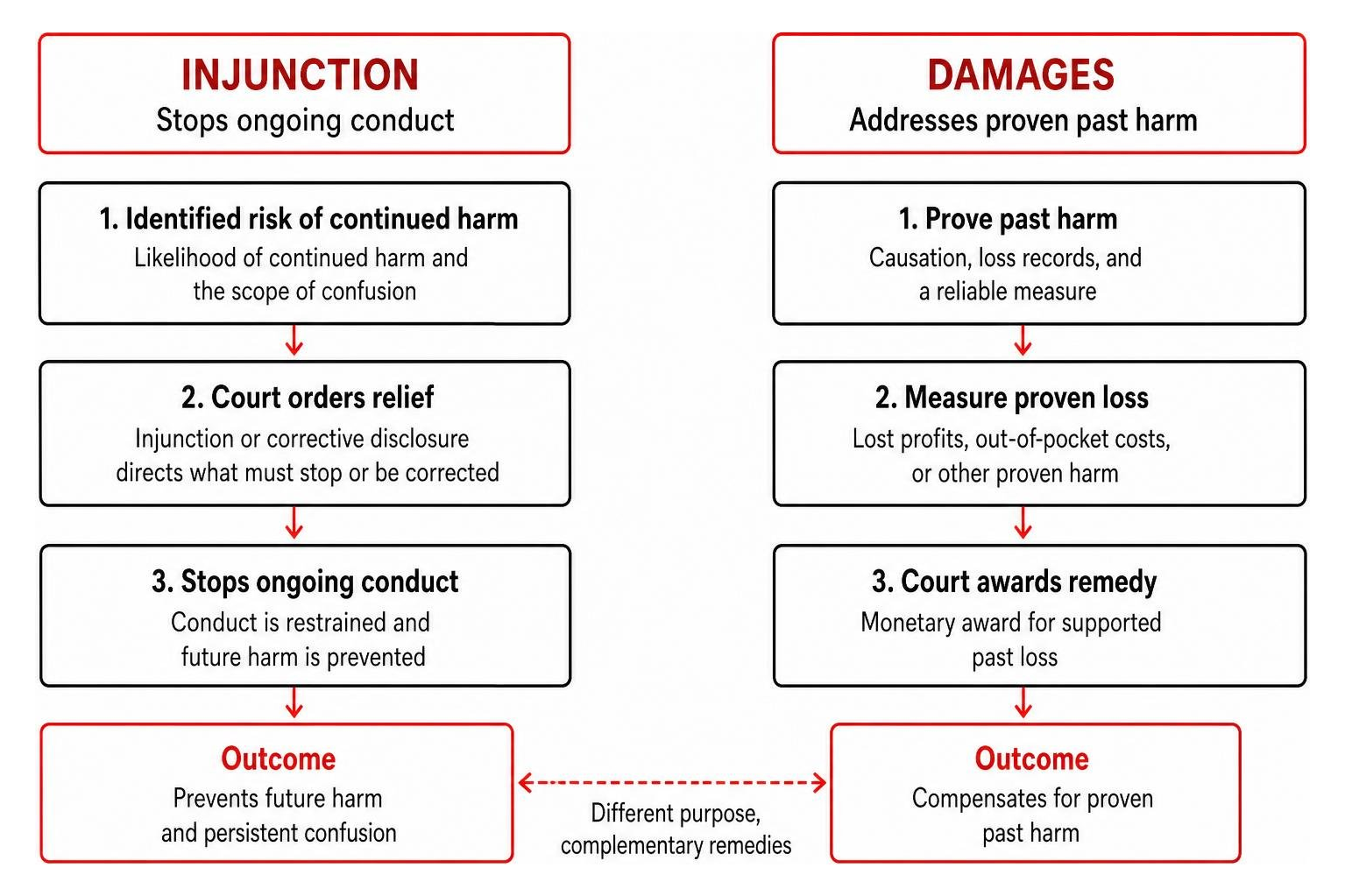
Corrective advertising aims to counter a misleading message that may continue to shape consumer beliefs. It can be ordered as an injunction, or a court may consider a plaintiff’s actual counter-advertising costs as part of a monetary remedy. These are not the same thing: an injunction directs conduct, while damages compensate for supported past loss.
| Remedy or measure | What it addresses | Evidence that may matter |
|---|---|---|
| Injunction or corrective disclosure | Ongoing conduct or persistent confusion | Likelihood of continued harm and the scope of confusion |
| Lost profits | Plaintiff’s proven lost business | Causation, sales, margins, and other market factors |
| Disgorgement | Defendant’s profits linked to the conduct | Defendant sales, deductions, and apportionment |
| Counter-advertising costs | Reasonable expenses incurred to correct a message | Actual spending and evidence that the correction was needed |
In Big O Tire Dealers v. Goodyear, a jury awarded $2.8 million in compensatory damages based on a portion of Goodyear’s advertising expenditures, despite no evidence of lost sales or lost dealers. The award was later reduced to $678,302 using a calculation tied to the relevant advertising and states. In West Des Moines State Bank v. Hawkeye Bancorp, the Eighth Circuit affirmed an award based on 25% of the defendant’s advertising expenditures despite no quantified dollar loss to the plaintiff.
In U-Haul v. Jartran, the court awarded $6 million based on the defendant’s advertising expenditures and $13.6 million for U-Haul’s actual counter-advertising expenses. The total was doubled under the Lanham Act, producing a judgment of about $40 million.
The FTC has also used corrective advertising as an injunctive remedy. In Warner-Lambert, the company was required to spend $10 million on corrective disclosures addressing decades of claims that Listerine could prevent colds and sore throats. Research has raised concerns that corrective messages may not fully undo consumer beliefs. Corrections may also create broader distrust, so their design and explanation matter.
Why a defendant’s advertising spend is not automatically a damages formula
An advertising budget shows what a defendant spent to communicate, not necessarily the harm a plaintiff suffered. A percentage of that spend may be a poor fit if the plaintiff cannot show consumer confusion, lost sales, reduced goodwill, or a need for correction on that scale. The familiar 25% figure in some cases is not a universal rule or a standard damages formula.
A better analysis asks what consumers saw, how they responded, what correction is reasonably necessary, and what expenses were actually incurred. Depending on the facts, a focused message to affected customers may be enough; widespread, lasting confusion may require a more extensive response. The aim is to avoid both under-compensation and a windfall unsupported by evidence.
How courts use injunctions alongside monetary damages
An injunction can stop an ongoing practice, require a corrective disclosure, or reduce the risk of future confusion. Monetary damages address proven past harm, such as lost profits or reasonable corrective costs. Courts may use both forms of relief when appropriate, but the legal standards and evidence for each are distinct.
Damages marketing: how law firms can communicate services and attract qualified cases
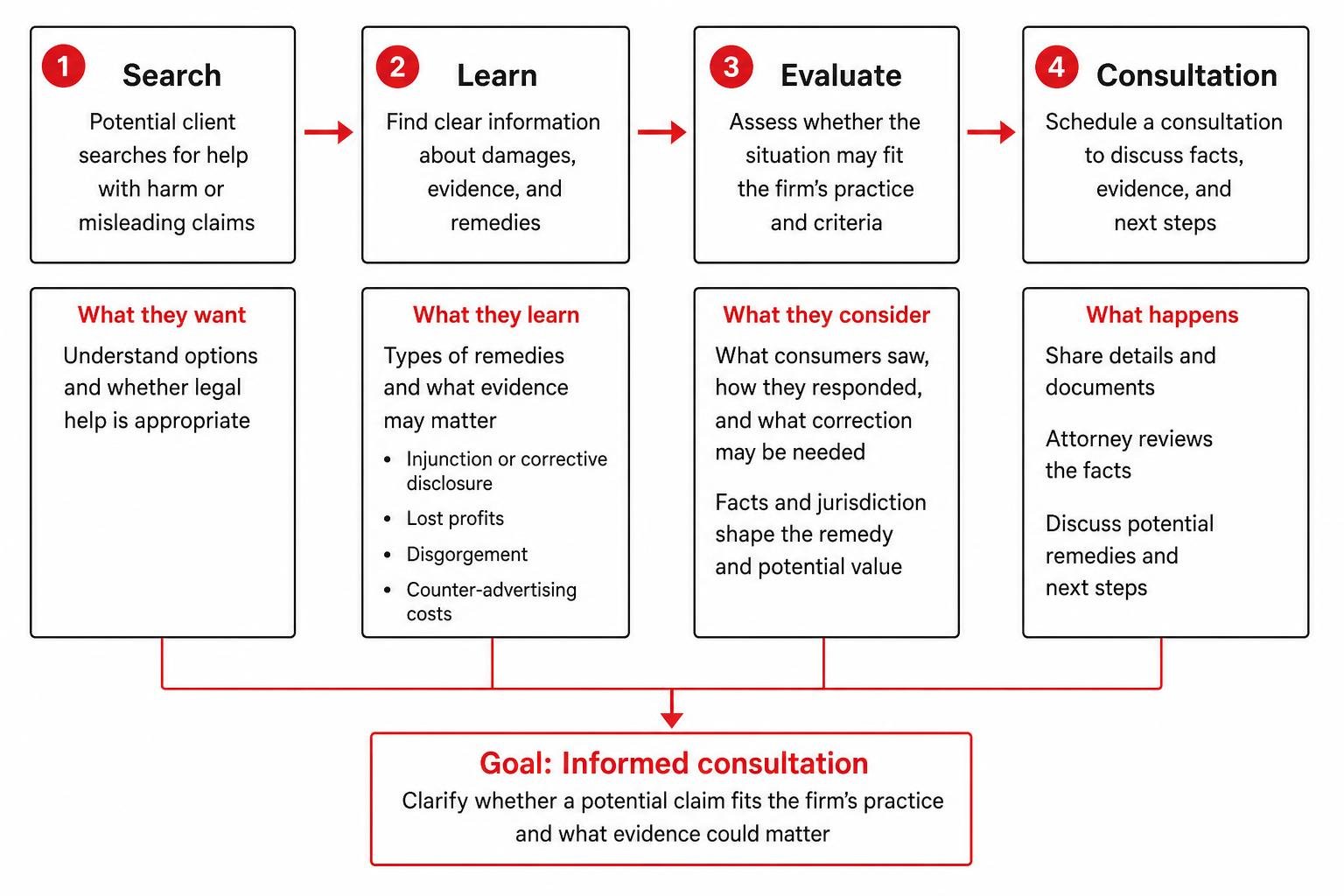
For law firms, marketing around damages is most useful when it educates rather than promises. Explain what kinds of evidence could matter, why the remedy depends on the facts, and how a consultation can clarify whether a potential claim fits the firm’s practice. In Houston, as elsewhere, firms should follow applicable Texas lawyer advertising rules and ensure claims are accurate, not misleading, and free of guaranteed outcomes.
We focus on lead generation and case acquisition for law firms. With a results-driven approach, we use AI and data mining to help target potential clients more precisely, then evaluate whether campaigns bring in qualified inquiries. A clear path from search to consultation supports that process.
Our work connects with practical approaches to law firm conversion optimization, lead generation for personal injury law firms, and paid advertising for lawyers.
How damages marketing can set accurate expectations without promising results
Use plain language to explain that a business may have suffered harm without being entitled to every dollar it claims. The relevant evidence, the cause of the loss, the available remedy, and the jurisdiction all matter. Avoid fixed recovery estimates or claims that a particular fact guarantees a result. A disclaimer can clarify that general website information is not legal advice, but it does not make misleading content acceptable.
How law firms can measure damages marketing performance
Clicks and impressions are useful campaign signals, but they are not cases. Track qualified inquiries, consultation rates, signed cases, cost per qualified lead, and cost per signed case. Review intake quality by channel and use attribution carefully, since a prospective client may interact with several sources before contacting a firm.
Regularly compare marketing data with intake outcomes. That helps us understand which topics and campaigns attract relevant inquiries, rather than simply generating activity.
What businesses can do to prevent reputational harm and manage a crisis
Prevention is usually less costly than repairing avoidable damage. Businesses can:
- Review compliance practices and assign responsibility for risk monitoring.
- Check supplier reliability and plan for disruptions.
- Maintain cybersecurity safeguards and a process for responding to suspected breaches.
- Prepare a crisis response plan with clear decision-makers and stakeholder communications.
- Respond promptly and accurately, preserve relevant records, and correct misleading information where appropriate.
A calm, well-supported response can help limit confusion. Speculation, silence, or contradictory explanations can make it harder to restore trust.
Frequently asked questions about damages marketing
What is the difference between damage and damages?
Damage is the harm or loss, such as a damaged reputation or lost sales. Damages are money a court may award for a legally recognized claim. The harm alone does not establish the amount recoverable.
Can a business recover money for reputational harm?
Possibly, depending on the legal claim, evidence, causation, and applicable law. A business may need to show how the conduct affected goodwill, profits, or reasonable response costs. A negative review or sales decline by itself may not prove a compensable loss.
Is a percentage of a defendant’s advertising budget a standard damages measure?
No. Some courts have used advertising expenditures in particular corrective advertising cases, but there is no universal percentage formula. The measure should fit the evidence of consumer response, injury, and reasonable correction.
Turn proof into clearer decisions and better case conversations
The difference between harm and compensation is more than wording: it helps businesses understand what happened and helps law firms explain what evidence and remedies may matter. Reliable damages analysis depends on proof, causation, and a measure suited to the claim. Responsible marketing carries that same care into every client conversation.
We help law firms build practical campaigns through digital marketing strategies for law firms. Connect with Triple Digital in Houston or schedule a strategy meeting to discuss qualified lead generation and case acquisition.