




Stop Wasting Time on Low-Impact SEO Content for Lawyers
How to Create SEO Content for Lawyers That Brings in Cases
SEO content for lawyers works best when each page answers a real client question and gives the reader a clear next step. Start with the legal services your firm wants to grow. Find the questions people ask before hiring a lawyer, then build a useful page for each distinct need. Explain the law in plain language, add relevant local details, and make it easy to contact your firm.
A steady stream of generic blog posts may bring traffic without bringing cases. Focus instead on content that helps a potential client move from a search to a consultation.
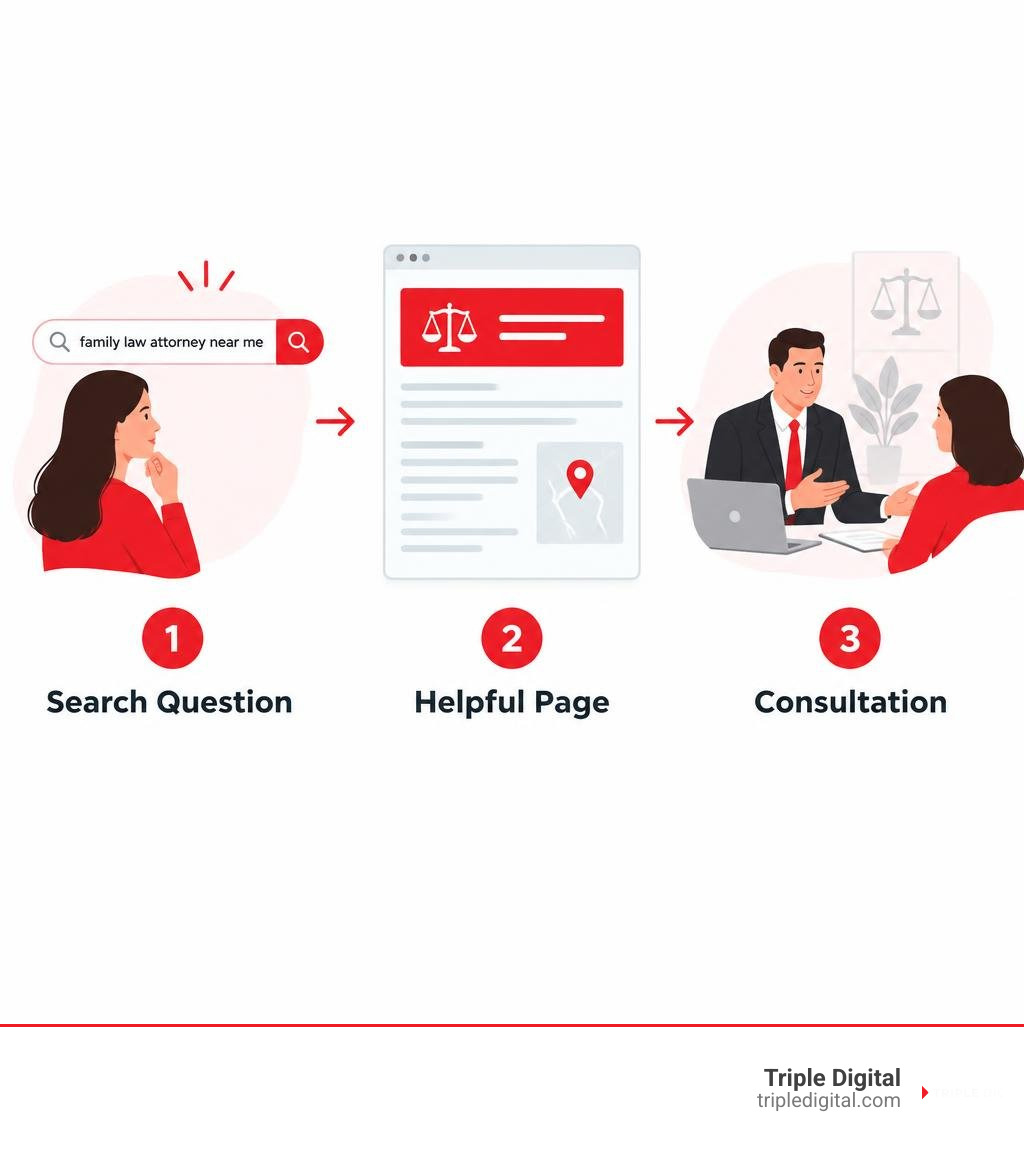
SEO content for lawyers terms at a glance:
Strategic Keyword Research and Intent Mapping for Legal Practices
In legal marketing, vanity metrics like raw page views mean very little if they do not result in qualified consultations. Around 96% of people seeking legal advice turn to search engines, and roughly 90% click on organic listings rather than paid advertisements. PPC ads capture only about 10% of clicks. To capture high-value organic traffic, your strategy must focus on search intent rather than just broad search volume.
Prospective clients search across several distinct mindsets:
- Informational Intent: Early-stage inquiries seeking to understand legal rights, definitions, or processes (e.g., “what happens during probate administration”).
- Commercial Investigation: Users comparing legal options, evaluating firm capabilities, or looking for specific qualifications (e.g., “what to look for in a corporate real estate attorney”).
- Transactional Intent: High-urgency queries from individuals actively seeking immediate legal representation (e.g., “hire an estate planning lawyer near me”).
Conducting effective keyword research for lawyers means identifying the specific phrases potential clients use when facing complex legal situations. By mapping these queries to dedicated pages, we help prospective clients find exact answers while establishing your firm’s immediate availability to assist them.
Intent-Driven Keyword Clustering Across the Client Intake Funnel
To convert searchers into retained clients, structure your website’s content around the traditional AIDA model (Awareness, Interest, Desire, Action):
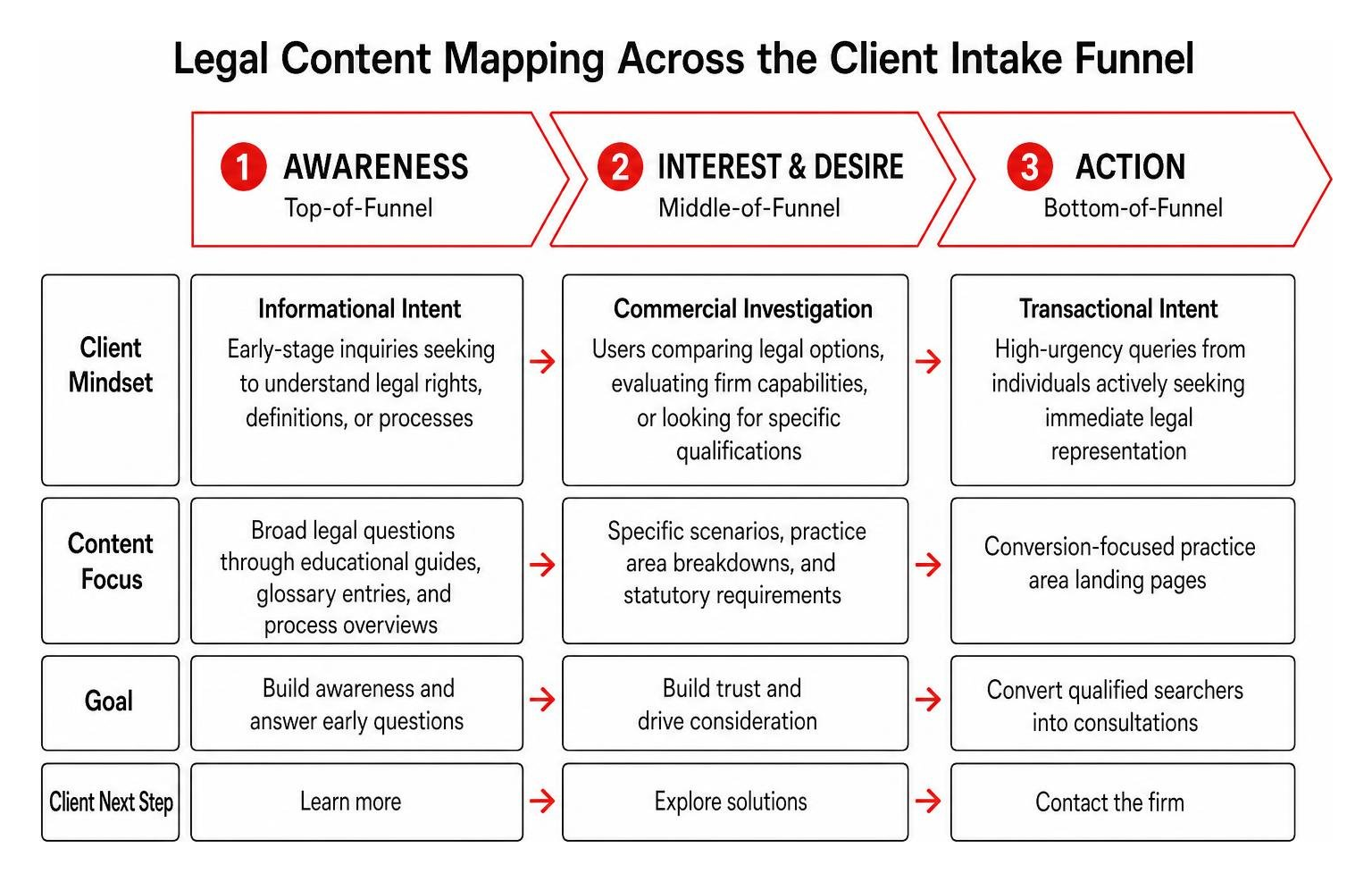
- Awareness (Top-of-Funnel): Address broad legal questions through educational guides, glossary entries, and process overviews.
- Interest & Desire (Middle-of-Funnel): Guide prospects through specific scenarios, practice area breakdowns, and statutory requirements using practical legal copywriting strategies.
- Action (Bottom-of-Funnel): Direct qualified searchers to conversion-focused practice area landing pages equipped with prominent contact forms and clear phone numbers.
Comparing High-Impact and Low-Impact SEO Content for Law Firms
| Dimension | Low-Impact Legal Content | High-Impact Legal Content |
|---|---|---|
| Search Intent Alignment | Targets broad, generic head terms with no local or hiring intent. | Directly answers specific, jurisdiction-aware client questions. |
| Topical Depth | Thin, 400-word articles that state superficial generalities. | In-depth resources explaining procedural steps, timelines, and rights. |
| User Engagement | Dense legalese that confuses visitors and drives immediate bounces. | Plain-language explanations structured with clear headings and summaries. |
| Conversion Potential | Lacks clear calls-to-action or contact pathways. | Prominent consultation forms, direct phone lines, and attorney bios. |
| Long-Term Value | Outdated news recaps that lose relevance within weeks. | Evergreen assets that continuously attract qualified organic inquiries. |
Creating High-Impact SEO Content for Lawyers That Converts
Google assesses legal websites under strict Your Money or Your Life (YMYL) guidelines, demanding high levels of Experience, Expertise, Authoritativeness, and Trustworthiness (E-E-A-T). With over one million licensed attorneys across the country, generic legal information simply will not rank or convert.
High-converting legal pages balance authoritative legal knowledge with accessible writing:
- Translate complex statutes and procedural steps into clear, layperson-friendly language.
- Feature prominent author bios showcasing bar admissions, industry recognitions, and relevant experience.
- Maintain transparent contact details and clear above-the-fold calls to action so visitors can immediately request an initial consultation.

A well-structured page addresses the user’s underlying anxiety, outlines the legal process clearly, and provides an immediate method to reach an attorney. Discover more about developing an authoritative legal content strategy to systematically connect with potential clients.
Building Topical Authority with Scalable SEO Content for Lawyers
Search engines reward websites that demonstrate exhaustive coverage of a practice area rather than those offering disjointed, superficial posts. We build topical authority using a structured hub-and-spoke model.
Implementing this pillar content architecture for law firms involves creating a comprehensive core landing page for each primary service area, supported by detailed sub-pages covering related questions, local court processes, and common legal scenarios. Review our guide on advanced strategies for authoritative content to scale your topic coverage.
Comparing Brochure Websites and Comprehensive Legal Resources
| Feature | Static Brochure Website | Comprehensive Legal Resource Hub |
|---|---|---|
| Content Scope | Basic home, about, services, and contact pages. | Extensive library of practice guides, FAQs, and local resources. |
| Organic Reach | Ranks only for branded firm name queries. | Captures hundreds of long-tail, high-intent legal searches. |
| Visitor Trust | Presents sales pitches without educating the reader. | Demonstrates legal knowledge by answering crucial legal questions. |
| Conversion Rates | High bounce rates from visitors seeking actual information. | Sustained engagement leading to higher consultation requests. |
| Inbound Links | Rarely earns editorial backlinks or media citations. | Naturally attracts citations from news outlets and professional journals. |
Streamlining Production with AI-Assisted Workflows and Specialized Writers
Maintaining a consistent publishing cadence of 4 to 6 comprehensive, well-researched pages per month can strain internal firm resources. Forward-thinking firms leverage modern workflows to accelerate research while maintaining strict editorial quality:
- AI-Powered Research: Generate content briefs, uncover semantic keyword clusters, and identify common user questions in minutes.
- Specialized Drafting: Work with dedicated legal writers who understand practice-specific nuances and jurisdiction rules.
- Attorney Review: Ensure all published material complies with professional conduct rules and local advertising ethics.
Many firms choose outsourcing to specialized legal content writing services to ensure consistent quality and scale, or refine internal processes using effective content creation workflows for attorneys.
Technical Foundations, Schema Markup, and Generative AI Optimization
A strong content strategy requires a robust technical foundation. Modern search performance depends heavily on website health, clean navigation, and fast page delivery. Review our comprehensive law firm SEO fundamentals to ensure your technical base is sound.
- Core Web Vitals: Ensure Largest Contentful Paint (LCP) loads in under 2.5 seconds.
- Mobile-First Design: Maintain clean, responsive navigation, as 88% of users will abandon a site after a poor mobile experience.
- Site Architecture: Keep URLs logical and descriptive (e.g.,
/practice-areas/business-contracts/) and eliminate broken internal links.
Technical and AI Search Optimization for SEO Content for Lawyers
Legal searches trigger AI Overviews approximately 78% of the time—the highest rate among all major search categories. When an AI Overview is present, click-through rates on traditional organic results can drop by as much as 58%.
To maintain search visibility, optimize for Generative Engine Optimization (GEO) and Answer Engine Optimization (AEO):
- Provide direct, self-contained answers within the first 50 words of major subheadings.
- Structure content with descriptive H2 and H3 tags that mirror common client questions.
- Use bulleted lists and concise summary tables to make key statutory steps easy for AI search engines to parse and cite.
- Follow our framework for mastering legal posts to outrank competitors across both traditional and AI-driven results.
Implementing Structured Data and Schema Markup for Attorneys
Schema markup provides structured code that helps search engines interpret your firm’s specific credentials, services, and geographic locations.
Key schema types for law firm websites include:
LegalService: Identifies your firm, address, phone number, operating hours, and accepted payment methods.Attorney: Outlines individual lawyer credentials, bar admissions, education, and practice specializations.FAQPage: Generates expandable question-and-answer snippets directly within search results.LocalBusiness: Reinforces geographic service areas and office coordinates.
Dominating Local Search and Building Authoritative Legal Backlinks
Because legal services are tied to specific jurisdictions, local search visibility is essential. Over 85% of people looking for legal help use online maps to locate firms nearby.
At Triple Digital, we help firms secure prominent visibility within Google’s local Map Pack by verifying and refining every element of their Google Business Profile, maintaining strict Name, Address, and Phone (NAP) consistency, and building localized practice area landing pages.
Reputation Management and Local Citation Velocity
Client reviews are a major local ranking factor and a decisive social proof signal for prospective clients:
- Implement automated post-matter review requests to build consistent feedback volume.
- Respond professionally to all reviews while maintaining client confidentiality.
- Claim and verify profiles on trusted business directories and local legal indices.
- Ensure inquiry forms route directly into your firm’s intake management workflow for prompt follow-up.
High-Impact Backlink Acquisition for Law Firm Websites
Search engines treat high-quality inbound links as votes of confidence in your firm’s authority. Rather than pursuing low-value link schemes, focus on earning authoritative editorial placements:
- Legal & Bar Association Directories: Maintain active listings on state and local bar profiles.
- Media Commentary & HARO: Provide expert legal analysis on developing statutory updates and regional news stories.
- Academic & Legal Publications: Author guest columns or research summaries for law journals and educational platforms.
- Content-Driven Assets: Publish original surveys, comprehensive infographics, and evergreen legal guides that naturally attract citations via proven blog writing tactics for law firms.
Frequently Asked Questions About Law Firm SEO
How long does it take for legal content to generate organic cases?
Organic SEO is a compounding investment. While initial indexation and rank improvements often appear within 60 to 90 days, meaningful client acquisition and sustained top-tier rankings typically develop over 4 to 9 months, depending on local market competition and baseline domain authority.
What are the most common SEO mistakes law firms make?
The most frequent missteps include:
- Publishing thin, 300-word practice area pages that offer no substantive answers.
- Repeating exact-match keywords unnaturally throughout the text.
- Neglecting mobile site speed and user experience.
- Failing to claim and optimize their Google Business Profile.
- Omitting proper structured data markup.
What tools are essential for measuring law firm SEO performance?
Track your firm’s progress using industry-standard analytics tools:
- Google Search Console: Monitor index status, organic impressions, and real search queries.
- Google Analytics (GA4): Evaluate user engagement, bounce rates, and consultation goal conversions.
- PageSpeed Insights: Check Core Web Vitals performance across desktop and mobile devices.
- Legal CRM & Intake Tracking: Connect organic landing page visits directly to signed retainer agreements.
Turn High-Intent Legal Searchers into Retained Clients
Creating high-impact legal content requires moving away from generic blog posts toward a structured, data-driven approach that addresses real client needs. By combining intent-driven keyword research, comprehensive practice area hubs, technical schema optimization, and strong local authority, your firm can build a sustainable pipeline of high-value cases.
Ready to stop wasting time on low-impact content and scale your firm’s caseload? Schedule a strategic consultation for law firm growth with our team to discover how our data-driven frameworks can transform your online visibility into signed retainers. You can also explore our full range of specialized marketing services or contact us directly to audit your current search footprint.