





Law Firm SEO: Understanding Search Engine Optimization for Attorneys
Law firm SEO is the practice of optimizing your firm’s website so that potential clients find you — not your competitors — when they search Google for legal help.
Here’s what you need to know at a glance:
- What it is: A set of strategies (content, technical fixes, local listings, backlinks) that push your site higher in search results
- Why it matters: 96% of people seeking legal advice use a search engine — and most never scroll past page one
- Key components: Practice area pages, Google Business Profile, local SEO, link building, and technical performance
- How long it takes: Most firms see meaningful lead growth between months 6 and 12
- What it costs: Typically $2,000–$15,000+ per month depending on market competition and firm size
- Biggest mistake: Treating it as a one-time project instead of a long-term growth asset
The way clients find lawyers has changed permanently. According to the Clio Legal Trends Report, 57% of legal consumers now begin their search for representation online — not through referrals, not through bar listings, not through billboards. For clients under 45, that number exceeds 70%.
That shift has made your website either your best business development tool or your biggest missed opportunity.
The problem? The legal SEO space is crowded with agencies making big promises, using jargon-heavy pitches, and delivering generic strategies that were never built for the specific pressures of law firm marketing. Comparing services is genuinely hard when every agency sounds the same.
This guide cuts through that noise. It explains exactly what law firm SEO involves, what separates a strong service from a weak one, what you should expect to pay, and how to measure whether it’s actually working.
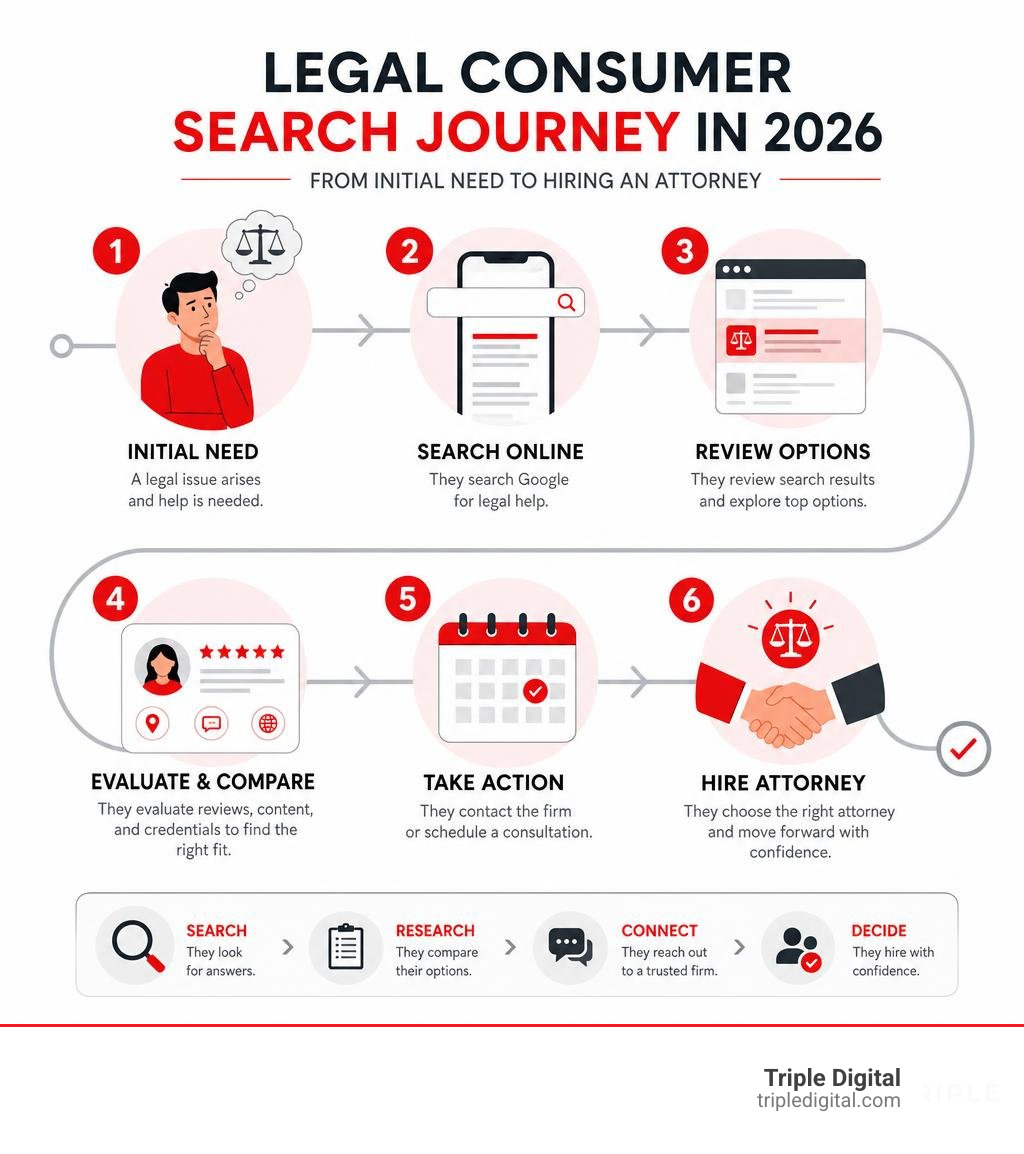
When someone searches for a “car accident lawyer in Houston” or asks Google “commercial truck accident lawyer in Texas,” they aren’t just browsing. They have an immediate, high-intent legal need.
Unlike general retail search engine optimization, where a bad piece of advice might result in a flat loaf of sourdough bread, search engines hold legal websites to an incredibly high standard. Google classifies legal content under its YMYL (Your Money or Your Life) category. Because legal advice can fundamentally alter a person’s freedom, finances, and future safety, search algorithms apply strict scrutiny to who is publishing this information.
To rank your website, Google relies heavily on human Search Quality Rater Guidelines to train its algorithms around the concept of E-E-A-T:
- Experience: Does the writer show hands-on, first-person experience with the legal system?
- Expertise: Is the content written or reviewed by a credentialed attorney who knows the law?
- Authoritativeness: Is your firm recognized as an authority in your practice area and community?
- Trustworthiness: Is your site secure, transparent, and built to protect the user?
Understanding these guidelines is the difference between a site that ranks consistently and one that gets buried by algorithm updates. For a deeper dive into why this matters, read our guide on Why SEO is important for attorneys and explore the core Reasons to use law firm SEO.

How Legal Search Differs from General SEO
If you hire a generalist agency that optimizes flower shops and plumbing businesses, you are walking into a compliance trap. General SEO focuses purely on search volume and generic keywords. Legal SEO, however, must operate within strict state bar advertising regulations.
In Texas, for example, the Texas Disciplinary Rules of Professional Conduct strictly regulate how attorneys can present themselves online. You cannot make comparative claims of superiority (like calling yourself the “best personal injury lawyer in Houston”) unless those claims are objectively verifiable.
Furthermore, legal search operates on a high-value, low-volume acquisition model. A retail site might need 10,000 visits to sell 100 pairs of socks. A personal injury firm, however, might only need 10 highly targeted organic visits to sign a single, multi-million dollar commercial truck accident case. This requires a dedicated approach to Lawyer search engine optimization that values case quality over raw traffic metrics.
The Long-Term Value of SEO vs PPC
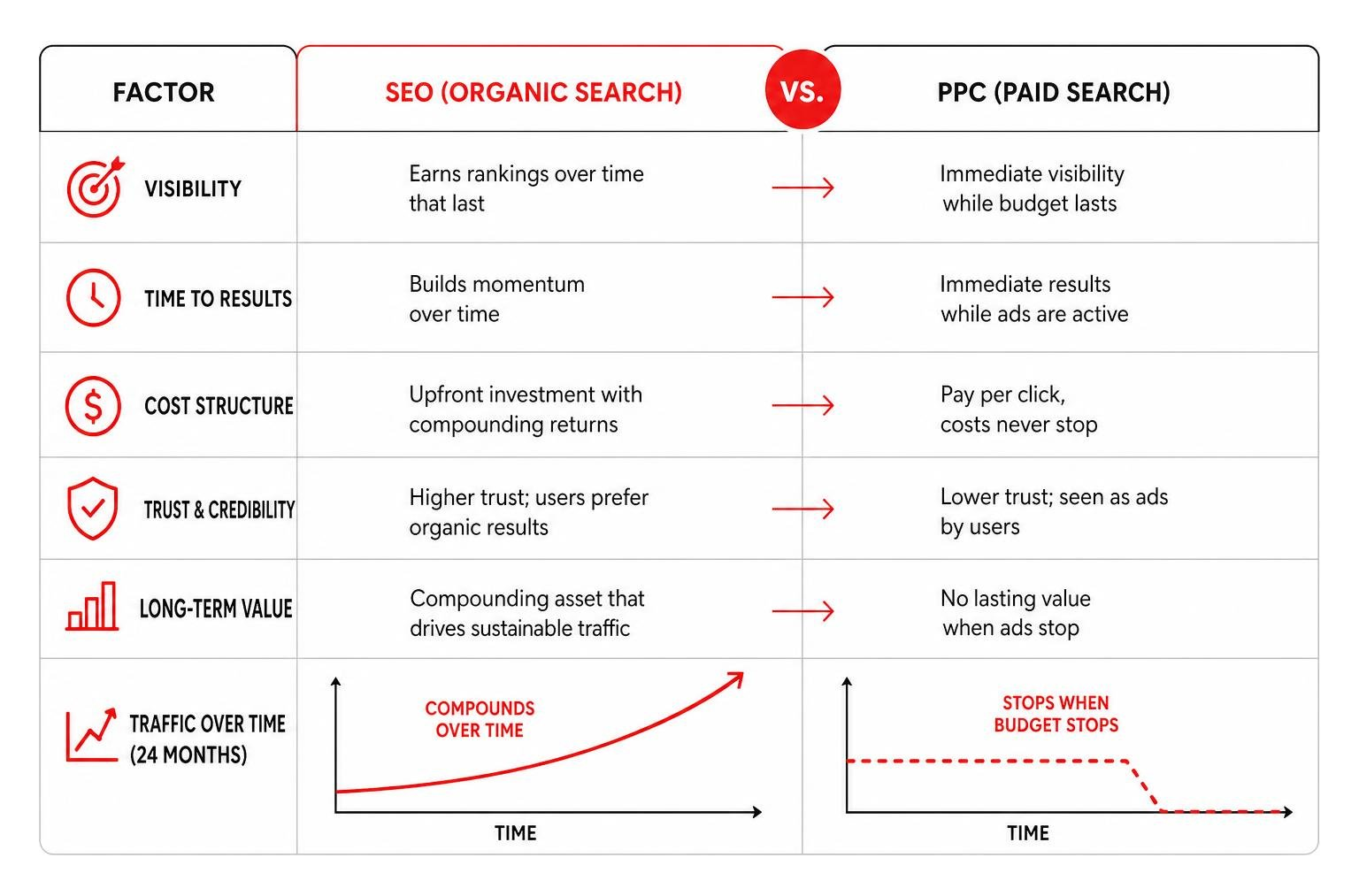
Many law firms rely heavily on Google Ads (Pay-Per-Click or PPC) to generate cases. While PPC offers immediate visibility, it is incredibly expensive. Legal keywords are consistently the most expensive in all of digital marketing. In highly competitive metros like Houston, practice-area-specific keywords like “personal injury lawyer” or “DUI attorney” regularly exceed $200 to $700+ per click.
If a competitor clicks your ad, or a user bounces within three seconds, that money is gone forever.
SEO, by contrast, is a compounding asset. When you invest in ranking organically, that position doesn’t disappear when your daily budget runs out. Over a 24-month period, firms that balance their ad spend with search engine optimization report up to 40% lower client acquisition costs compared to PPC-only strategies.
To see why organic search is a smarter long-term play, read our breakdown on Why SEO is great for your business.
The Five Pillars of a Successful Digital Strategy
A successful law firm seo campaign is not built on a single trick. It requires an integrated approach that balances organic visibility, search intent, and conversion optimization to turn casual searchers into signed clients. To understand how these pieces fit together, check out our resource on Mastering law firm SEO: your blueprint for online success and review the Top 3 digital SEO strategies for law firms.
The Core Pillars of Law Firm SEO
When evaluating different agencies, make sure their campaigns cover all four core pillars of organic performance. If any of these are missing, your rankings will eventually stall. Explore how these factors interact in our guide to Law firm SEO: what are the most important SEO ranking factors?.
Keyword Research and the Case-Value Framework
Most agencies will hand you a spreadsheet of keywords with high search volume and tell you they are going to target them. This is a mistake.
A smart strategy uses the Case-Value Keyword Framework. Instead of chasing high-volume, low-value informational terms (like “what is a tort”), we target high-intent, high-value transactional terms (such as “Houston commercial truck accident lawyer”). We segment keywords by searcher intent:
- Transactional: “Hire personal injury attorney Houston”
- Local: “DUI lawyer near me”
- Informational: “What is the difference between mediation and litigation?”
By aligning your content with the exact stage of the legal buyer’s journey, you capture users when they are ready to make a hiring decision. Learn more about prioritizing high-value cases in our guide to SEO for personal injury attorneys.
On-Page Optimization and Content Depth
On-page optimization is more than just stuffing a keyword into a header. It requires building comprehensive, authoritative practice area pages that average 1,500 to 2,500+ words.
Each page must have:
- Optimized Title Tags: Keep them under 55–60 characters using a formula like:
[Practice Area] Lawyer in [City] | [Firm Name]. - Meta Descriptions: Write these as micro-sales copy under 155 characters, complete with a clear call to action and credibility markers.
- Structured Schema Markup: Use LegalService, Attorney, and FAQPage schema to help search engines easily read and display your information.
For a step-by-step optimization playbook, read our guide on how to Rank higher, get more clients: essential website SEO for attorneys.
Local SEO, Google Business Profile, and Reviews
For law firms, local SEO is non-negotiable. Roughly 85% of people use online maps to find legal services in their area, and the Google Local Pack captures 42% of all organic clicks.
To dominate the local map pack, you must:
- Claim and fully optimize your Google Business Profile (GBP), listing every specific city and county you serve.
- Maintain absolute NAP Consistency (Name, Address, Phone number) across every directory online.
- Build a steady stream of positive client reviews. Implement a text-message-based review acquisition system to ask clients for feedback at their point of peak satisfaction.
Avoid leaving money on the table by reading Stop wasting money: the ultimate guide to local SEO for your law firm and Get found locally: a lawyer’s guide to local SEO success.
Technical SEO and Site Architecture
If your website takes longer than 3 seconds to load, 88% of users will leave and never return. Google’s Core Web Vitals measure user experience through three main metrics:
- Largest Contentful Paint (LCP): Loading speed (aim for under 2.5 seconds).
- Interaction to Next Paint (INP): Page responsiveness (aim for under 200 milliseconds). Heavy live chat widgets are a common culprit for failing this metric.
- Cumulative Layout Shift (CLS): Visual stability (aim for under 0.1).
Ensure your site structure is flat, meaning any page can be reached within three clicks from the homepage. If you use WordPress, check out our specialized WordPress SEO services for lawyers.
Ethical Link Building and Authority
Backlinks are like digital votes of confidence. However, buying cheap link packages or using Private Blog Networks (PBNs) will get your site penalized by Google.
Instead, build high-quality, authoritative links through:
- Legal Directories: High-authority listings on Avvo, Justia, and FindLaw.
- Digital PR: Serving as an expert source for journalists on Qwoted and HARO (Help a Reporter Out).
- Local Sponsorships: Backlinks from local community organizations, youth sports teams, or legal aid societies.
To understand how to safely scale your firm’s authority, read our advanced guide on Advanced SEO: authoritative content.
How to Compare Law Firm SEO Services
When you begin interviewing agencies, you will find that deliverables and pricing vary wildly. To make an informed decision, you need a clear framework to compare their strategies, transparency, and reporting. Learn more in our guides on Finding your digital partner: a guide to attorney SEO companies and SEO agency for lawyers: how to spot a legal marketing unicorn.
What Does Professional Law Firm SEO Cost?
Quality legal marketing is a major investment. Any agency offering “guaranteed rankings” for $500 a month is either using automated tools that will get your site penalized, or they are doing no work at all.
Here is how the market typically breaks down in 2026:
- Solo Practitioners / Small Markets: $2,000–$4,000/month. Focuses on local SEO and core practice area pages.
- Mid-Sized Firms / Competitive Markets: $4,000–$8,000/month. Includes advanced content marketing, link building, and technical audits.
- Enterprise / High-Competition (e.g., Houston Personal Injury): $8,000–$15,000+/month. Requires aggressive digital PR, continuous content scaling, and advanced conversion optimization.
Be wary of agencies that use a percentage-of-spend model, which incentivizes them to increase your ad spend rather than your organic performance. For a full breakdown of what you should expect to pay, read How much should lawyers pay for SEO?.
Measuring ROI and Conversion Tracking
Rankings and organic traffic are vanity metrics if they don’t turn into signed cases. To measure your actual return on investment, your agency must set up closed-loop tracking in Google Analytics 4 (GA4) integrated with your firm’s CRM (like Clio or Filevine).
You should track:
- Organic Leads: Phone calls, contact forms, and live chat submissions.
- Cost Per Lead (CPL): Total monthly SEO spend divided by the number of organic leads.
- Signed Cases: Leads that convert into paying clients.
- SEO ROI Formula:
(Revenue from Organic Cases - SEO Investment) / SEO Investment x 100
Learn how to leverage search data to measure this success in our guide on How can Google Search Console help with law firm marketing?.
In-House SEO vs Specialized Agencies
Some larger firms attempt to hire an in-house marketer to handle SEO. While having a dedicated internal resource is helpful, a single person rarely has the diverse skill set required to execute a modern search strategy.
A successful campaign requires a technical developer, a high-level strategist, a legal content writer, and a digital PR specialist. Partnering with a specialized agency gives you access to an entire team of experts for less than the cost of a single full-time senior employee.
However, make sure you choose an agency that understands the legal field. To avoid common pitfalls, read Don’t get sued by bad SEO: finding top agencies for your law firm.
Common Mistakes to Avoid When Comparing Services
When comparing proposals, watch out for these major red flags:
- Proprietary Websites: Some agencies build your site on their proprietary platform. If you ever leave them, they keep your website and content. Always make sure you own your WordPress site 100%.
- Commodity Content: If an agency promises to write 20 blog posts a month using cheap, AI-generated templates without attorney review, your rankings will tank under Google’s helpful content updates.
- Ignoring your Google Business Profile: If they don’t have a dedicated local SEO plan, you are missing out on the most valuable local real estate. Read more about these local issues in GMB Mistakes You’re Digital Marketing Firm Is Making.
Frequently Asked Questions About Legal Marketing
How long does it take to see results from legal SEO?
SEO is a long-term strategy, not an overnight fix. Most law firms begin seeing improvements in technical performance and keyword rankings within the first 3 to 6 months. Meaningful lead generation and signed cases typically begin to scale between months 6 and 12.
As your domain authority grows, your cost per lead will continue to drop, making it a highly sustainable channel. For a complete timeline of what to expect, read Rank higher, get more clients: your SEO playbook for law firms.
How does AI search impact law firm rankings?
AI search engines like ChatGPT, Perplexity, and Google’s AI Overviews are changing how users find legal help. In 2026, roughly 78% of informational legal queries trigger an AI summary at the top of search results.
To stay visible, firms must adopt a Generative Engine Optimization (GEO) strategy. This involves optimizing your site for conversational, long-tail queries and structuring your content so LLMs can easily cite you as a source. Learn more in our guides: Guide to AI overview optimization for lawyers and Winning the AI search trial with generative engine optimization.
Do we need separate pages for different practice areas?
Yes, absolutely. A single “Practice Areas” page listing all of your services is an SEO dead end. Google ranks individual pages, not entire websites.
If you practice family law and criminal defense, you need dedicated, deep pages for “divorce,” “child custody,” “DUI defense,” and “drug offenses.” This allows search engines to understand your specific expertise for each search query. For practical tips, see Family Law SEO: A Complete Guide for Divorce Attorneys and our Top SEO tips for criminal defense lawyers in the AI search era.
Dominate Your Local Market: Partner with Triple Digital for Law Firm SEO
At Triple Digital, we don’t believe in vanity metrics or empty promises. We are a Houston-based digital marketing agency specializing in high-intent lead generation and case acquisition for law firms. Our approach is simple: “less fluff, more cases.”
We leverage advanced AI and data mining to target high-value clients with precision, ensuring your marketing budget is spent where it actually drives revenue. If you are ready to stop renting temporary ad space and start building a permanent digital asset, let’s talk.
Explore our comprehensive guide on Mastering law firm SEO: your blueprint for online success or reach out to our team today to schedule your free, data-driven website audit.