




7 Practical Tactics to Optimize for Conversions and Lower Acquisition Costs
Why You Must Optimize for Conversions Instead of Clicks
When managing paid digital campaigns, optimizing for clicks treats all traffic as equal. It rewards the ad network for finding people who tap links, regardless of whether those users ever contact your business, book an evaluation, or purchase a service. In contrast, choosing to optimize for conversions instructs ad algorithms to locate prospects demonstrating high transactional intent.
Relying purely on click volume creates an illusion of efficiency. While your cost-per-click (CPC) might decline, your actual cost per acquisition (CPA) often skyrockets because unqualified visitors bounce without engaging. By contrast, a disciplined conversion optimization guide strategy ensures you pay for measurable actions that yield downstream revenue.
| Strategy Metric | Click-Focused Optimization | Conversion-Focused Optimization |
|---|---|---|
| Primary Goal | Maximize link visits within budget | Secure consultations, calls, or sales |
| Algorithm Bidding | Maximize Clicks / Manual CPC | Target CPA, Target ROAS, Maximize Conversion Value |
| Traffic Quality | Broad, low intent, click-heavy | Narrow, high commercial intent |
| Primary Risk | High bounce rates and wasted spend | Requires adequate data tracking setup |
| Impact on Revenue | Indirect, unpredictable | Direct, predictable, scalable |
The Costly Mistake of Buying Traffic Without Value
Training smart bidding algorithms on raw clicks causes automated networks to optimize toward low-friction, unintended taps. This results in “phantom traffic”—users who visit and exit in under two seconds.
Without sufficient conversion signal density, machine learning systems struggle to discern who your true buyers are. When you feed platforms rich conversion events, you train machine learning models to identify users whose digital profiles match your highest-value clients. Doubling a landing page conversion rate from 2% to 4% effectively halves your acquisition cost without requiring a single bid adjustment.
How to Optimize for Conversions Using View-Through and AI Bidding
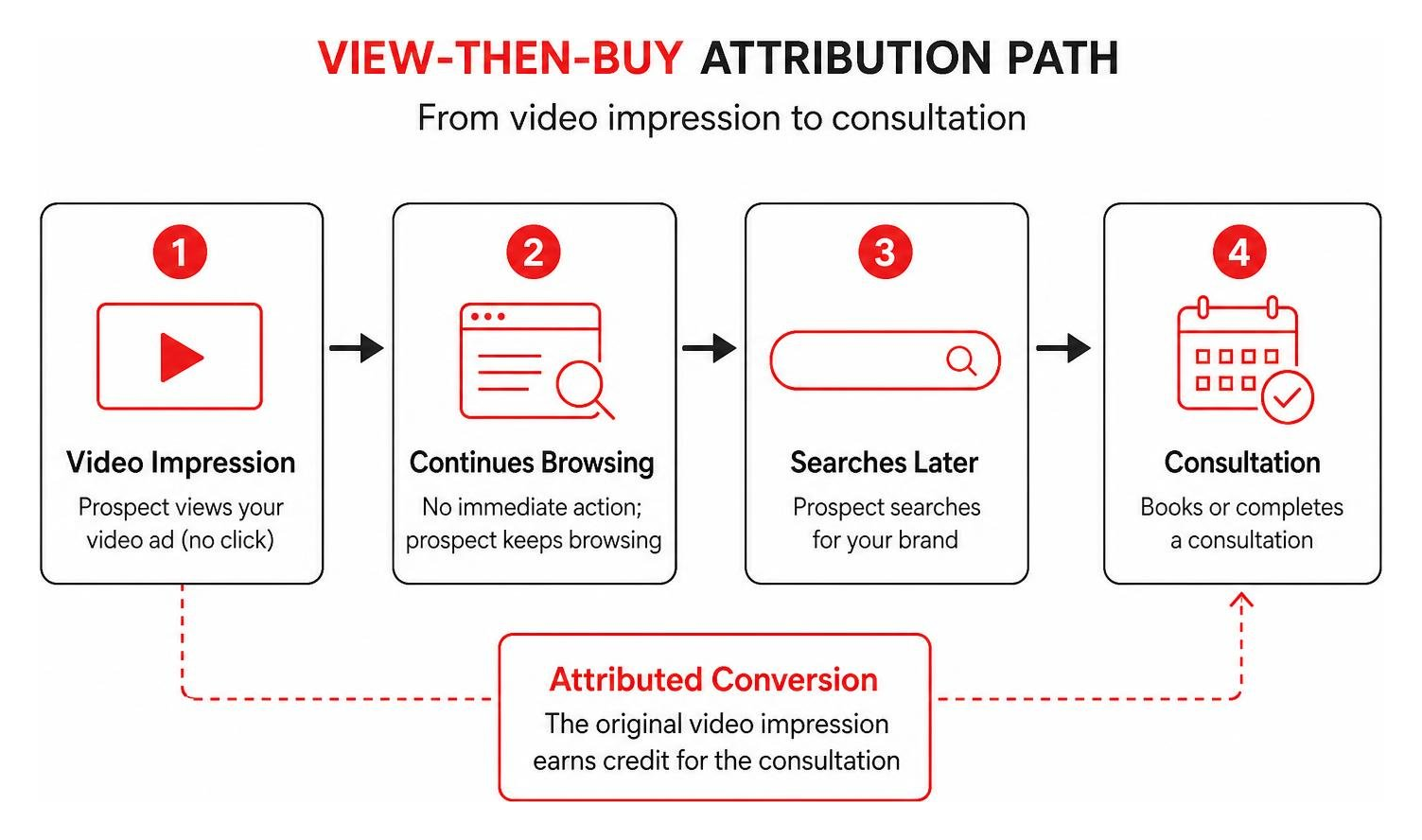
Modern consumer behavior rarely follows a straight line. Many prospective clients view a video ad on YouTube or social feeds, avoid clicking immediately to continue their browsing, and search for the brand later to make contact. These are known as view-through conversions (VTCs).
Modern bidding systems utilize advanced artificial intelligence to evaluate user propensity across multi-touch journeys. By integrating view-through data within your attribution models, you capture the broader impact of your awareness campaigns, ensuring that bidding engines allocate budget toward campaigns that drive genuine pipeline value rather than just immediate clicks.
How to Diagnose and Prioritize Your Funnel Leaks
Many marketing funnels fail to convert because businesses attempt broad redesigns without pinpointing where drop-offs actually occur. A conversion funnel is a multi-step sequence where compounding drop-offs dictate final outcomes.
For instance, consider a four-step lead sequence converting at 50%, 40%, 60%, and 70% across its individual stages. The cumulative end-to-end conversion rate is only 8.4%. Lifting the weakest step from 40% to 50% increases the total conversion rate to 10.5%—a gain of over two full percentage points without spending an extra dollar on traffic.
Finding the Worst Drop-Off Step Across the User Journey
To patch funnel leaks effectively, analyze step-by-step visitor loss rather than broad site-wide metrics. A step losing 30% of 10,000 visitors costs substantially more potential revenue than a later step losing 60% of 200 visitors.
Common friction areas across digital intake flows include:
- Requiring sensitive information too early in the engagement process
- Unclear next steps after a form submission
- Lack of reassurance regarding data confidentiality and security
- Slow page responses when submitting intake forms
Addressing these friction points across professional services funnels helps streamline user progression from initial landing to final contact.
Aligning Ad Copy, Message Match, and Quality Score
When a user clicks an ad promising a specific solution, the destination page must reflect that exact messaging in its primary headline. Any disconnect creates cognitive friction, driving visitors away.
Strict message match reassures visitors they have arrived at the right place, directly improving ad network Quality Scores. Higher Quality Scores lower your effective CPC and improve ad placement, creating a compounding advantage in your acquisition economics.
High-Impact Landing Page Strategies That Drive Results
A high-converting landing page is built on clarity, focused visual hierarchy, and strategic friction reduction. Rather than treating a landing page like an expansive corporate website, structure it around a single conversion goal using proven landing page optimization techniques.
Core Landing Page Elements to Optimize for Conversions First
When launching landing page tests, prioritize high-impact structural components over minor cosmetic details:
- The Primary Headline: State your core value proposition clearly above the fold.
- The Call-to-Action (CTA): Use specific, commitment-matched language (e.g., “Request Your Case Evaluation” instead of “Submit”).
- The Intake Form: Keep required initial fields minimal to reduce cognitive burden.
- Hero Visuals: Use contextual imagery that reinforces credibility rather than generic stock graphics.

Reducing Technical Friction, Page Speed Lag, and Form Barriers
Technical performance directly governs user action. A site loading in 1 second achieves an average conversion rate of 39%, but that rate drops to 18% when load time increases to 6 seconds. In fact, every additional second of load time reduces overall conversions by an estimated 7%.

Because more than 61.5% of web traffic originates from mobile devices, implementing responsive, lightweight layouts is critical. Applying profitable web design principles ensures touch targets are accessible, code is streamlined, and page assets load instantly. For lengthy intake questionnaires, switching to multi-step or conversational formats helps improve completion rates by presenting questions in manageable stages.
Strategic Trust Signals and Social Proof Placement
Trust signals are most effective when placed adjacent to conversion decision points. If a user hesitates before submitting a form, placing recognizable credibility markers directly beneath the button provides reassurance.
Key trust elements include:
- Real, outcome-driven client testimonials
- Professional accreditations and industry association badges
- Clear statements outlining privacy protection
- Transparent explanations of what occurs after contact
Measuring Real Performance: Beyond Surface-Level Clicks
Optimizing digital assets requires looking past surface-level metrics like bounce rates and raw clicks. To prevent false positives in testing, programs must be measured against macro business milestones. Partnering with professional conversion rate optimization services helps establish rigorous testing frameworks that connect front-end adjustments directly to operational metrics.
Tracking Downstream Pipeline and Revenue Metrics
A test that doubles raw form completions is counterproductive if lead quality deteriorates and your team spends hours filtering spam. Connecting offline conversion imports from your CRM back to your advertising platforms ensures your bidding systems optimize for qualified client revenue rather than unvetted submissions.
Implementing a streamlined intake management process bridges the gap between digital marketing and client onboarding, preserving lead value from first contact through resolution.
Segment-Level Testing vs. Misleading Site-Wide Averages
Site-wide conversion rates can mask underlying performance issues. A 3% average conversion rate might conceal a 6% conversion rate on desktop traffic alongside a 0.8% conversion rate on mobile devices.
Always segment experimentation data across:
- Traffic Sources: Paid search, display campaigns, organic traffic, and direct visitors
- Device Profiles: Mobile, desktop, and tablet screen dimensions
- Geographic Locations: Local metro areas versus broader regional traffic
- Audience Types: New prospects versus returning visitors
Evaluating data at the segment level prevents misleading averages from obscuring actionable opportunities.
Eliminating Dev Bottlenecks with AI and Automation
Traditional testing workflows frequently stall due to lengthy development cycles. Modern optimization workflows leverage AI and visual-first experimentation engines to draft, deploy, and allocate traffic to winning variations dynamically.
By utilizing automated traffic allocation models, teams can run multi-variant tests safely without waiting months for traditional statistical significance on lower-traffic pages. The Houston-based digital marketing team at Triple Digital specializes in eliminating these technical bottlenecks to turn clicks into clients.
Frequently Asked Questions About Conversion Optimization
What is the difference between optimizing for clicks and optimizing for conversions?
Optimizing for clicks instructs ad networks to find users most likely to interact with an ad, regardless of intent. Optimizing for conversions focuses algorithms on finding users who exhibit high purchase or inquiry intent, lowering your true cost per acquired client.
How much traffic is required before running reliable conversion tests?
Classical A/B tests require hundreds of conversion events per variant to achieve standard statistical confidence. For lower-traffic pages, teams can utilize directional Bayesian testing methods, evaluate micro-conversions, or implement larger structural adjustments rather than minor cosmetic tests.
Why do most conversion rate optimization experiments fail to produce winners?
Industry data indicates that only about 12% of conversion rate experiments produce clear winning results. Most tests fail because they focus on superficial adjustments—like button colors—rather than addressing core value propositions, load speeds, messaging relevance, or user friction.
Transforming Traffic into Long-Term Business Growth
Sustainable paid acquisition relies on conversion efficiency. When you systematically identify funnel drop-offs, align messaging from ad to landing page, and optimize for downstream value, you build a resilient client acquisition engine.
Instead of burning budget on empty clicks, focus your resources on turning qualified traffic into measurable business growth. To review your paid acquisition setup and build a high-performing lead generation engine, schedule a strategy meeting with our team today.