




Balancing Institutional Trust and Consumer Action
When an injured individual lands on your website, they arrive in a state of high stress, cognitive overload, and physical discomfort. Effective personal injury website architecture must bridge two distinct psychological needs: the institutional credibility of an authoritative portal and the frictionless ease of high-conversion consumer platforms.
If your website looks too bureaucratic, visitors feel overwhelmed and leave. If it looks like an aggressive late-night commercial, they question your legitimacy. Combining authoritative credibility cues with intuitive user journeys creates an environment where injured claimants feel protected and motivated to act. Tailoring these elements requires specialized custom lawyer web design that respects the user’s emotional state while systematically removing barriers to contact.
| Design Attribute | Authoritative Institutional Portals (e.g., IRS.gov) | High-Velocity Consumer Apps (e.g., Fast Food / Retail) | Ideal Personal Injury Law Hybrid Model |
|---|---|---|---|
| Primary Goal | Task resolution, absolute trust, clarity | Instant conversion, minimal friction, speed | Trust validation paired with rapid case evaluation |
| Navigation Style | Task-based categorization (“What do you need?”) | Visual visual menus, promotional cards | Visual incident grids with guided self-selection |
| Call to Action | Secure login, search records, file details | “Order Now,” prominent special offers | “Free Case Evaluation,” direct click-to-call |
| Trust Mechanism | Official seals, security badges, statute citations | Customer ratings, delivery guarantees | Verified settlement results, client testimonials, bar credentials |
| Interaction Speed | Structured, multi-step documentation | One-click actions, persistent bottom drawers | Sticky mobile actions, smart two-step intake |
Institutional Credibility: Establishing Unquestioned Authority
Authority is non-negotiable in legal representation. Visitors need immediate confirmation that your firm possesses the resources, trial experience, and ethical standing to handle serious claims. Modern web design for law firms builds this foundation through deliberate visual hierarchy:
- Verified Settlement and Verdict Track Records: Highlight specific case outcomes prominently on the homepage, anchoring financial recoveries to specific injury types without misleading guarantees.
- Board Certifications and Accreditations: Position badges such as Super Lawyers, Martindale-Hubbell, and local Bar Association credentials near high-friction decision points (like contact forms).
- Data Security and Privacy Assurances: Display explicit SSL encryption badges, HIPAA compliance notices for medical records, and clear confidentiality statements to reassure visitors that their intake information remains privileged.
Frictionless UX: Borrowing Conversion Patterns from High-Velocity Consumer Apps
While institutional authority provides reassurance, consumer-grade user experience drives action. High-performing consumer brands excel at making complex actions feel effortless. Incorporating proven tactics to increase law firm conversion rates ensures that once a visitor trusts your firm, reaching out requires zero cognitive strain:
- Persistent Sticky Headers: Keep direct phone numbers and evaluation links visible across all viewports during page scrolling.
- Instant Click-to-Call Mechanics: Feature prominent, tap-friendly phone elements formatted specifically for mobile users seeking immediate assistance.
- Streamlined Value Propositions: Replace dense legal jargon with clear, empathetic messaging highlighting your contingency fee structure (such as “No Win, No Fee”).
User-Centric Information Architecture: From “What Happened?” to Case Intake

A visitor rarely arrives looking for legal definitions; they arrive looking for answers about an incident that disrupted their life. Structuring your architecture around user intent rather than internal law firm silos keeps potential clients engaged. Designing law firm websites that convert requires organizing navigation paths by what the user experienced rather than purely academic legal categories.
Task-Based Navigation in Personal Injury Lawyer Website Design
Taking inspiration from modern public service portals, your primary navigation should quickly answer: “What happened to you today?” By introducing self-selection pathways on the homepage, visitors can self-identify their situation within seconds.
- Incident Selection: Visual pathways for common scenarios (e.g., Auto Collisions, Commercial Truck Crashes, Workplace Injuries, Premises Liability).
- Immediate Guidance: Dynamic landing pages offering immediate, practical guidance on medical documentation, insurance communication boundaries, and critical timelines.
- Frictionless Intake: A streamlined intake pathway supported by building high-performing intake forms embedded directly at the bottom of the guidance page.
Practice Area Menu Categorization Without Cognitive Overload
Presenting twenty different niche practice areas in a generic drop-down menu creates choice paralysis. Instead, draw inspiration from clean, categorized consumer menus by grouping practice areas into distinct visual cards with recognizable iconography.
Maintaining a clean law firm web architecture allows visitors to locate specialized practice areas without sifting through walls of text. Segment your core practice areas into four clear categories:
- Motor Vehicle Collisions: Passenger cars, commercial trucking, rideshare vehicles, and motorcycle incidents.
- Catastrophic & Severe Injuries: Traumatic brain injuries, spinal damage, and severe burn trauma.
- Workplace & Industrial Incidents: Plant explosions, construction accidents, and third-party industrial claims.
- Premises & General Negligence: Slip and fall injuries, negligent security, and wrongful death matters.
High-Converting Homepage Elements and Strategic Trust Architecture
A high-converting homepage serves as an interactive decision matrix. Implementing professional website conversion rate optimization services ensures every visual element—from hero sections to client testimonials—actively reassures the visitor and guides them toward a free consultation.
Deploying High-Impact Social Proof and Settlement Showcases
Social proof is the strongest conversion catalyst in legal marketing. Presenting past successes effectively validates your firm’s capability to take on complex litigation:
- Settlement Carousels with Context: Showcase recoveries alongside relevant case details (e.g., “$2,400,000 – Commercial Vehicle Collision Settlement”) rather than isolated numbers.
- Authentic Video Testimonials: Integrate short, professionally filmed client stories focusing on your firm’s communication, empathy, and advocacy during difficult times.
- Independent Review Integration: Embed verified client review streams directly from Google Business Profile to validate external reputation.
Ethical Urgency: Communicating Statutes of Limitations Constructively
Personal injury claims operate under strict legal deadlines, yet artificial scarcity or aggressive countdown timers damage credibility. Instead, frame urgency as helpful, protective guidance regarding legal timeframes and evidence preservation.
- Statutory Timeframe Notices: Provide clear educational reminders regarding state-specific deadlines for personal injury claims without offering procedural litigation advice.
- Evidence Preservation Advisories: Explain how traffic camera footage, black-box telematics, and commercial records can be overwritten if not preserved promptly.
- Clear Next Steps: Outline legal intake process steps so claimants know exactly what happens after submitting their details, eliminating fear of the unknown.
Mobile-First Performance and App-Like Interaction Standards
Over 70% of initial personal injury web inquiries occur on mobile devices, often while the claimant is away from home, recovering, or dealing with immediate logistical challenges. Our team at Triple Digital prioritizes mobile infrastructure that delivers app-like responsiveness, instant interactivity, and seamless technical execution across every device viewport.
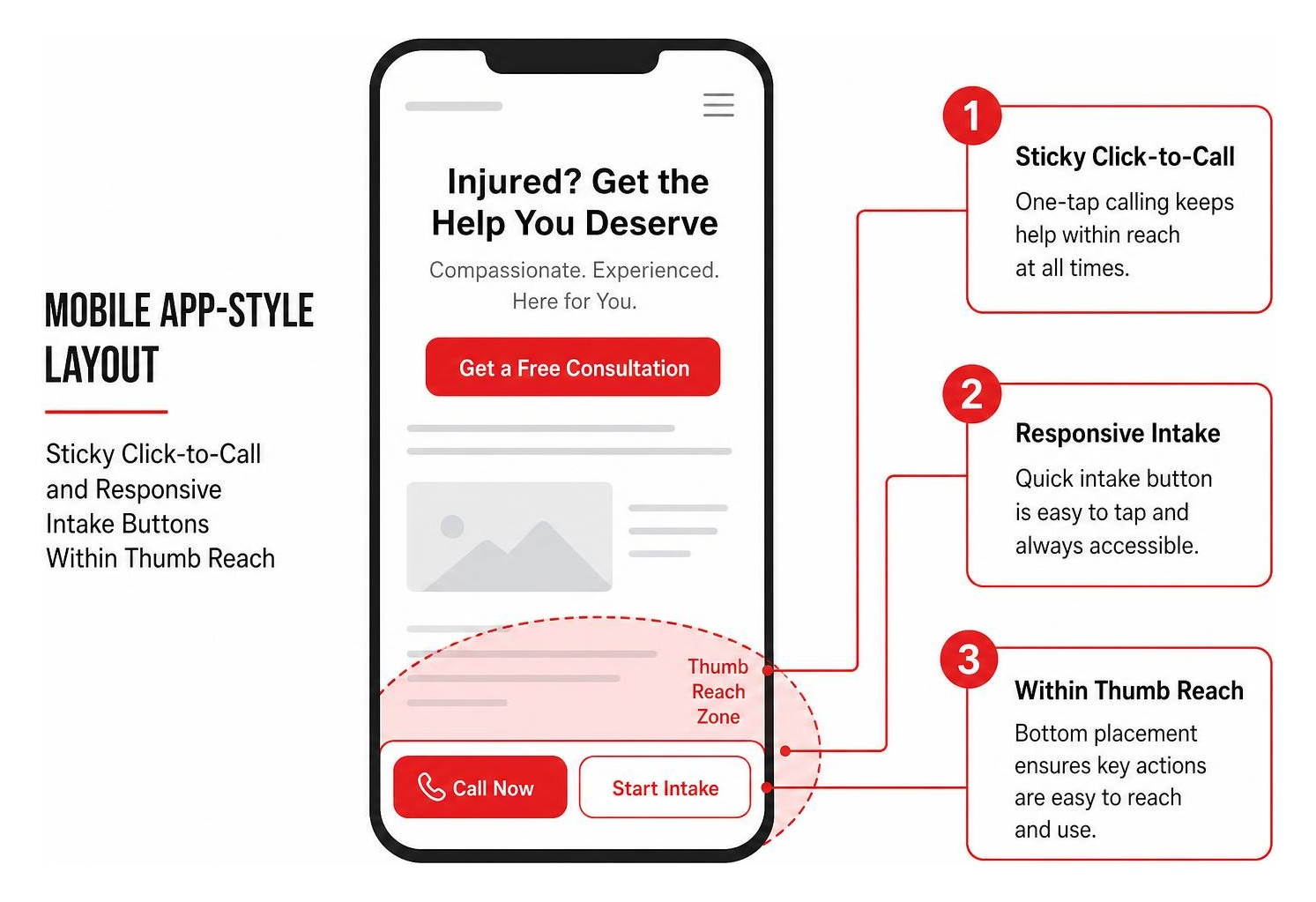
Mobile UX Optimization in Personal Injury Lawyer Website Design
Mobile visitors have lower tolerance for slow load speeds and complex forms. Optimizing for mobile requires aligning technical architecture with natural handheld usage:
- Thumb-Zone Navigation: Place critical conversion triggers—such as tap-to-call buttons and quick intake forms—within easy reach of the user’s thumb at the bottom of the screen.
- Automated AI Intake Chat: Provide an interactive chat module that allows injured visitors to answer basic screening questions asynchronously without waiting on hold.
- Lightweight Asset Loading: Compress scripts, stylesheets, and visual assets to guarantee sub-two-second load speeds over cellular networks.
Interactive Portals and Post-Intake Transparency Dashboards
Borrowing functionality from modern client dashboards, leading firms use interactive client portals to provide ongoing case clarity. After initial contact, offering transparent case milestones reduces inbound status inquiries and improves client satisfaction. This structured operational workflow directly supports your efforts in generating qualified personal injury leads by creating a reliable, modern intake ecosystem.
Frequently Asked Questions About Legal Website Strategy
How fast must a personal injury law firm website load on mobile devices?
Your mobile site should achieve an interactive load time of under 2.0 seconds, meeting Google’s Core Web Vitals thresholds for Largest Contentful Paint (LCP under 2.5s) and First Input Delay. Slow loading directly increases bounce rates for time-sensitive legal queries. Maintaining technical speed standards is fundamental to executing essential website SEO for attorneys.
What is the most effective placement for Free Case Evaluation forms?
The most effective configuration combines a simplified two-step intake form above the fold on desktop and a persistent, sticky bottom CTA drawer on mobile. Implementing these landing page optimization tips minimizes form abandonment by capturing preliminary incident details before requesting personal contact information.
How do modern PI websites balance conversion design with AI search visibility?
Modern sites balance both priorities by integrating structured Schema markup (such as LegalService and Attorney schemas) with clear, informational copy answering specific legal questions. This architecture allows search engine algorithms to surface your content while preserving high conversion rates, supporting your strategy for ranking in Google AI Overviews.
Elevate Your Firm With High-Performance Web Design
Transforming your law firm website into a reliable source of qualified client inquiries requires an intentional balance of institutional authority, frictionless UX, and technical execution. At Triple Digital, our Houston-based team delivers a straightforward, results-driven approach that combines data mining with conversion-focused web architecture to help modern practices grow. Explore our strategic framework for choosing the best lawyer website design firm for your practice and upgrade your digital client acquisition today.