




Web Conversion Optimization: What Is It and Why Does It Matter?
How to Improve Website Conversions
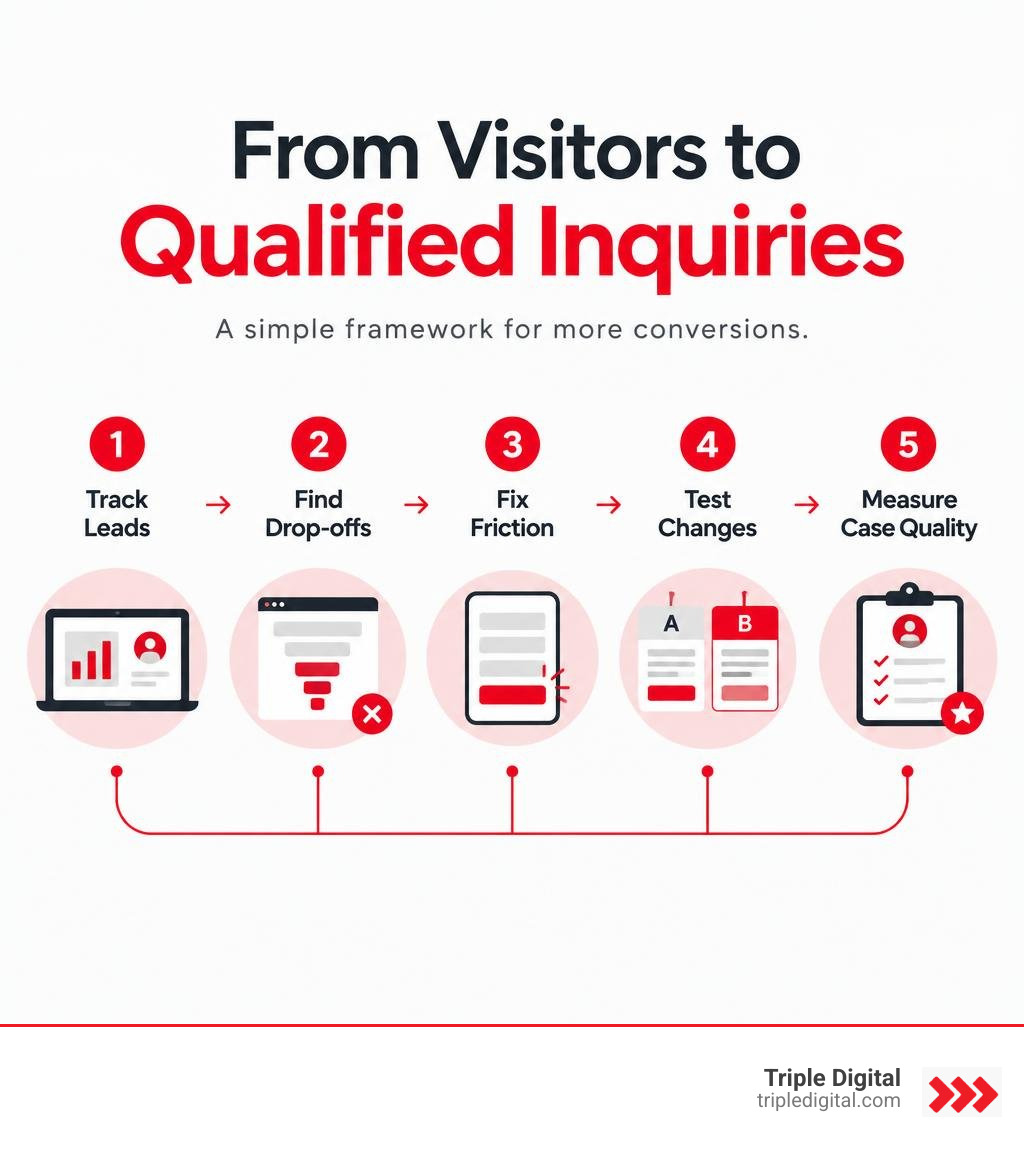
Web conversion optimization means helping more visitors take a valuable action. Start by tracking how many visitors contact your firm or submit an intake form. Then find where they leave, make the next step clearer, and remove friction from forms and mobile pages. Test each change and keep what brings in more qualified inquiries, not just more clicks.
This matters when traffic is hard to earn: a better website can generate more leads from the visitors you already have.
I’m Paul Taylor, President of Triple Digital in Houston. I bring more than 28 years of experience in growth strategy and now help law firms use web conversion optimization to turn inquiries into signed clients.
Related content about web conversion optimization:
Fundamentals of Web Conversion Optimization: Metrics, Formulas, and Benchmarks
Every digital growth strategy begins with traffic acquisition, but acquiring visitors has never been more expensive. As search engines deploy generative overviews and paid ad auctions become fiercely competitive in 2026, relying purely on volume is a losing game. Winning requires extracting significantly higher yield from the audience you already command.
To manage conversion effectively, we divide actions into two clear groups:
- Macro Conversions: The primary business outcomes that drive revenue. These include completing an intake consultation request, booking an appointment, calling an office directly, or submitting an application.
- Micro Conversions: The smaller behavioral milestones that signal intent along the journey. These include downloading a comprehensive guide, viewing a specific practice area page, watching a client case study video, or clicking an interactive fee calculator.
Understanding these behaviors allows you to master your economic levers. Tracking both levels within our comprehensive conversion rate optimization strategy guide helps identify where potential clients abandon the journey before they ever talk to your intake staff. Improving conversion metrics reduces your overall Customer Acquisition Cost (CAC) and lowers your Cost Per Lead (CPL) by converting higher percentages of existing traffic into retained clients.
Calculating Conversion Rates and Pipeline Impact
Measuring your performance requires simple, consistent arithmetic. The baseline formula for your conversion rate is:
Conversion Rate (%) = (Total Unique Conversions / Total Unique Visitors) × 100
For example, if your landing page receives 5,000 visitors per month and yields 150 completed contact forms, your conversion rate is 3%.
When setting growth goals and building pipeline revenue models, use two essential calculations:
Net New Clients Formula: Net New Clients = Total Website Visitors × Conversion Rate × Lead-to-Client Close Rate
Lead Generation Target Formula: Required Leads = Desired Revenue Target / (Average Case Value × Lead-to-Client Close Rate)
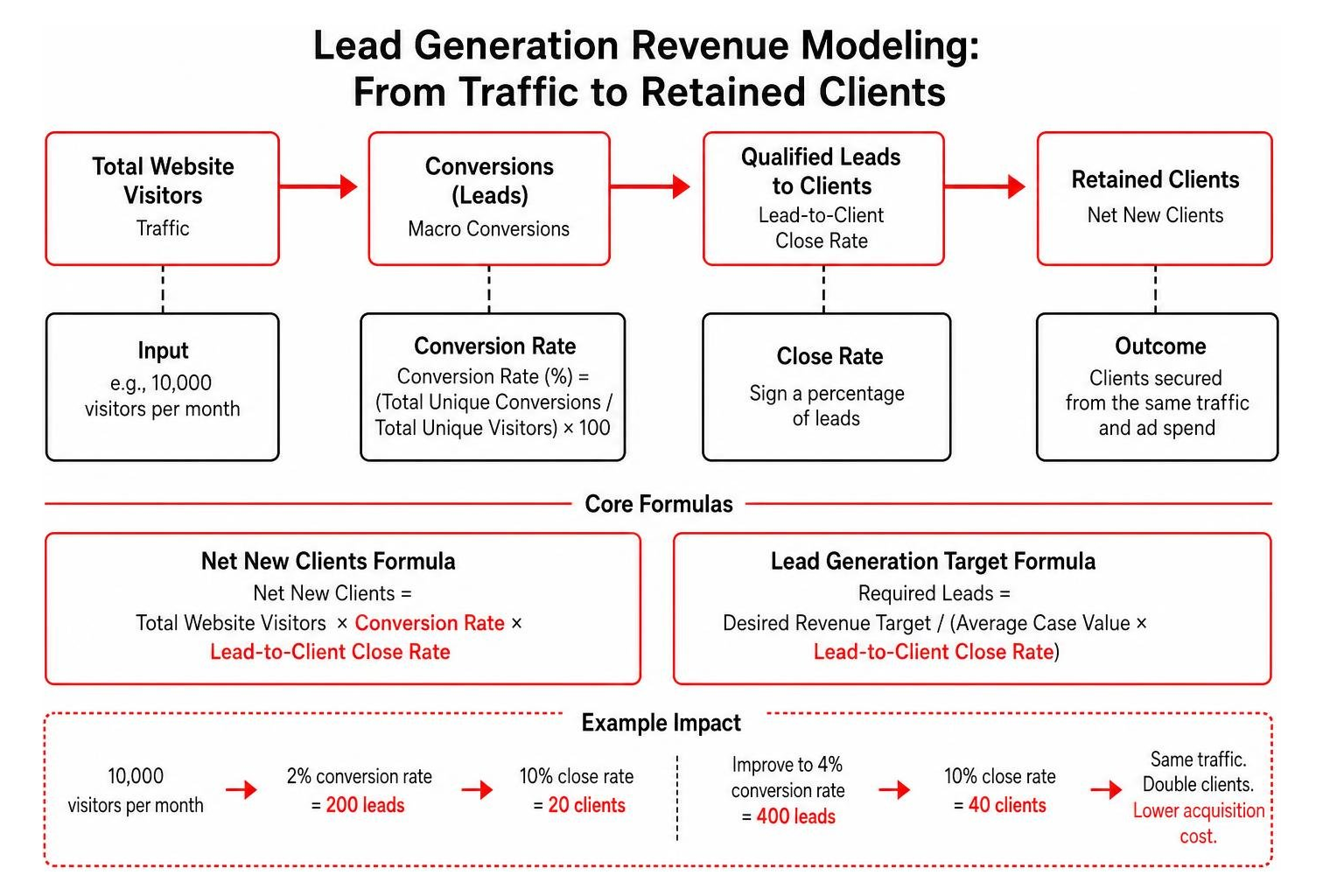
Consider how this transforms firm economics: if you receive 10,000 visitors per month at a 2% conversion rate, you generate 200 leads. If your team signs 10% of those leads, you secure 20 clients. By applying proven tactics to optimize conversions and lower acquisition costs, increasing that website conversion rate to 4% doubles your lead volume to 400. That produces 40 retained clients from the exact same ad spend and traffic volume, effectively slashing your acquisition cost in half.
Conversion Rate Benchmarks Across Key Industries
While industry benchmarks provide general guidance, context determines what qualifies as strong performance. High-friction, high-value professional services operate under very different conversion dynamics than low-ticket retail.
| Industry Vertical | Average Website Conversion Rate | Top 10% Quartile Performance | Primary Conversion Action |
|---|---|---|---|
| Legal & Professional Services | 2.1% – 4.5% | 7.5%+ | Intake Form / Phone Consultation |
| B2B Lead Generation & SaaS | 1.8% – 3.2% | 5.8%+ | Demo Request / Trial Signup |
| Financial Services & Banking | 1.5% – 2.8% | 5.0%+ | Application Start / Quote Request |
| Beauty & Personal Care | 4.8% – 5.4% | 8.2%+ | Direct Checkout Transaction |
| Luxury & High-Ticket Retail | 0.7% – 1.2% | 2.5%+ | E-Commerce Purchase / Inquiry |
Across all digital sectors globally, the baseline average conversion rate sits around 2.74%, with general website averages frequently hovering around 1.7%. Noticeably, mobile devices convert at roughly half the rate of desktop computers across complex services. Mobile visitors seek immediate answers, whereas desktop users often conduct detailed research before submitting personal information.
High-Impact On-Page Strategies to Turn Traffic into Leads
Converting traffic into inquiries requires intentional visual architecture. A visitor lands on your page and makes a subconscious judgment within 50 milliseconds. If the page feels cluttered, generic, or confusing, they will bounce immediately back to the search results.

To capture and hold attention, your layout must respect proven visual hierarchy:
- The Dominant Headline: Must explicitly articulate your core value proposition above the fold. State exactly what you do, who you serve, and the primary benefit you deliver.
- Search Intent Match: The message on the landing page must mirror the precise intent of the search query or advertisement that brought the visitor there. When exploring actionable landing page conversion tips, you will find that message mismatch is the single fastest way to destroy user trust.
- Scannable Layouts: Use short paragraphs, clear section headers, and bold benefit statements. Online readers scan in F-shaped patterns; placing critical evidence along their natural reading path ensures key messages register before they scroll away.
High-Converting Call-to-Action Architecture
Your Call-to-Action (CTA) is the gateway between passive browsing and active engagement. Generic phrasing like “Submit” or “Click Here” signals effort without communicating value.
To maximize responsiveness, implement these CTA principles:
- High-Contrast Styling: Your primary CTA button should use a color that contrasts sharply with the rest of your site palette, ensuring it stands out immediately on any screen.
- Value-Driven, Action-Oriented Copy: Replace passive text with active commitments that emphasize the benefit to the user. Instead of “Submit Form,” use “Request Your Confidential Consultation” or “Claim Your Case Evaluation.”
- Strategic Placement: Ensure your main CTA appears prominently above the fold for immediate action, reappears logically as the user reads your qualifications, and remains anchored on mobile screens as a persistent, thumb-friendly sticky button.
Structuring these interaction points properly aligns directly with the natural sales funnel optimization stages, guiding prospective clients smoothly from initial interest to direct contact.
Frictionless Form Design and Intake Flow
Every extra input field you add to a contact form introduces friction and lowers the likelihood of completion. Research consistently indicates that reducing form fields from seven down to three or four can lift conversion rates by 20% to 50%.
To eliminate unnecessary intake friction:
- Request Only Essential Information Initially: Collect only the visitor’s name, phone number, email address, and a brief description of their situation on the initial web form. Detailed background questions can be handled during the intake follow-up.
- Utilize Multi-Step Form Logic: For complex evaluations, break the form into progressive, bite-sized steps with a visual progress bar. Asking low-friction questions first (such as “What type of assistance do you need?”) builds psychological momentum before requesting contact details.
- Incorporate Inline Validation and Smart Autocomplete: Show real-time checkmarks as fields are completed correctly, and enable browser autofill for contact details. Nothing frustrates mobile users more than submitting a form only to have it reload with confusing, red error messages.
Our team at Triple Digital focuses extensively on designing high-converting case management intake form design workflows that capture qualified prospects cleanly. Pairing intuitive forms with automated client intake software solutions ensures every submission is routed instantly to your team, preventing valuable inquiries from going cold.
Trust Signals and Social Proof Placement
High-intent decisions, especially in professional services, carry emotional weight and perceived financial or legal risk. To persuade a visitor to reach out, you must provide clear proof of credibility right at the point of decision.
Applying Dr. Robert Cialdini’s established principles of persuasion—specifically social proof, authority, and liking—builds genuine confidence. Placing specific, verifiable social proof directly adjacent to forms and CTA buttons can lift conversion rates by 10% to 30%.
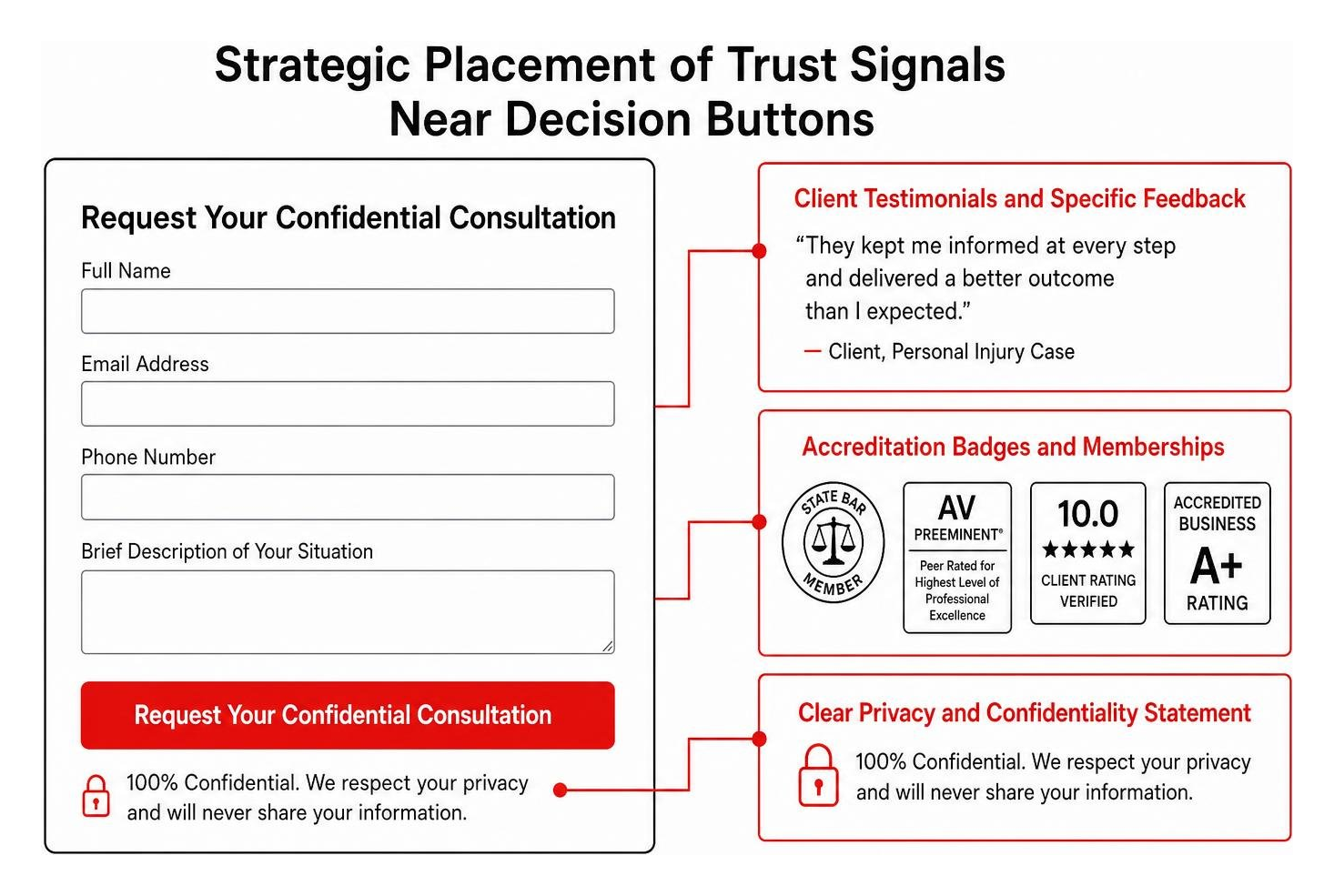
Incorporate these trust elements across your key conversion areas:
- Client Testimonials and Specific Feedback: Use genuine quotes that speak to clear outcomes, communication responsiveness, and peace of mind. Specificity builds authenticity.
- Accreditation Badges and Memberships: Prominently display professional association seals, verified rating badges, and state bar certifications.
- Clear Privacy and Confidentiality Statements: Add a simple micro-copy note beneath the submission button stating: “100% Confidential. We respect your privacy and will never share your information.”
Technical Performance, Mobile UX, and Friction Removal
You can craft compelling copy and persuasive designs, but if your website takes several seconds to load, potential clients will abandon the page before reading a single word.

Site performance directly impacts bounce rates. As page load time increases from 1 second to 3 seconds, the probability of a bounce increases by 32%. If load time stretches to 5 seconds, bounce probability climbs to 90%. Over 53% of mobile users abandon pages that take longer than two seconds to render. Speed is not just a technical preference; it is a fundamental conversion metric.
Page Speed Optimization and Core Web Vitals
To keep visitors engaged, your technical infrastructure must satisfy Google’s Core Web Vitals, with particular focus on Largest Contentful Paint (LCP), which measures when the main visual content is fully rendered:
- Aggressive Image and Asset Compression: Convert imagery to modern next-gen formats like WebP or AVIF, and serve responsive image sizes based on device screen dimensions.
- Implement Robust Browser Caching and CDN Infrastructure: Utilize Content Delivery Networks (CDNs) to distribute static site assets across global edge servers, delivering files from the location closest to the visitor.
- Eliminate Render-Blocking Scripts: Minify CSS and JavaScript, and defer non-critical third-party tracking scripts until after the core interactive elements of the page have loaded completely.
Mobile-First Conversion Architecture
Over 60% of all global web traffic originates from mobile devices, yet mobile conversion rates regularly trail desktop. The reason is simple: desktop pages crammed onto small touchscreens create unnecessary user friction.
A true mobile-first conversion layout requires:
- Designing for the Natural Thumb Zone: Place primary navigation buttons and core interactive elements within easy reach of the user’s thumb when holding the device in one hand.
- Click-to-Call Buttons: Mobile users in need of urgent consultation prefer immediate phone contact. Prominently display a sticky “Call Now” button at the base of the mobile viewport.
- Touch-Friendly Form Inputs: Use appropriately sized input fields with proper HTML input types (
type="tel"for phone numbers,type="email"for email addresses) so mobile operating systems automatically display the correct keyboard layout.
Systematic Experimentation: Tools and Testing Methodologies
Guesswork has no place in a mature growth strategy. Systematic web conversion optimization relies on a rigorous balance of quantitative metrics (what is happening on your site) and qualitative insights (why visitors behave the way they do).
Combining quantitative web analytics with dedicated data-driven lead generation tracking reveals exact funnel leakage points. Meanwhile, qualitative tools—such as heatmaps, scroll maps, session recordings, and user usability testing—uncover where users encounter hesitation or frustration. Integrating this data within your overall analytics and data-driven marketing ecosystem transforms raw numbers into clear, actionable testing initiatives.
Prioritising Hypotheses with ICE and PIE Frameworks
Before running a single test, establish a clear hypothesis using an evidence-based format:
“If we [make this specific change] on [this page], then [this conversion metric will improve] because [of this specific user data or insight].”
To prioritize which tests to launch first from your backlog, utilize the established PIE or ICE scoring models:
The PIE Framework:
- Potential: How much improvement is possible on this page?
- Importance: How valuable is the traffic going to this page?
- Ease: How complex and time-consuming is the implementation?
The ICE Framework:
- Impact: What degree of uplift will this deliver if successful?
- Confidence: How certain are we that this hypothesis is correct based on data?
- Ease: What level of engineering, design, and copywriting effort is required?
Score each candidate test from 1 to 10 on each metric, average the scores, and prioritize your experimentation pipeline based on the highest-ranking initiatives.
Executing Rigorous A/B and Multivariate Tests
A/B testing evaluates two distinct versions of a page element against one another by splitting incoming traffic evenly between Version A (the control) and Version B (the variation).
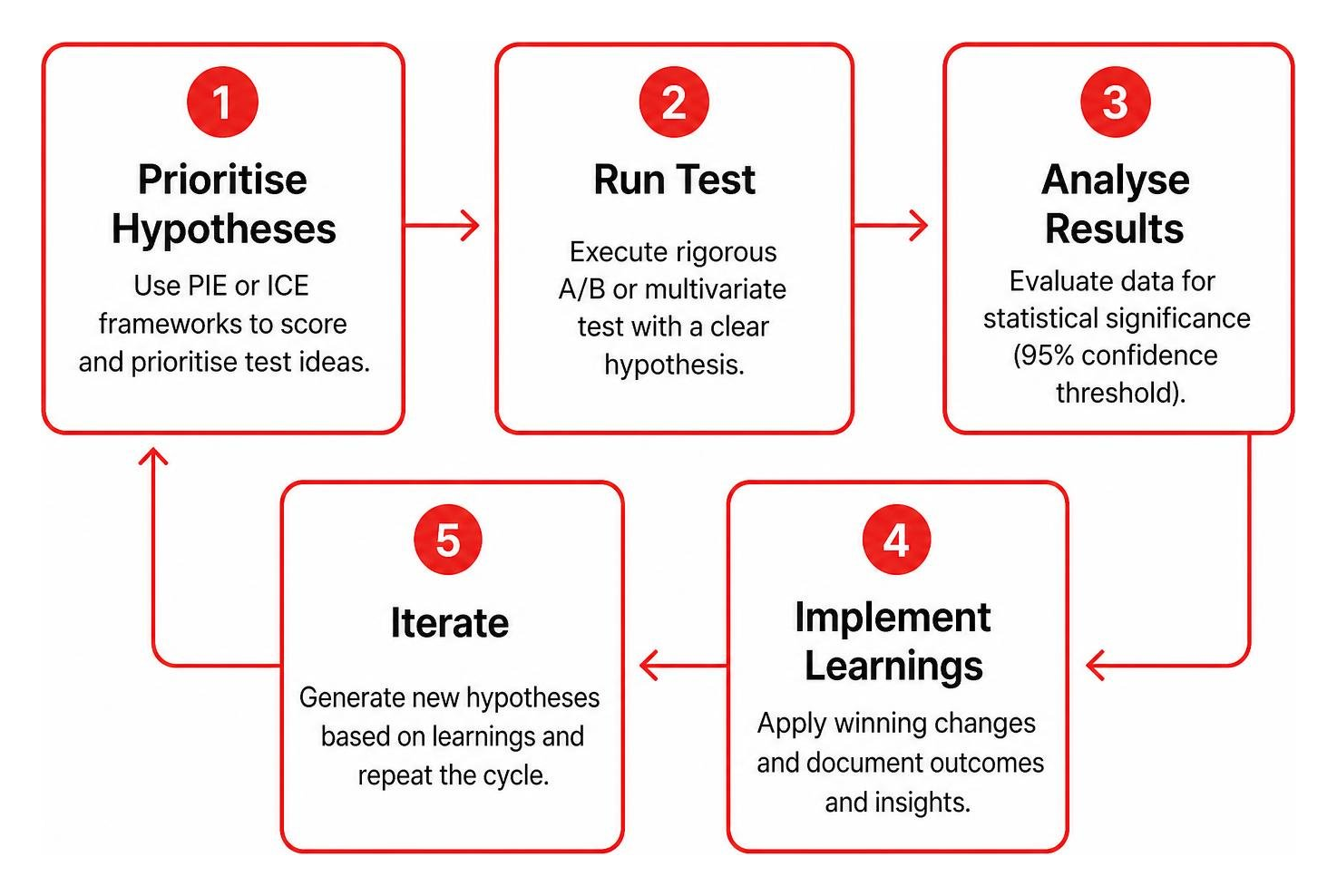
To maintain scientific integrity during experimentation:
- Isolate Single Variables for Standard Tests: When testing headlines, button colors, or form lengths, change only that specific element so you can definitively attribute any measured lift.
- Calculate Necessary Sample Size in Advance: Never end an experiment early simply because an initial spike appears promising. Use statistical sample size calculators to determine the exact number of visitors and conversions required to reach validity.
- Maintain a 95% Statistical Significance Threshold: Ensure your testing platform confirms at least a 95% confidence level, meaning there is less than a 5% chance the observed outcome occurred by random chance.
- Document Every Experiment: Keep a shared repository recording the hypothesis, test variants, quantitative outcomes, and strategic learnings for every test run—including failed variations.
Integrating Search and Continuous Optimization Frameworks
Conversion optimization and Search Engine Optimization (SEO) are complementary disciplines. SEO drives qualified, high-intent traffic to your website, while CRO turns that traffic into phone calls and consultations.
Search engines heavily factor user experience metrics—such as bounce rates, dwell time, and interaction signals—into organic search rankings. When you improve on-page clarity, accelerate loading speed, and provide immediate answers that satisfy search intent, your engagement signals strengthen, supporting long-term organic search performance.
Aligning Search Intent with Web Conversion Optimization Tactics
A common point of failure occurs when a user searches for a specific topic, clicks an organic link, and arrives on a generic homepage. To maximize conversion yield:
- Map Keyword Intent to Landing Experience: Informational search queries need educational content paired with lightweight micro-conversion upgrades (such as practical checklists or downloadable guides), while commercial, high-intent search terms must route directly to conversion-focused practice landing pages.
- Maintain Tight Message Match: The headline of your landing page must directly echo the theme and language of the search query that brought the user there, immediately reassuring them they have reached the right place.
- Streamline the Path to Contact: Provide contextual internal links and embedded intake forms directly within in-depth educational resources, capturing readers when their interest is highest.
Implementing a Sustainable Web Conversion Optimization Process
Sustainable business growth does not come from a single website redesign. Redesigns often introduce new assumptions without testing what previously worked. Growth comes from an ongoing, repeatable optimization cycle:
- Step 1: Collect Data: Continuously monitor analytics, session recordings, and form drop-off funnels.
- Step 2: Formulate Hypotheses: Identify friction points and draft data-backed improvement hypotheses.
- Step 3: Prioritize Backlog: Score testing opportunities using the ICE or PIE framework.
- Step 4: Execute Experiments: Run controlled A/B or multivariate tests until reaching statistical significance.
- Step 5: Deploy and Iterate: Hard-code winning variations into production and use the findings to inform the next round of testing.
Firms seeking consistent, data-backed execution often partner with specialized website conversion rate optimization services to manage this experimentation pipeline and deliver repeatable, compounding returns.
Frequently Asked Questions About Web Conversion Optimization
What is the average timeframe required to see measurable results from web conversion optimization?
Individual A/B tests generally require 2 to 4 weeks to collect sufficient traffic, balance day-of-week fluctuations, and reach a 95% statistical significance threshold. For websites with lower traffic volumes, tests may run 6 to 8 weeks. However, fixing obvious usability friction—such as broken mobile forms, slow hosting infrastructure, or confusing phone links—often yields noticeable improvements in lead volume within days of deployment.
What is the primary difference between client-side and server-side testing?
Client-side testing executes within the user’s web browser using JavaScript to alter the visual presentation of the page after the raw code loads from the server. It is fast to deploy and ideal for testing copy, styling, and visual layouts, though it can occasionally cause a brief visual flicker if not configured properly. Server-side testing renders the variations directly on the web server before the page is transmitted to the user. This approach is better suited for testing complex interactive intake workflows, dynamic pricing engines, or backend database integrations without impacting site speed.
Why do mobile conversion rates consistently lag behind desktop conversion rates?
Mobile conversion rates are typically lower because mobile users operate under different constraints: smaller screen space, touch-keyboard limitations, variable cellular connection speeds, and more frequent environmental distractions. Furthermore, mobile visitors frequently conduct initial preliminary research while on the go, saving lengthy intake forms or detailed document submissions for when they return to a desktop computer. Providing simplified forms, thumb-friendly layouts, and instant one-tap calling significantly narrows this gap.
Driving Sustainable Practice Growth Through Strategic Optimization
Web conversion optimization is the most cost-effective lever available for growing organizations. When you double your website conversion rate from 2% to 4%, you double your incoming consultations and signed cases without spending an extra dollar on traffic acquisition.
Rather than relying on aesthetic hunches or industry trends, sustainable growth requires data-driven iteration, consistent user testing, and a focus on removing friction across every step of the intake journey.
If you are ready to stop losing high-value inquiries and turn your website into a reliable client acquisition engine, schedule a strategy meeting to improve your website conversion rates with our team at Triple Digital today.