





How Artificial Intelligence is Changing the Legal Game
AI for Legal Marketing: The Industry’s Biggest Shift Is Already Here
AI for legal marketing is no longer a future concept — it’s the competitive divide separating growing firms from stagnating ones right now.
Here’s what that means in practice:
How AI is changing legal marketing (quick answer):
| Area | What AI Does for Law Firms |
|---|---|
| Client discovery | Prospective clients now ask ChatGPT and Gemini for lawyer recommendations instead of Googling |
| Content creation | AI drafts blogs, practice area pages, and social posts in minutes |
| Lead intake | AI chatbots and voice agents qualify leads 24/7, including after hours |
| Ad targeting | Predictive analytics prioritize high-intent prospects and reduce wasted spend |
| Search visibility | Generative Engine Optimization (GEO) gets your firm cited inside AI-generated answers |
| Competitive intel | AI monitors competitor activity in near real time to surface gaps you can own |
The numbers tell a stark story. AI-driven search referrals from platforms like ChatGPT, Perplexity, and Gemini surged over 500% in the first half of 2025. Four out of five people now rely on AI-generated summaries for at least 40% of their searches — and once they get an answer, 60% never click through to a website at all.
That last stat is the one that should get every law firm’s attention.
Think about what that means for your firm. A potential client sits down to start a new business, opens ChatGPT, and asks: “Do I need a business lawyer to draft a contract, and who should I call?” If your firm isn’t showing up in that answer, you don’t exist to that person.
Meanwhile, firms that have embraced AI are seeing real results. According to the 2025 Clio Legal Trends Report, firms that adopted AI nearly doubled their revenue over four years — with only a 50% increase in clients and matters. Firms that moved slowly saw the opposite: a 50% decline in revenue over the same period.
This guide breaks down exactly how AI for legal marketing works, what tools and strategies actually move the needle, and how to do it in a way that keeps you on the right side of your bar association’s rules.
AI for legal marketing basics:
- best social media sites for law firms
- data-driven legal marketing
The Shift in Client Acquisition: How AI for Legal Marketing Works
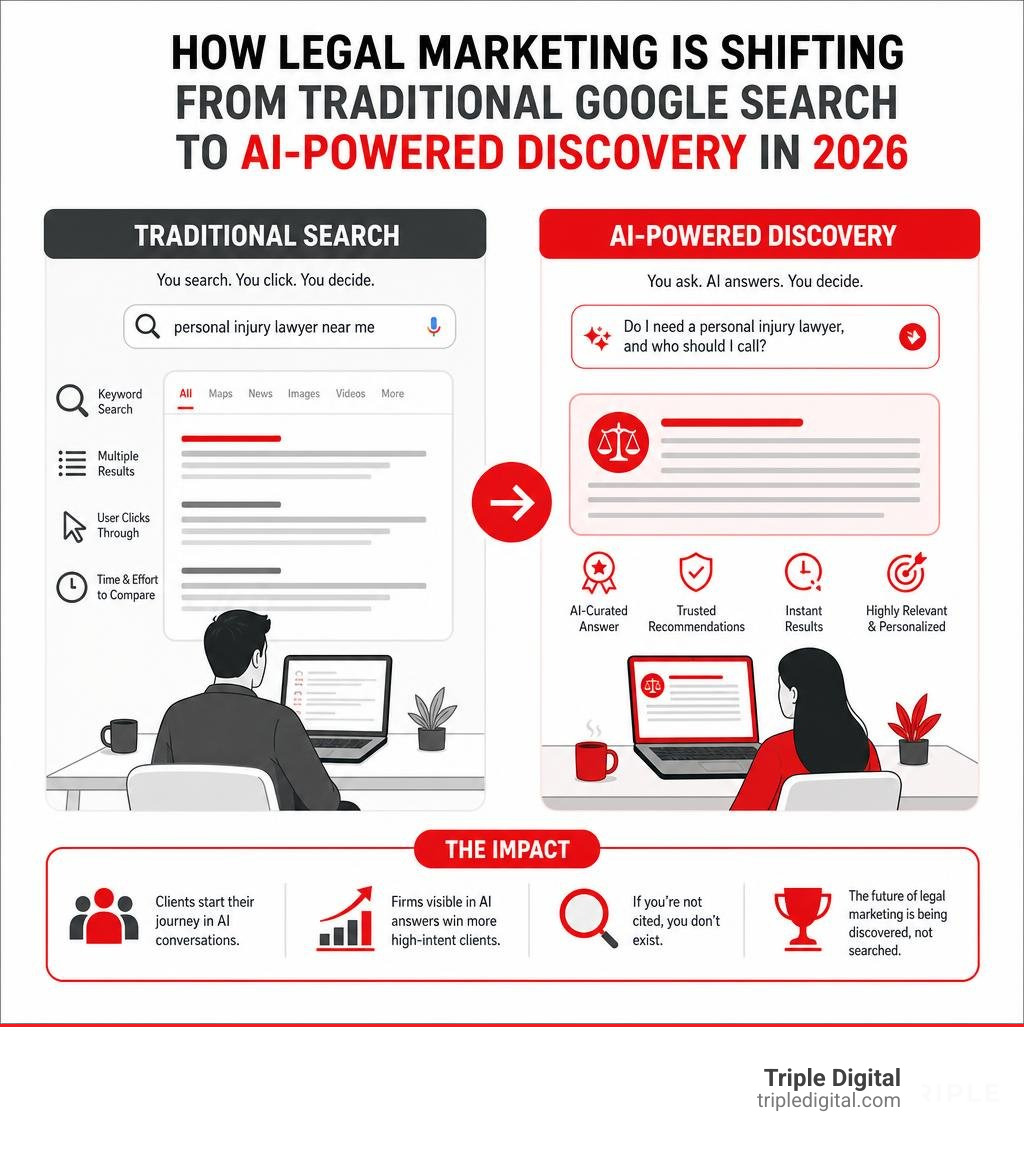
The days when a potential client’s journey began with a simple “business lawyer in Houston” Google search and ended on a static landing page are fading. In July 2026, the modern consumer’s search behavior is conversational, , and heavily reliant on direct answers.
This behavioral shift has introduced the “zero-click search” phenomenon. Instead of scrolling through ten blue links, clicking a website, and evaluating the firm’s credentials, clients are asking AI models to do the filtering for them. They ask complex, long-tail questions like: “I am setting up a new commercial partnership in Houston, we have three co-founders, and we need a custom operating agreement. Do I need a lawyer and who are the top three business law firms nearby with partnership experience?”
AI models analyze indexed data, synthesize the most relevant information, and present a concise summary complete with direct recommendations. If your firm lacks a clear digital footprint that these models can read, you become completely invisible. Transitioning your firm’s strategy to AI-Driven Law Marketing is no longer optional—it is the baseline for modern client acquisition.
To capture these high-intent leads, we must also adapt our marketing to AI Digital Marketing for Law Firms. This means structuring our online presence so that AI search engines recognize our authority, trust, and geographical relevance.
Comparing ChatGPT, Gemini, and Perplexity in AI for Legal Marketing
To build an effective strategy, we must understand the distinct engines powering this new search ecosystem. Each platform relies on different models and retrieval methods to answer user queries:
- ChatGPT (OpenAI): Boasting over 700 million weekly active users, ChatGPT is the market leader in general conversational search. It excels at answering complex, natural language questions and providing personalized advice. When users ask for attorney recommendations, ChatGPT synthesizes information from its extensive training data and live web browsing to suggest firms that have consistent, authoritative mentions across the web.
- Gemini (Google): Gemini is uniquely powerful because it is integrated directly into Google’s ecosystem and powers Google’s AI Overviews. It has direct access to real-time search data and local map pack listings. For local legal services, Gemini heavily relies on Google Business Profile data, local reviews, and established technical SEO signals to deliver answers.
- Perplexity: Functioning as a pure “answer engine,” Perplexity does not just generate text; it curates real-time web searches and presents highly structured summaries with clear, numbered citations. For legal searches, Perplexity is incredibly popular among users who want transparent, verifiable sources before making a decision.
Understanding how these engines differ helps us select the right AI Tools for Law Firm Marketing to measure and improve our visibility across each platform.
Predictive Analytics and Smart Ad Targeting
Beyond organic search, AI is revolutionizing paid client acquisition through predictive analytics. Traditional pay-per-click (PPC) campaigns often result in wasted ad spend on low-intent clicks. AI-driven ad platforms solve this by analyzing historical case data and search behaviors to forecast which prospects are most likely to sign a retainer.
By utilizing Everything You Need to Know About Attorney AI Ad Targeting, we can target ads with surgical precision. AI models analyze signals such as public records, real-time local news, and search trends to place ads in front of users at their exact moment of need. For instance, if a new zoning regulation is passed in the Houston area, predictive algorithms can instantly optimize ad delivery to affected commercial property owners, prioritizing high-intent queries.
Furthermore, applying predictive models allows us to look Beyond the Gavel: Using AI for Predictive Analytics in Legal Proceedings to evaluate case value, helping us allocate marketing budgets dynamically toward the practice areas and case types that generate the highest ROI.
Generative Engine Optimization (GEO) vs. Traditional SEO
As legal marketing evolves, we are witnessing the emergence of Generative Engine Optimization (GEO)—also known as Answer Engine Optimization (AEO)—alongside traditional Search Engine Optimization (SEO).
While traditional SEO focuses on keyword density, backlink quantity, and ranking on the first page of Google, GEO focuses on optimizing your content so that AI engines can easily read, summarize, and cite your firm as a recommended source.
Fortunately, these two strategies are not mutually exclusive. There is a 68% to 75% overlap between content that ranks well in traditional Google search and content cited by AI systems, particularly for Your Money or Your Life (YMYL) topics like legal advice. However, GEO requires a deeper focus on entity clarity, semantic variety, and direct answer formatting.
To help you visualize the shift, we have mapped out how traditional SEO metrics compare to GEO metrics:
| Metric | Traditional SEO | Generative Engine Optimization (GEO) |
|---|---|---|
| Primary Goal | Rank on page one of search engines | Secure citations and recommendations in AI answers |
| Search Query Style | Short, keyword-focused (“Houston business lawyer”) | Long-tail, conversational (“How do I set up an LLC in Houston?”) |
| Success Indicator | Organic website traffic and click-through rates | Discoverability score and brand mentions inside AI tools |
| Content Structure | Long-form articles optimized for keyword variations | Direct Q&A formatting, schema markup, and HTML tables |
| Core Authority Signal | Domain Authority and backlink profile | Entity clarity, brand sentiment, and consistent local citations |
To succeed in this new landscape, we must design a unified strategy that addresses both disciplines. You can read more about this in our guide on Winning the AI Search Trial with Generative Engine Optimization and explore how to implement these changes through professional Guide to AI SEO Services.
Best Practices for Optimizing Your Website for AI Search
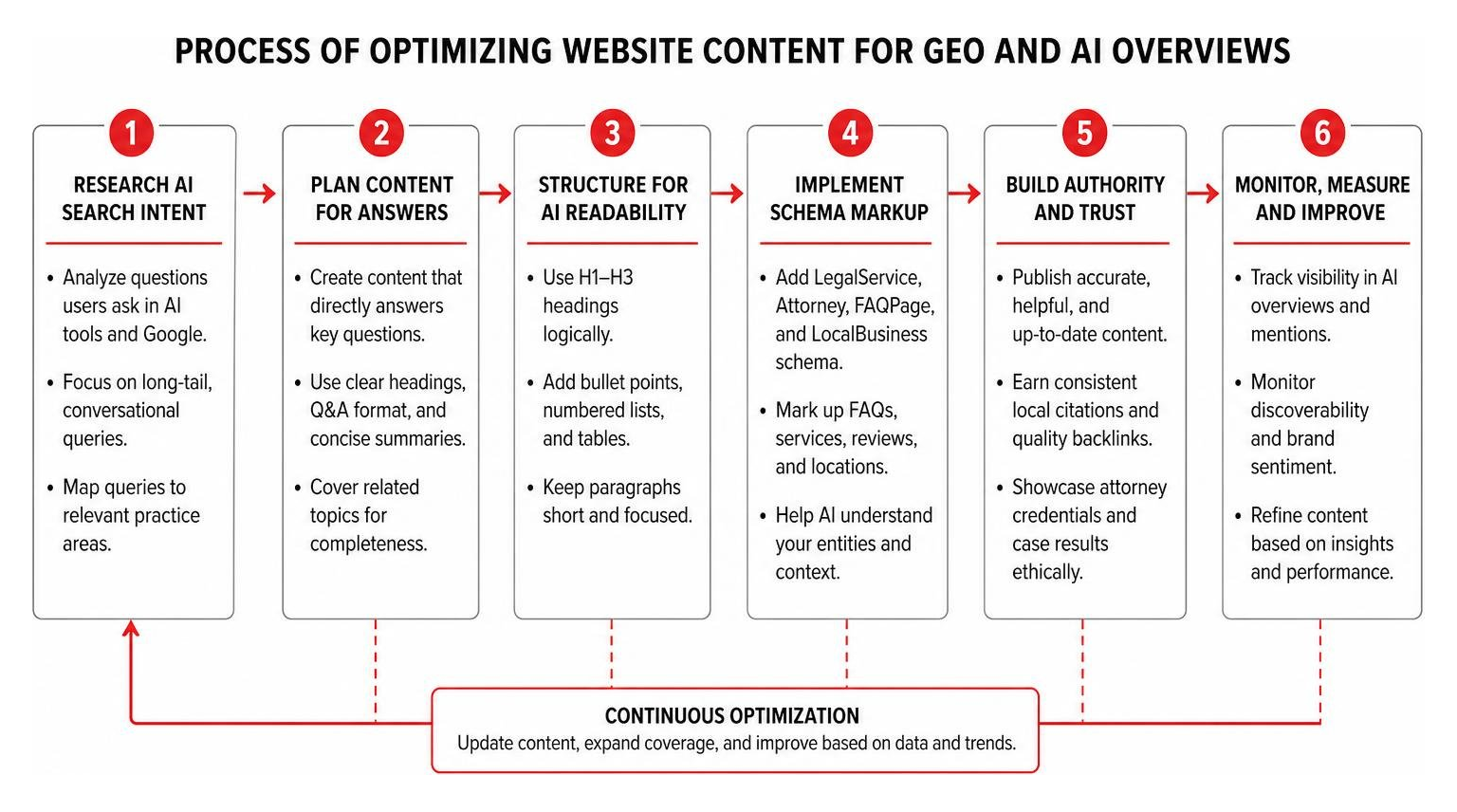
To make your law firm’s website highly readable for AI crawlers, you must implement several technical and structural optimizations:
- Implement Detailed Schema Markup: Use advanced schema markup, including
LegalService,Attorney,FAQPage, andLocalBusinessschemas. This structured data acts as a translator, allowing AI engines to instantly identify your practice areas, attorneys, physical locations, and credentials. - Write for Conversational Queries: Structure your content around natural, conversational questions that clients actually ask. Avoid heavy legal jargon and write in plain, accessible English.
- Provide Direct, Concise Answers: Use a “Q&A” format. Pose a clear question in an H3 heading, and provide a direct 40-to-60-word answer immediately below it before expanding into deeper details. This structure makes it incredibly easy for AI engines to pull your text as a direct summary.
- Build Entity-Rich Content: Name specific courts, local Houston landmarks, Texas statutes, and relevant legal terms. AI models rely on “entity recognition” to connect your firm to specific geographic areas and legal specialties.
For a step-by-step technical roadmap, refer to our Guide to AI Overview Optimization for Lawyers and learn how to navigate Google’s AI Overviews system.
Winning Citations in Google AI Overviews
Google’s AI Overviews place synthesized summaries above traditional organic results, making them the most valuable real estate on the web. To win citations here, your website must demonstrate impeccable E-E-A-T (Experience, Expertise, Authoritativeness, and Trustworthiness).
First, establish topical authority by building comprehensive content clusters. Instead of writing a single, generic page about business law, create a robust pillar page supported by 8 to 12 highly targeted spoke articles addressing specific sub-topics (e.g., “Texas LLC formation requirements,” “How to draft a partnership agreement”).
Second, ensure your attorney biography pages are incredibly detailed. Document your bar admissions, trial experience, specific case outcomes, and publications. AI engines search for these trust signals to verify that your firm is a credible, licensed authority before recommending you to users.
To dive deeper into securing these coveted spots, check out 7 Ways Lawyers Can Win More Cases From AI Overview for Lawyers and our comprehensive Guide to AI Overview for Attorneys.
Streamlining Lead Generation, Intake, and Conversions
Attracting potential clients to your website is only half the battle. If your firm takes hours to respond to inquiries, those leads will quickly move on to a competitor. In the legal industry, responsiveness is the ultimate differentiator.
AI-powered automation allows law firms to establish a 24/7 intake pipeline that qualifies leads, collects essential case details, and schedules consultations instantly. By implementing a Guide to AI Automation for Lawyers, we can eliminate manual bottlenecks, ensuring no high-value case slips through the cracks.
AI Chatbots and Voice Agents for After-Hours Intake
Most legal leads are lost after 5 PM because firms route calls directly to voicemail. Modern AI voice agents and conversational chatbots solve this by managing after-hours communications with human-like responsiveness.
These intelligent agents do not just follow generic scripts; they engage in natural, dynamic conversations. They can ask qualifying questions based on your firm’s specific criteria (e.g., checking for conflict of interest, verifying the type of legal service needed, and confirming their location) and instantly schedule an appointment for qualified leads.
By integrating these tools, we can keep the intake desk open 24/7, dramatically increasing conversion rates without increasing administrative overhead. To explore how to build these systems into your firm, read our Guide to Law Firm AI Strategies.
Measuring ROI and Caseload Growth Metrics
Adopting AI-driven marketing strategies yields measurable, compounding returns. Law firms utilizing specialized legal marketing software see a potential caseload growth of 38% on average. Furthermore, automating routine tasks allows attorneys to capture an average of 5.3 additional billable hours per month (64 hours per year) that would otherwise go unrecorded.
Operational efficiency accounts for 77% of the revenue gains reported by legal professionals using AI. By lowering client acquisition costs (CAC) and accelerating lead-to-client conversion times, firms can scale their revenue rapidly while maintaining a lean operational footprint.
To learn how to project and track these growth metrics for your practice, explore our Guide to AI Lawyer Growth Strategy.
Ethical Guardrails: Compliance, Confidentiality, and Accuracy
While the efficiency gains of AI are undeniable, law firms must navigate strict ethical guardrails. Bar associations across the country—including the State Bar of Texas—have strict rules regarding attorney advertising, direct solicitation, and client confidentiality.
When using generative AI to produce marketing copy, we must ensure that all content is accurate, honest, and entirely compliant with these professional standards. Utilizing The Key to AI Written Content means establishing a rigorous “human-in-the-loop” review process where a licensed attorney evaluates every piece of content before it is published.
Balancing Content Creation with Professional Responsibility
One of the greatest risks of using public generative AI tools is the potential compromise of client confidentiality. Under ABA Model Rule 1.6, attorneys have a strict duty to protect all information relating to the representation of a client. Therefore, we must never input sensitive, private, or identifiable client data into public AI platforms, as these systems may use that data to train future models.
Additionally, we must remain vigilant against AI “hallucinations”—instances where an AI model generates incorrect legal citations or false factual claims. Publishing inaccurate legal information on your website does not just hurt your SEO; it violates your professional responsibility to avoid misleading the public.
To understand how different AI models stack up regarding security and compliance, review our Attorney Generative AI Rankings 2026.
Implementing AI for Legal Marketing Safely
To safely leverage AI for your firm’s digital presence, we recommend adhering to the following best practices:
- Maintain Attorney Oversight: Never automate the direct publishing of AI-generated legal content without a thorough review by a licensed attorney.
- Verify Local Bar Rules: Ensure your ad copy does not make prohibited claims, such as guaranteeing specific case outcomes or claiming “specialist” status unless officially certified by the Texas Board of Legal Specialization.
- Use Secure, Legal-Specific AI Tools: Partner with marketing agencies and software providers that utilize secure, private LLM instances that do not store or share your data.
For specialized guidelines on maintaining compliance while ranking highly in local search, read our Top SEO Tips for Criminal Defense Lawyers in the AI Search Era and see how we help firms outrank competitors safely by reading about how Triple Digital LLC Unveils Groundbreaking AI Tool to Help Law Firms Outrank Competitors Online.
Frequently Asked Questions About AI in Legal Marketing
What is the difference between SEO and GEO for law firms?
Traditional SEO focuses on optimizing your website to rank on the first page of search engines like Google and Bing by targeting specific keywords and building backlinks. GEO (Generative Engine Optimization) focuses on optimizing your content so that conversational AI platforms like ChatGPT, Gemini, and Perplexity can easily parse, summarize, and cite your firm as a recommended source in direct conversational answers.
Is it ethical for attorneys to use AI for content creation?
Yes, it is entirely ethical, provided that a licensed attorney reviews, edits, and verifies the accuracy of all AI-generated content before publication. Attorneys must ensure that the content complies with state bar advertising rules, protects client confidentiality, and contains no misleading or inaccurate legal information.
How does AI improve lead conversion rates for law firms?
AI improves conversion rates by providing instant, 24/7 responsiveness. AI-powered chatbots and voice agents capture leads immediately, qualify them based on specific case criteria, and schedule consultations even after hours, preventing potential clients from slipping away to competitors.
Dominate the AI Search Era with Triple Digital
The digital landscape is changing at a breakneck pace, but one fundamental truth remains: the law firms that adapt to new technology first will always capture the lion’s share of the market.
At Triple Digital, we help Houston-based law firms cut through the technological noise and focus on what actually matters: signing high-value cases. Our USP is simple—we deliver a results-driven, “less fluff, more cases” approach by leveraging cutting-edge AI and advanced data mining for ultra-precise client targeting.
We don’t just optimize for vanity metrics like clicks and impressions. We engineer your entire digital presence—from technical GEO and local SEO to automated intake systems—to maximize your signed retainers and accelerate your firm’s growth.
Ready to outpace your competitors and dominate the AI search era? Schedule a Meeting with our team of legal marketing experts today, and let’s build a data-driven strategy tailored to your practice.