





AI Search Is Here — and Your Law Firm Is Either Being Cited or Being Invisible
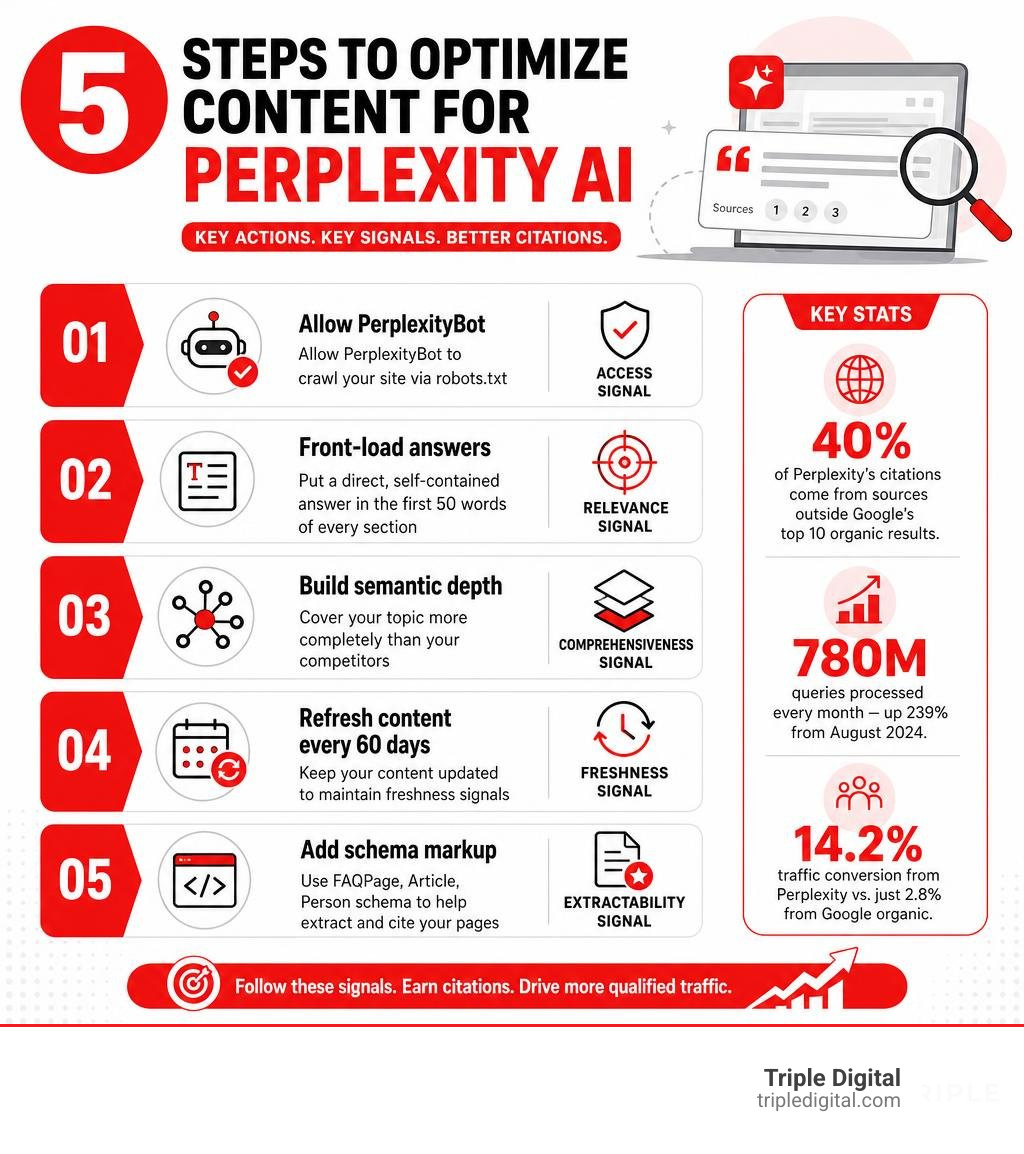
To optimize content for Perplexity AI and earn citations in its answers, follow these five core steps:
- Allow PerplexityBot to crawl your site via robots.txt
- Front-load answers — put a direct, self-contained answer in the first 50 words of every section
- Build semantic depth — cover your topic more completely than your competitors
- Refresh content every 60 days to maintain freshness signals
- Add schema markup (FAQPage, Article, Person) to help Perplexity extract and cite your pages
Here’s the uncomfortable truth for law firms: you can rank #1 on Google and still be completely invisible on Perplexity.
That’s not a theory. Research shows that 40% of Perplexity’s citations come from sources outside Google’s top 10 organic results. The two platforms use fundamentally different signals to decide what gets surfaced.
And the stakes are real. Perplexity now processes 780 million queries every month — up 239% from August 2024. The traffic it sends converts at 14.2%, compared to just 2.8% for Google organic. For a law firm trying to turn website visitors into consultations, that gap is enormous.
AI search isn’t a future trend. It’s already where a growing slice of your potential clients are going to find — or not find — your firm. AI Overviews on Google, ChatGPT, and Perplexity are all pulling from the same web, but ranking in each one requires a different playbook.
This guide breaks down exactly what Perplexity looks for, and the five steps your firm can take right now to start earning citations.
Why Google Rankings Don’t Guarantee Perplexity Citations
For decades, the SEO playbook was simple: build a massive backlink profile, match your keywords, and climb Google’s ten blue links. But when users search on Perplexity, they aren’t looking at a list of links. They are reading a single, synthesized answer that pulls facts from across the web.
Because of this, the traditional link graph is no longer the ultimate source of truth. Perplexity’s citation algorithm evaluates content on its immediate extractability, factual density, and semantic clarity. It is entirely common for a page ranking on page two of Google to be selected as Perplexity’s primary citation because it directly and cleanly answers the specific conversational prompt.
If we want to secure our share of the high-converting AI search market, we have to look past standard rankings and embrace Winning the AI Search Trial with Generative Engine Optimization.
The Three-Layer Reranker and Entity Detection
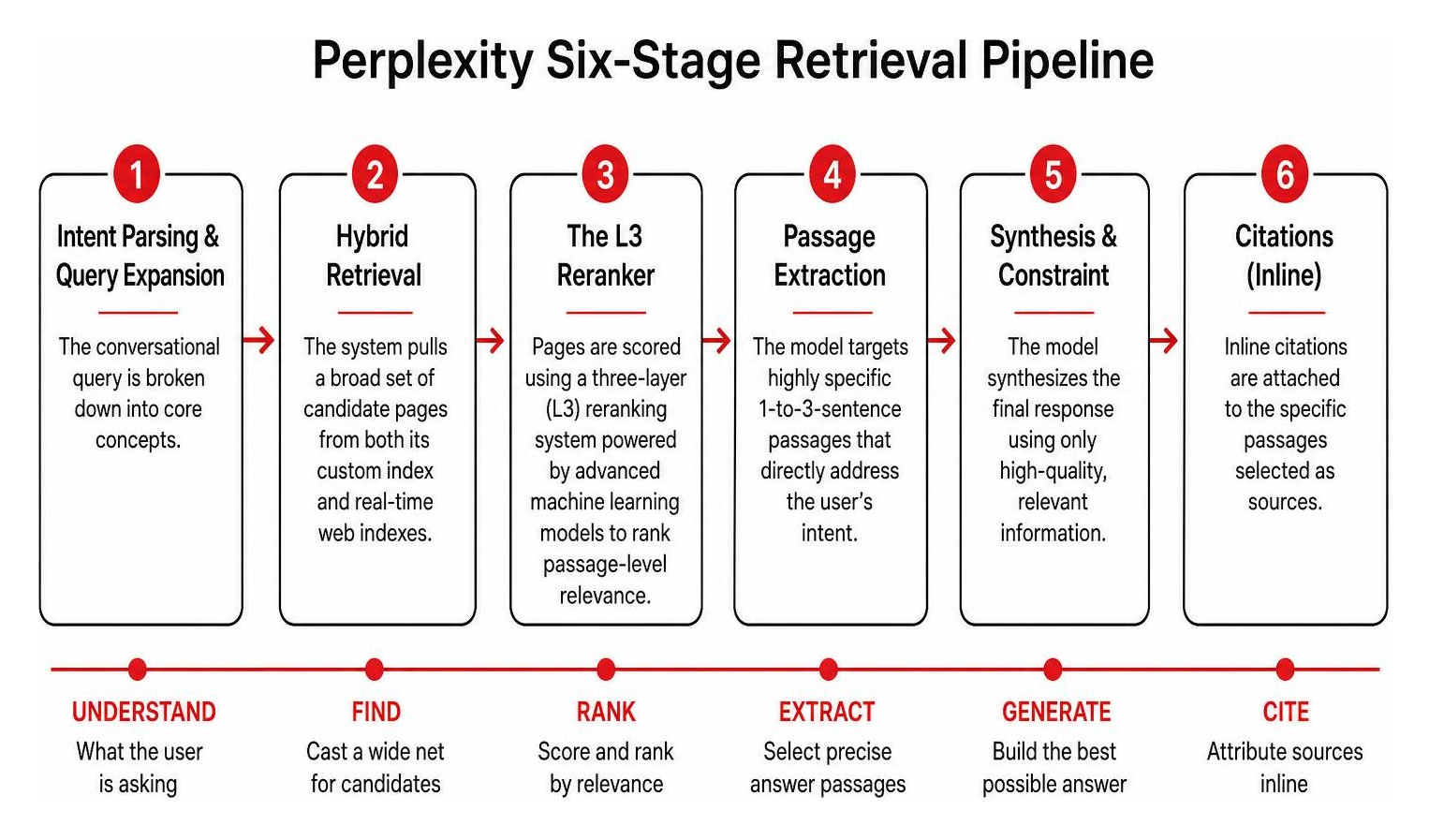
To understand how to earn citations, we have to understand the pipeline Perplexity uses to select its sources. When a user enters a query, Perplexity does not just search an index; it runs a complex, multi-stage retrieval process:
- Intent Parsing & Query Expansion: The conversational query is broken down into core concepts.
- Hybrid Retrieval: The system pulls a broad set of candidate pages from both its custom index and real-time web indexes.
- The L3 Reranker: This is where the magic happens. Perplexity uses a three-layer (L3) reranking system powered by advanced machine learning models (like XGBoost and customized BERT-based architectures) to score pages based on passage-level relevance.
- Passage Extraction: Instead of reading your entire page, the model targets highly specific 1-to-3-sentence passages that directly address the user’s intent.
- Synthesis & Constraint: The model synthesizes the final response, attaching inline citations to the specific passages it selected.
If your content is buried under fluff, or if your page lacks clear entity boundaries, the L3 reranker will filter you out before the synthesis stage even begins. This passage-level focus is why a solid Guide to AI Overview for Attorneys must prioritize clear, independent sections over long, rambling paragraphs.
Web Mentions vs. Backlinks in AI Search
In traditional SEO, a backlink is a vote of confidence. In AI search, a web mention is a verification of existence.
Recent search data has revealed a massive shift in how authority is measured. While backlink quality correlates at a mere 0.218 with AI search visibility, web mentions correlate at a massive 0.664.
Perplexity relies heavily on cross-referencing. If your law firm is mentioned across multiple authoritative platforms — directories, local news sites, legal forums, and social media — the algorithm’s confidence in your “entity” increases. In fact, sites that maintain an active presence on four or more platforms are 2.8 times more likely to appear in AI search responses.
When optimizing our digital footprint, we must transition from a link-building mindset to a brand-context optimization mindset. Securing unlinked brand mentions on high-authority local sites is often more valuable for AI engine discovery than getting a standard backlink from an irrelevant blog. This is a core pillar of a modern Guide GEO Strategy for Attorneys.
Technical Prerequisites: Preparing Your Site for PerplexityBot
Before we can even talk about content structure, we have to make sure Perplexity can actually access your site. Many sites inadvertently block the very crawlers they need to attract.
Perplexity uses its own proprietary crawler, PerplexityBot, alongside other search agents, to discover and index real-time web content. If your technical foundation is closed off, your content is dead on arrival.
To ensure your site is completely crawlable, review your robots.txt file. Make sure you are not blocking PerplexityBot or related user-agents. A standard, open configuration in your robots.txt file should look like this:
User-agent: PerplexityBot Allow: /
User-agent: * Allow: /
Ensuring these crawlers have a clear path to your content is the first step in any modern suite of Guide AI SEO Services.
Schema Markup and Technical Freshness Signals
Once PerplexityBot lands on your page, it needs to parse your data instantly. This is where structured data (JSON-LD) becomes a critical ranking signal.
Independent technical audits show that pages with complete JSON-LD structured data achieve a 47% Top-3 citation rate on Perplexity, compared to just 28% for pages without it. Furthermore, implementing specific Person schema for your authors increases the likelihood of being cited by roughly 2.3 times.
To give your pages the highest probability of being extracted, you should deploy:
- Article Schema: To explicitly declare the publication date, modified date, and author credentials.
- FAQPage Schema: To map out question-and-answer pairs, making it incredibly easy for the extraction layer to pull direct answers.
- Person Schema: To link your attorneys to their professional credentials, awards, and affiliations, directly feeding Perplexity’s trust algorithm.
Adding these schema types is a highly effective way to build the trust signals needed to win citations, as detailed in our Guide AI Overview Optimization for Lawyers.
How to Optimize Content for Perplexity with llms.txt
As generative engines dominate the search landscape, a new standard has emerged for technical optimization: the llms.txt file.
Much like a traditional sitemap.xml helps Google find your pages, an llms.txt file is a markdown file placed in your root directory designed specifically for LLMs and AI search engines. It provides a clean, machine-readable directory of your site’s key pages, complete with concise, high-density summaries of what each page contains.
By serving a clean llms.txt file, you allow PerplexityBot to instantly understand your site’s architecture, key entities, and top-performing resources without wasting crawl budget on unnecessary code. Implementing this file is a forward-thinking step that sets elite firms apart, making it a natural fit for sophisticated Guide to Law Firm AI Strategies.
How to Optimize Content for Perplexity: The 5-Step Framework
To systematically win citations on Perplexity, we use a structured, 5-step framework built around how LLMs retrieve and process information.
| Optimization Factor | Traditional Google SEO | Perplexity GEO |
|---|---|---|
| Primary Authority Signal | Backlink Profile (PageRank) | Web Mentions & Entity Consistency |
| Content Evaluation Unit | Entire Page | Passage-Level (1-3 Sentences) |
| Optimal Structure | Keyword-optimized headings, long-form prose | Answer-Evidence-Depth (AED) pattern |
| Freshness Importance | Medium (Depends on query intent) | Extremely High (60-day refresh loops) |
| Structured Elements | Recommended for UX | Essential (Tables, lists, Q&A blocks) |
By shifting our focus from traditional page-level metrics to passage-level clarity, we can build a highly effective system for Content Creation for Attorneys.
Step 1: Front-Load Answers with the AED Pattern
When a user asks Perplexity a question, the engine wants to deliver the answer immediately. It does not want to read an introductory paragraph about the history of the law before finding the definition of a statute.
To satisfy this, we use the Answer-Evidence-Depth (AED) pattern. This means structuring every key section of your page like this:
- Answer (BLUF – Bottom Line Up Front): Provide a direct, self-contained answer in the first 50 words. Use clear, declarative, and definitive language. Avoid hedging or vague phrasing.
- Evidence: Follow up immediately with 100 to 150 words of supporting evidence, statistics, or expert quotes.
- Depth: Expand into the nuances, context, and secondary questions that naturally follow.
By structuring your content this way, you hand Perplexity’s extraction pipeline a perfect, pre-packaged passage to quote. This is The Key to AI Written Content that actually drives results.
Step 2: Build Deep Entity Scaffolding and Semantic Density
Perplexity’s models are trained to recognize complete concepts. Data shows that cited content contains 32% more explicit concepts than uncited content on the same topic.
To bridge this gap, we must run a semantic audit of our top pages. Instead of simply repeating a target keyword, we need to map out the entire entity graph surrounding the topic. For example, if we are writing about “commercial truck accidents,” our content must explicitly mention related entities like “Federal Motor Carrier Safety Administration (FMCSA),” “electronic logging devices (ELD),” “black box data,” and “hours-of-service regulations.”
By covering these related concepts thoroughly, we build a deep semantic scaffolding that signals complete topical authority to the L3 reranker. This is especially critical in highly competitive areas, as outlined in our Top SEO Tips for Criminal Defense Lawyers in the AI Search Era.
Step 3: Implement the 60-Day Freshness Loop
Perplexity has an incredibly strong recency bias. Roughly 50% of Perplexity’s citations come from content published or updated in the current year, and 65% of AI bot hits target content published within the last 12 months.
Furthermore, content updated “two hours ago” is cited 38% more often than content last updated a month ago. To prevent your citations from decaying, you cannot rely on a “publish and forget” strategy.
We recommend establishing a strict 60-day freshness loop for your highest-value pages. Every 60 days, review these pages to:
- Update dates and timestamps.
- Add fresh statistics, local legal updates, or recent case results.
- Ensure all outbound links to primary sources are active and highly relevant.
This consistent maintenance keeps your technical freshness signals strong, ensuring you stay competitive in the Attorney Generative AI Rankings 2026.
Step 4: Leverage Structured Elements and Tables
AI search engines love structured data because it is incredibly easy to parse, summarize, and display in conversational interfaces.
If you present comparison data in a long, narrative paragraph, the model has to work to extract the comparison. If you present that same data in a clean, responsive comparison table, Perplexity can extract the entire block instantly.
To make your content highly citable:
- Use comparison tables for pricing, timelines, or service differences.
- Use numbered lists for step-by-step explanations of legal concepts.
- Use bullet points to group key requirements or eligibility criteria.
These elements act as pre-formatted content blocks that simplify the extraction process, a strategy that is highly valued in AI Driven Law Marketing.
Step 5: Prioritize High-Value Pages for Refreshes
You don’t need to optimize all 500 pages on your site for Perplexity overnight. Instead, prioritize your pages based on commercial intent and conversational search volume.
Start by auditing your site to find pages that already rank on Google page two or three for high-intent queries. Because Perplexity frequently pulls citations from outside the top 10, these “mid-ranked” pages are prime candidates for a GEO lift. In fact, adding clear citations and direct answers to mid-ranked pages can produce a 115.1% increase in AI search visibility.
Focus your initial optimization efforts on high-value practice area pages, deep FAQ resources, and local guides. This targeted approach is one of the most efficient 7 Ways Lawyers Can Win More Cases from AI Overview for Lawyers.
Measuring and Tracking Your Perplexity Citation Performance
What gets measured gets managed. Because Perplexity does not report keyword rankings in a traditional search console, we have to adapt our tracking and analytics workflows to monitor our performance in AI search.

To stay ahead of the curve, we must use a mix of specialized AI tracking tools and standard analytics to measure how often our brand is being recommended, cited, and clicked, which is a key part of leveraging AI Tools for Law Firm Marketing.
Core KPIs for AI Search Visibility
When tracking your performance in generative search, focus on these three primary KPIs:
- Citation Share: The percentage of times your site is cited as a source across a basket of high-value, conversational queries in your practice areas.
- Brand Alignment Score: How accurately the AI engine describes your firm’s core services, locations, and unique selling propositions when asked about your brand.
- AI Referral Traffic: The volume of direct clicks coming to your site from “perplexity.ai” or “chatgpt.com” referrers. While AI search can lead to zero-click answers, the clicks you do get are highly qualified and convert at roughly 5x the rate of traditional search.
Monitoring these metrics gives us a clear picture of our overall authority, a practice we detail in our guide on AI Digital Marketing for Law Firms.
Tools to Optimize Content for Perplexity and Track Citations
To track these KPIs effectively, we rely on a combination of cutting-edge tools and manual audits:
- ZipTie.dev: A leading platform that monitors how your brand and content appear across Google AI Overviews, ChatGPT Search, and Perplexity simultaneously, giving you a complete picture of your generative engine visibility.
- xseek / Profound: Specialized tools designed to track AI search engine recommendations, brand mentions, and citation share over time.
- Manual Query Audits: Periodically inputting your target conversational questions directly into Perplexity to verify if your firm is being cited, and checking which sources your competitors are using to secure their spots.
Using these tools allows us to build a highly responsive, data-driven strategy for our clients, as outlined in our Guide to AI Lawyer Growth Strategy.
Timeline for Seeing GEO Results
Because Perplexity runs live retrieval and updates its custom index of high-citation domains on 24-to-72-hour cycles, you can see results much faster than in traditional SEO.
If your site is already crawled regularly, implementing the AED pattern, adding JSON-LD schema, and updating your timestamps can result in new citations within 1 to 3 months. For newer domains with lower initial authority, it may take slightly longer to build the necessary web mentions, but the path to visibility is still significantly faster than waiting for traditional backlink authority to build.
This rapid feedback loop makes GEO an incredibly attractive option for firms looking to scale their digital footprint quickly, as we discuss in Future Proof Your Firm The AI Advantage in Legal Marketing.
Frequently Asked Questions About Perplexity Optimization
How is Perplexity SEO different from Google SEO?
Google SEO focuses on page-level authority, traditional keyword matching, and backlink graphs. Perplexity optimization (GEO) focuses on passage-level relevance, semantic concept density, direct answer formatting (BLUF), and web mentions. While Google ranks entire pages, Perplexity extracts and cites specific 1-to-3-sentence passages. Understanding these differences is essential for implementing smart Guide AI Automation for Lawyers.
Does Perplexity use backlinks as a ranking factor?
While domain authority plays a role in the initial retrieval stage, Perplexity weights topical depth and passage relevance far more heavily. Independent research shows that 92.78% of cited pages on Perplexity have fewer than 10 referring domains. This means smaller, highly focused sites with deep, well-structured content can easily out-cite massive, high-authority domains. This is a critical insight for anyone looking into Everything You Need To Know About Attorney AI Ad Targeting.
How many sources does Perplexity cite per answer?
Perplexity typically cites between 3 to 12 sources per synthesized response, depending on the complexity of the query. By structuring your content to be highly extractable, you increase the probability of being selected as one of these primary inline citations, allowing you to capture highly qualified traffic even in a zero-click environment, as discussed in Beyond the Gavel Using AI for Predictive Analytics in Legal Proceedings.
Dominate the AI Search Era with Precision Legal Marketing
The search landscape is shifting rapidly, and the traditional SEO playbook is no longer enough to keep your firm ahead. To capture the high-converting traffic of the AI era, you need a partner who understands the deep technical mechanics of generative engine optimization.
At Triple Digital, we are a Houston-based digital marketing agency specializing in lead generation and case acquisition for law firms. Our results-driven, “less fluff, more cases” approach leverages advanced AI and data mining to target your ideal clients with pinpoint precision. We don’t just optimize for rankings; we optimize for citations, consultations, and signed cases.
Ready to secure your firm’s position in the future of search? Schedule a meeting with our team today, and let’s build an AI search strategy that wins.