




Why Law Firm Website Templates HTML5 Are a Smart Choice for Solo Attorneys
How to Choose an HTML5 Law Firm Website Template
Start with templates built for legal clients, not just good looks. For a free starting point, compare Counsel and Justice. For more page layouts, look at premium options such as ProCounsel, Atorn, and Lyzo. Check each live preview on your phone, then confirm it has separate practice area pages, attorney bios, a clear consultation button, and room for required disclaimers.
An HTML5 template gives you the site’s design and front-end code. A contact form may still need a secure service or server-side setup before it can receive inquiries. Responsive design is a starting point, too; test speed and accessibility before you publish.
I’m Paul Taylor, president of Triple Digital, and I bring more than 28 years of marketing experience to helping firms succeed with impactful attorneys web design. Whether you are refining your practice’s digital footprint or developing specialized personal injury lawyer website design, selecting the right template ensures your site helps visitors take the next step.
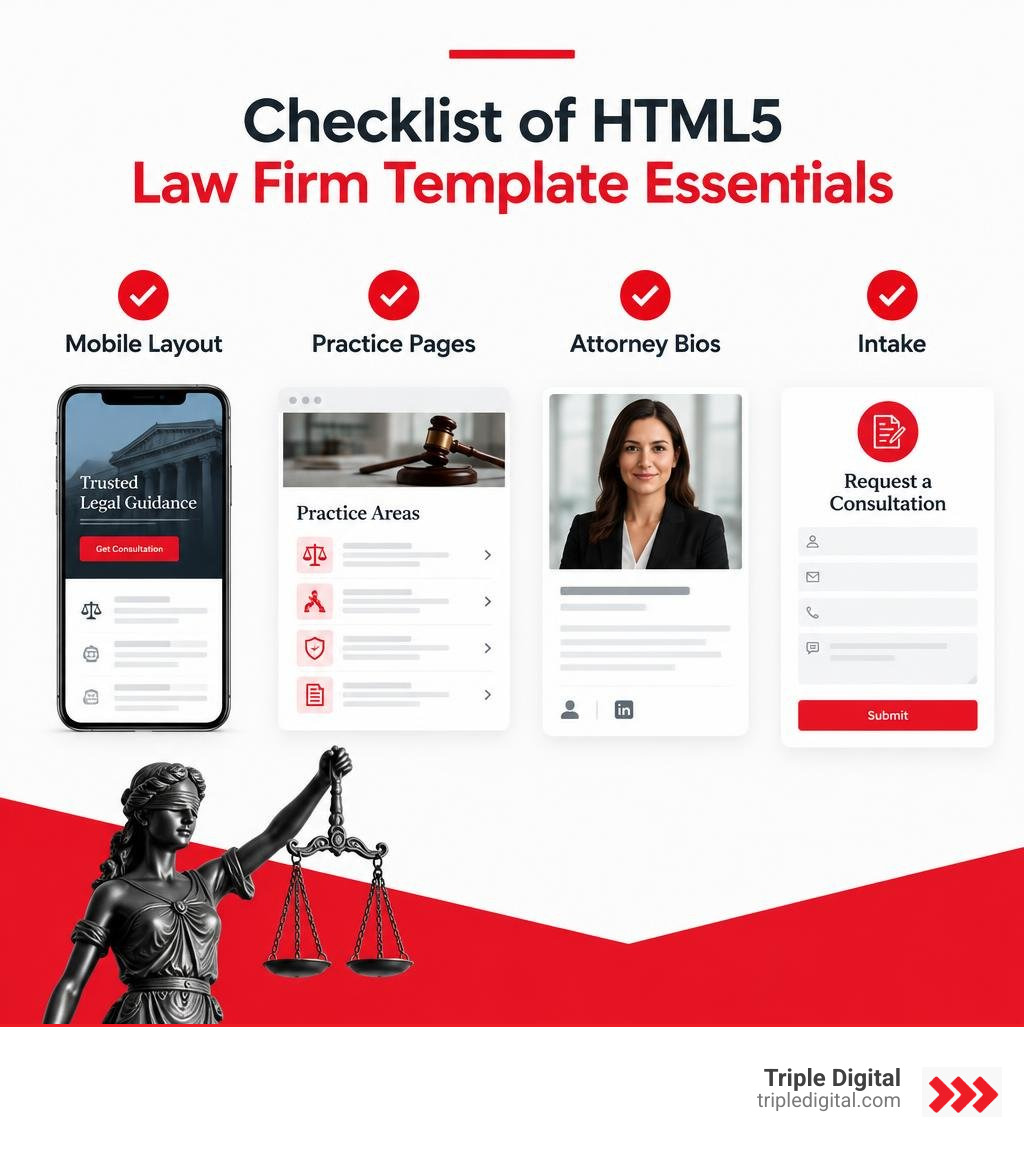
Essential Features in Law Firm Website Templates HTML5
Selecting the right front-end foundation determines whether your firm projects institutional authority or looks like an amateur project. Modern legal websites require clean code, rapid mobile rendering, and intentional conversion pathways. Modern HTML5 templates built on responsive frameworks like Bootstrap 5 provide the structural backbone needed to meet strict Google Core Web Vitals thresholds while delivering a frictionless user experience.
When comparing HTML5 law firm website templates, look beyond decorative visual effects. A high-performing legal template should prioritize semantic HTML5 elements (, , , ), valid W3C markup, responsive CSS3 grids, and accessible color contrast. In 2026, search engines reward sites that provide seamless accessibility and logical content hierarchy. Investing in legal website design that incorporates structured lawyer cards, trust badges, and dedicated credential sections establishes immediate authority with prospective clients.
Dedicated Practice Area Silos and Service Pages
A common mistake in generic web templates is forcing all service offerings onto a single scrolling page. Effective legal marketing requires individual, dedicated pages for each practice area—such as corporate counsel, estate planning, family law, criminal defense, and personal injury.
Search engines evaluate topical authority based on depth. Having dedicated service URLs allows your firm to target specific jurisdictional keywords and provide detailed answers to common legal questions. When you upgrade your law firm web architecture, you establish clear internal linking silos. These connect parent practice categories directly to specialized child sub-pages, making it effortless for both potential clients and search crawlers to navigate your legal capabilities.
Interactive Intake Forms and Legal Lead Capture
Your website’s primary function is converting qualified visitors into consultations. Templates must feature streamlined, accessible intake forms with instant AJAX front-end validation. This allows prospective clients to submit their details without clunky page reloads.
At the same time, client confidentiality and privacy compliance are critical. Forms must clearly communicate that submitting an inquiry does not automatically establish an attorney-client relationship. Incorporating user-friendly elements such as consultation schedulers, clear intake checklists, or preliminary case evaluation prompts directly into high-performing law firm website design ensures you capture essential matter details efficiently while maintaining absolute professionalism.
Static HTML5 Templates vs. Dynamic WordPress Themes for Attorneys
When building a legal website, attorneys frequently weigh the pros and cons of static HTML5 templates against dynamic Content Management Systems (CMS) like WordPress. While WordPress themes power many sites across the web—with popular items like Attorney logging 4.7K sales and Lawsight reaching 1.1K sales on ThemeForest—static HTML5 files offer distinct performance and security advantages that directly impact client acquisition.
Static HTML5 files are pre-rendered and served directly from storage or a Content Delivery Network (CDN) to the browser. There is no underlying database to query, no PHP execution on every page request, and no heavy plugin stack creating render-blocking bottlenecks. This lightweight architecture drastically improves mobile loading speeds and elevates Core Web Vitals scores. For a broader overview of platform capabilities, explore our guide evaluating law office website design options.
| Feature / Metric | Static HTML5 Templates | Dynamic WordPress Themes |
|---|---|---|
| Page Speed & Core Web Vitals | Exceptional; sub-second load times with minimal asset bloat | Variable; often slowed down by plugins and server database calls |
| Security Risk Profile | Extremely low; no dynamic database or admin panel to exploit | High maintenance; frequent target for brute-force attacks and plugin vulnerabilities |
| Hosting Costs | Low to zero; deployable on fast global edge CDNs | Moderate to high; requires dedicated PHP/MySQL server hosting |
| Maintenance Overhead | Minimal; no weekly security patches or core updates | High; requires ongoing updates for themes, core files, and third-party plugins |
| Content Updates | Requires basic code editing or developer support | User-friendly dashboard for non-technical staff to publish blog posts |
Hosting Requirements and Ongoing Maintenance Demands
One of the greatest benefits of static HTML5 templates is the simplicity of their hosting infrastructure. Because static files do not rely on server-side databases or complex background processes, they can be deployed directly to high-speed global CDNs and modern static cloud hosts. This setup reduces server overhead, eliminates database crashes during traffic surges, and virtually removes the risk of malicious server-side injections.
Understanding why website development for law firms is crucial means recognizing that your digital storefront cannot afford downtime. Static architectures require virtually zero ongoing server patching, protecting your firm from the sudden plugin breakages that often plague dynamic CMS installations.
Technical Skills Needed for HTML5 Management
While static HTML5 templates offer unmatched speed and security, they do require some technical comfort:
- Code Editing: Modifying text, navigation menus, and images involves opening files in a code editor like VS Code or Sublime Text.
- CSS and SASS Management: Adjusting color schemes, custom margins, and typography requires working with modern CSS custom properties or compiling SASS stylesheets.
- Form Endpoint Integration: Because static templates do not include backend databases, contact forms must be connected to server-side scripts (such as a secure PHP mailer) or third-party form handling endpoints (like Formspree or CRM webhooks).
- Version Control: Utilizing Git for versioning helps track edits and allows seamless deployments to edge hosting providers.
Free vs. Premium Legal HTML5 Templates: What to Choose in 2026
Law firm templates generally fall into two categories: free open-source downloads and premium commercial licenses. Budget-conscious solo attorneys often start with free templates. For instance, the Justice template has garnered over 6,362 downloads by offering a functional Bootstrap-based framework under Creative Commons licensing.
However, premium commercial templates—typically priced between $13 and $35 on marketplaces like ThemeForest—provide comprehensive documentation, valid W3C code structures, dedicated developer support, and pre-built sub-pages tailored to specialized legal niches. Choosing the right tier depends on your firm’s growth objectives and whether you are investing in comprehensive web design for law firms designed to scale.
Top-Rated Law Firm Website Templates HTML5 in 2026
Several standalone HTML5 templates stand out in the legal sector for code quality, responsiveness, and conversion-ready page layouts:
- ProCounsel: A heavyweight HTML template featuring 6 distinct homepage variations, 5 single-page landing options, and over 60 inner pages. It is ideal for multi-partner firms requiring deep silos for distinct practice areas.
- Counsel (by uiCookies): A completely free, progressive-enhancement Bootstrap 5 template. It is built entirely jQuery-free using vanilla JavaScript, offering ultra-fast page speeds, a 6-card practice area grid, and native HTML accordion structures.
- Counsel (by designingmedia): A premium $16 template boasting over 261 sales, 8+ niche homepage variations, and 90+ handcrafted inner pages tailored to litigation, corporate law, and consulting.
- Atorn: A modern Bootstrap 5.3 template with 23+ pre-built pages, dark/light mode toggles, and built-in Right-to-Left (RTL) language formatting for international legal offices.
- Lyzo: A sleek Bootstrap 5.3 and Sass template (106+ sales) featuring 19+ pre-designed page layouts, integrated attorney bio cards, and working AJAX contact validation.
Recognizing Signs It Is Time to Upgrade
If your current website relies on outdated code frameworks, loads sluggishly on mobile devices, or fails to generate qualified inquiries, your online presence is actively costing you retainers. Identifying the critical signs your practice needs a lawyer website redesign allows you to modernize your brand before prospective clients turn to competing firms with faster, more accessible websites.
How to Customize Law Firm Website Templates HTML5 for Your Brand
A template should serve as your foundation, not an identical clone of every other practice in your city. Customizing static HTML5 templates to reflect your brand identity is straightforward when leveraging modern CSS custom properties (:root variables) and clean directory layouts.
Begin by aligning your typography and color palette with your physical office branding. Pairing authoritative serif header fonts (such as Fraunces, Merriweather, or Playfair Display) with clean, legible sans-serif body typefaces (like Inter or Open Sans) creates a balanced, professional tone. Updating your primary, secondary, and accent colors within your centralized stylesheet instantly transforms every component across your template. For firms looking for a completely bespoke look tailored to their market position, pursuing custom lawyer web design ensures your visual identity stands apart from template defaults.
Integrating State Bar Advertising Disclaimers
Every jurisdiction enforces specific ethical guidelines regarding legal marketing, case results, and client communications. When customizing an HTML5 template, verify that your structural layout accounts for mandatory disclosures:
- Footer Disclaimers: Place clear notices stating that website content is for informational purposes only and does not constitute formal legal advice.
- Prior Results Warnings: Ensure case result strips and testimonial sections include required disclaimers stating that past outcomes do not guarantee similar results.
- Jurisdiction & Office Disclosures: Clearly identify the firm’s physical office location and list the specific jurisdictions in which your attorneys are licensed to practice law.
- Advertising Notices: In states requiring explicit attorney advertising labeling, include visible notices near consultation forms and landing page headers.
Multi-Language and RTL Support for Diverse Jurisdictions
Legal practices operating in diverse communities or handling international matters frequently serve multilingual client bases. Leading HTML5 templates like Atorn provide native Right-to-Left (RTL) stylesheets, allowing seamless rendering for Arabic and Hebrew scripts.
When implementing multilingual legal content, maintain separate semantic HTML directories for each language (e.g., /es/ for Spanish) with proper hreflang attributes. This ensures international and non-English speaking clients experience a clean, localized layout that reflects the standards of the best websites for law firms.
Frequently Asked Questions About Legal HTML5 Templates
Do HTML5 law firm templates handle contact form submissions out of the box?
Static HTML5 templates include front-end form structures and client-side validation, but they do not process or store emails on their own. To receive messages sent through your website, you must point the form’s action attribute to a server-side script (such as a secure PHP script) or connect it to a dedicated form processing endpoint like Formspree, Basin, or your legal CRM’s webhook intake API.
Are HTML5 legal templates optimized for search engine indexing?
Yes. In fact, static HTML5 templates often outperform CMS platforms in technical search engine optimization because they feature clean DOM trees, valid W3C semantic markup, and lightning-fast loading speeds. To maximize search visibility, ensure your template incorporates structured JSON-LD LegalService schema markup, distinct meta title tags for each practice page, and descriptive alt attributes on all images.
Can I integrate legal practice management tools into a static HTML5 template?
Absolutely. Because static HTML5 pages support standard JavaScript embeds and iframes, you can easily embed third-party scheduling tools (such as Calendly or Microsoft Bookings), client intake workflows (such as Clio Grow), and secure client payment portals (such as LawPay) directly into your template pages without causing code conflicts.
Elevate Your Legal Practice With Proven Performance
Selecting the right HTML5 template gives your law firm an ultra-fast, secure, and visually commanding digital presence. By prioritizing dedicated practice area silos, accessible intake forms, mobile-first responsiveness, and strict bar compliance, you create a direct pathway for prospective clients to discover your expertise and request a consultation.
At Houston digital marketing agency Triple Digital, our mission is delivering results-driven marketing that eliminates fluff and focuses on securing high-value retainers. If you are ready to build an authoritative online presence tailored to your firm’s growth goals, explore our comprehensive lawyer website developer guide to launch a scalable, client-generating website.