




Upgrade Your Law Firm Web Architecture: Lessons from Industry Leaders
Architectural Benchmarks of Leading Law Firm Web Systems
When we examine the digital platforms of premier legal practices, one pattern stands out: elite sites are built as cohesive software ecosystems rather than static pages stitched together. High-performing practices leverage component engineering and modular frameworks. This approach allows marketing teams to roll out new practice areas, regional landing pages, and attorney profiles without rewriting core templates or introducing layout bugs.
Modular development breaks a website into reusable interface components—such as credential badges, dynamic contact modules, and related case summaries. These components scale seamlessly as a firm expands. When planning an infrastructure overhaul, evaluating all about law office website design options helps leadership choose between rigid legacy templates and flexible, headless, or component-driven systems. For firms seeking tailored digital branding, investing in custom lawyer web design provides the structural flexibility needed to match evolving firm milestones and client expectations.
Practice Area Architecture and Attorney Bio Structuring
Practice area directories and individual lawyer bios represent the two highest-traffic page types on any legal site. Yet, many firms treat them as static résumés rather than interconnected information hubs.
To maximize search visibility and user engagement, practice pages should follow a strict parent-child taxonomy. A primary practice hub (e.g., Corporate Governance) should naturally branch into specialized sub-practices (e.g., Cross-Border Mergers, Regulatory Compliance, Shareholder Disputes). Each sub-page must feature robust schema markup (LegalService, Service, and AboutPage), identifying the exact jurisdiction, attorney team, and service scope for search engine crawlers.
Attorney bios require an equally deliberate architecture. A top-tier bio should feature:
- Direct Practice Cross-Links: Automatic linking to the attorney’s specific service areas.
- Verified Credentials: Bar admissions, clerkships, and educational history wrapped in
Personschema. - Curated Thought Leadership: Direct feeds of articles, white papers, and speaking engagements authored by the attorney.
- Downloadable V-Cards & Direct Scheduling: Immediate, low-friction methods to book an introductory discussion.
Connecting these data points across your site ensures that prospective clients discover relevant attorney credentials regardless of where they enter your digital ecosystem. To learn how to structure deep subpages effectively, read our guide on beyond the homepage maximizing your legal websites potential.
Establishing Institutional Authority and Social Proof
Establishing digital credibility requires verifiable authority signals woven naturally throughout the user journey. High-performing legal platforms emphasize third-party validation, industry recognitions, and quantitative community impact.
Industry directories such as Chambers USA, The American Lawyer A-List, and peer recognitions serve as immediate visual reassurance for corporate and private clients. Similarly, highlighting pro bono contributions—such as tracking firm-wide volunteer hours and community legal clinics—demonstrates institutional depth and civic responsibility.
When presenting case summaries or past representative matters, firms must balance persuasive social proof with strict client confidentiality. Never publish sensitive deal values, settlement figures, or identifying details without explicit client consent and appropriate jurisdictional disclaimers. Reviewing the best websites for law firms reveals that the top practices frame case results around problem-solving frameworks and legal precedent rather than sensationalist promises.
High-Conversion Infrastructure and Digital Client Intake

A law firm web presence must function as an active engine for client acquisition. If a visitor arrives at your site with an urgent legal query but encounters a sluggish PDF intake form or a broken email link, that potential retainer is lost. At Triple Digital, we build conversion workflows based on a simple philosophy: less fluff, more cases.
Modern intake infrastructure bridges the gap between marketing visibility and matter management. When a prospective client submits an inquiry, the backend should instantly route the data through an encrypted pipeline into the firm’s Practice Management or CRM software (such as Clio, Lawmatics, or Salesforce).
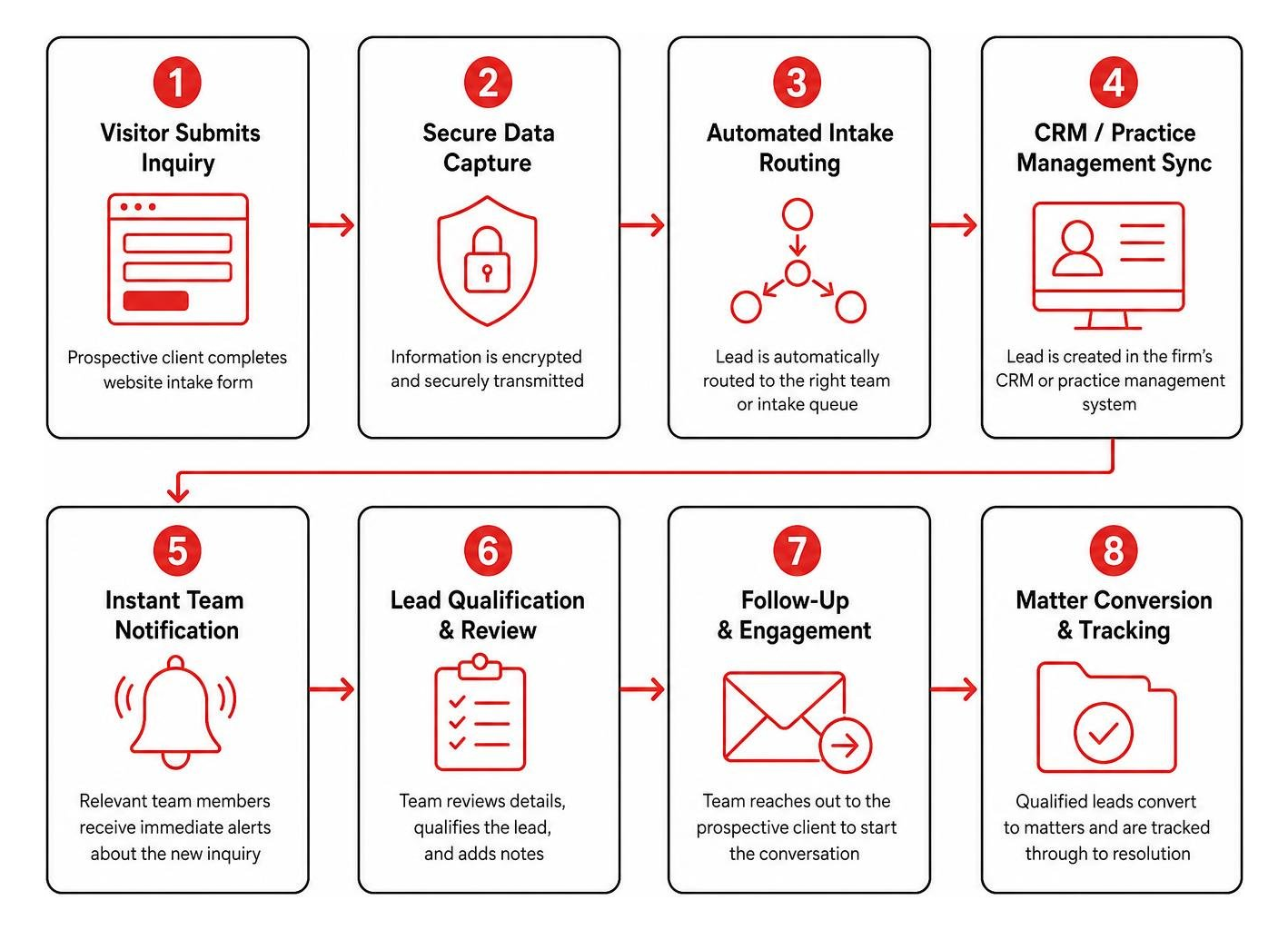
Implementing clear, step-by-step conversion architecture ensures your team captures essential information without overwhelming prospective clients. For a deeper exploration of this framework, discover how to design the best websites for law firms that actually convert and evaluate our tactical breakdown on from clicks to clients the ultimate law firm cro strategy.
Frictionless Lead Capture and Form Optimization
The traditional “Contact Us” page with ten mandatory fields and a broad “Message” box consistently generates high bounce rates. Modern users expect intuitive, accessible digital interactions.
To streamline intake, replace generic forms with progressive, conditional intake questionnaires:
- Step-by-Step Micro-Steps: Break intake into 2–3 low-friction questions (e.g., selecting the legal category before asking for personal details).
- Automated Conflict Screening Pre-checks: Ask basic adverse-party questions early to protect internal workflow.
- Integrated Calendar Scheduling: Allow qualified leads to book an initial phone assessment immediately.
- Mobile Click-to-Call Functionality: Keep direct phone access sticky on every screen for urgent matters.
Refining these touchpoints drastically improves conversion metrics. Review our foundational rules for landing page optimization 101 tips to turn clicks into customers and implement targeted methods to increase conversion rate law firms across all active practice silos.
Legal Ethics and Compliance in Law Firm Web Presence
Unlike standard commercial businesses, legal websites operate under strict regulatory and professional ethics rules. Modern web architecture must account for the ABA Model Rules of Professional Conduct (particularly Rules 7.1, 7.2, and 7.3) and state-specific bar advertising mandates.
Key compliance requirements to build into your site architecture include:
- Clear Disclaimers on Electronic Submissions: State plainly that submitting an inquiry form or sending an email does not create an attorney-client relationship.
- Jurisdictional Transparency: Prominently display where attorneys are licensed to practice law to avoid claims of unauthorized multijurisdictional practice.
- End-to-End Data Encryption: Utilize SSL/TLS protocols and encrypted storage for all form submissions to protect sensitive information and potential client privilege.
- Truth in Advertising Standards: Avoid subjective superlatives (e.g., “the top attorney in Texas”) or misleading guarantees regarding past performance.
Structuring these disclaimers transparently within your site layout protects the practice while maintaining visitor trust. Explore best practices in our overview of legal website design.
Performance Engineering and Search Engine Visibility
A visually impressive website is useless if slow load times cause visitors to bounce before the header renders. Search engines prioritize websites that deliver rapid, stable, and accessible user experiences.
Core Web Vitals represent Google’s standard metrics for user experience, measuring Largest Contentful Paint (LCP), Interaction to Next Paint (INP), and Cumulative Layout Shift (CLS). For law firms, achieving top-tier performance requires modern server-side caching, optimized WebP/AVIF image compression, efficient asset minification, and clean codebases free of bloated plugins.
Understanding why is website development for law firms crucial for winning retainers starts with technical reliability. If your current site exhibits slow load speeds or visual instability, check these 7 critical signs your practice needs a lawyer website redesign.
Technical SEO and Law Firm Web Discovery
Legal search engine optimization requires precise entity optimization, schema integration, and local search configuration. Because search engines evaluate legal content under strict “Your Money or Your Life” (YMYL) standards, your site’s technical architecture must clearly demonstrate Experience, Expertise, Authoritativeness, and Trustworthiness (E-E-A-T).
By linking attorney pages to authoritative external repositories—such as State Bar member directories—you provide direct entity confirmation to search algorithms. For a complete blueprint on structuring these technical layers, consult our comprehensive lawyer website developer guide.
Thought Leadership Engines and AI-Driven Content Delivery
Leading legal practices build dedicated knowledge engines that publish regular legal analyses, regulatory breakdowns, and industry updates. These educational repositories educate prospective clients while capturing organic search demand.
To maximize the reach of your intellectual property, configure your CMS to support diverse media formats:
- Multimedia & Podcast Integration: Host executive audio briefings and CLE panel discussions with embedded transcripts.
- Downloadable Research Papers: Offer deep-dive regulatory white papers that establish industry leadership.
- Structured Regulatory Trackers: Create dynamic index pages tracking legislative developments across your target practice areas.
Modern firms are also leveraging artificial intelligence and data mining to identify emerging legal queries in real time. This allows practice groups to publish authoritative guidance on new regulatory trends weeks ahead of competitors. Discover sustainable publishing workflows in our guide on how to design a high-performing law firm website without losing your mind.
Critical Technical Mistakes in Legal Web Development
Many law firms invest significant capital into website redesigns only to perpetuate architectural mistakes that sabotage their search visibility and lead flow.
| Architectural Dimension | Outdated Legal Web Architecture | Modern High-Performing Web Architecture |
|---|---|---|
| Site Structure | Flat, disorganized page trees with buried service info | Hierarchical practice area silos with explicit schema |
| Attorney Directory | Static bios lacking cross-links to practice areas | Dynamic relational bios linked to insights and cases |
| Intake Mechanism | Generic unencrypted contact forms and static email links | Secure, multi-step intake routed directly to CRM |
| Mobile Experience | Desktop layout scaled down with difficult touch targets | Mobile-first responsive UX with sticky contact buttons |
| Performance | Bloated CMS themes loaded with redundant scripts | Lightweight, component-engineered headless or optimized CMS |
Eliminating these mistakes requires a balanced focus on design aesthetics and conversion optimization. Explore comprehensive solutions through our dedicated web design for law firms and review our specialized website conversion rate optimization services to fix existing digital bottlenecks.
Frequently Asked Questions about Law Firm Websites
What are the essential security and compliance features for legal portals?
Legal portals must implement strict data isolation, SSL/TLS transport layer encryption, secure RESTful API connections to Practice Management Systems, and automated data purging schedules for unaccepted inquiries. Furthermore, portals must display explicit jurisdictional disclaimers and privacy notices detailing how prospect information is handled before formal representation begins.
How frequently should a law practice update its web architecture?
While educational content and lawyer bios should be updated weekly or monthly, the underlying web architecture should undergo technical audits quarterly to maintain Core Web Vitals compliance and security patches. Comprehensive architectural redesigns typically occur every 3 to 4 years to adapt to evolving search algorithms, mobile device standards, and modern intake integrations.
How does mobile site speed affect legal client acquisition rates?
Mobile users searching for legal assistance often operate under urgent timelines. Research shows that bounce rates climb sharply for every additional second a mobile page takes to load. If your site takes longer than three seconds to become interactive, prospective clients will simply return to search results and contact another practice.
Transform Your Digital Infrastructure into a Retainer-Generating Engine
A modern law firm website is far more than a digital business card; it is the central operational hub for your firm’s brand credibility, market visibility, and client acquisition. By implementing modular component design, optimizing technical SEO taxonomies, and building frictionless, secure client intake funnels, your practice can consistently outperform competitors in today’s digital landscape.
At Triple Digital, we specialize in cutting through digital complexity to build high-converting web systems engineered for tangible business growth. If your practice is ready to scale its client pipeline with a data-driven digital infrastructure, schedule a strategic consultation with our team today.